


Filter by Categories
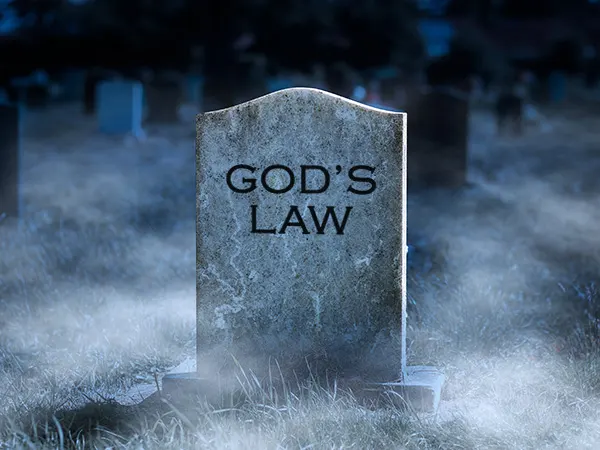
Dead to the Law?
'Ready Answer' by Earl L. HennBeing "dead to the law" (Romans 7:4) does not mean God's law is abolished, as those who distort Paul's writings claim. Romans 6 lays the foundation: the old man was crucified and buried with Christ in baptism, freeing the Christian from sin. In Romans 7:1, the law's "dominion" over a man lasts only while he lives. Paul uses the Greek kurieuo, meaning to exercise lordship over, in the same way in Romans 6:9 and 14, where death and sin lose their power. The law therefore has power to condemn a person to death only while he lives. Paul's marriage analogy makes the point. A woman is bound to her husband until he dies, and only then can she remarry without being condemned as an adulteress. The law in view is the Ten Commandments, since the seventh forbids adultery, and Paul treats it as still binding. The first husband is the old sinful man, who died at baptism. Because Christ died in the believer's place, the law regards the believer as having died, the penalty has been paid, and the law can no longer condemn him. He is now free to be married to the risen Christ and bear fruit to God. Romans 7:6 concludes that Christians serve "in the newness of the Spirit and not in the oldness of the letter," keeping God's laws in their full spiritual intent through the Holy Spirit. Far from being abolished, the law is even more binding.

Was Jesus Christ Born Under the Law?
'Ready Answer' by Earl L. HennNo sections of the material address the topic of being dead to the law. The material instead explains that to be under the law means to be under its condemnation for sin. It states that Jesus Christ was never under this condemnation except at His crucifixion. It adds that a repentant Christian who receives forgiveness through the blood of Christ stands perfect and sinless before God.
The Covenants, Grace, and Law (Part Twenty-Six)
Sermon by John W. RitenbaughPaul states in Galatians 2:19 that through the law he is dead to the law in order to live unto God. The law reveals a person as a sinner under its curse and claims its due, prompting repentance. Once the sacrifice of Jesus Christ is applied through faith, the individual is justified by the Father and made alive to God. This process does not eliminate the law but shows that the law itself cannot justify, grant life, or impart power to obey. It can only condemn, guide conduct, and describe the character of God. This declaration forms part of Paul's response to the claim that justification by Christ permits continued sin. He insists that Christ is not the minister of sin and that returning to the former way of life after forgiveness makes the person a transgressor. The same principle appears in Romans, where those dead to sin through baptism must not allow sin to reign, because they are under grace rather than under the law's condemnation. The law therefore retains its role in exposing sin and directing the believer toward righteousness, yet it must be joined with faith in Jesus Christ for justification to occur. When faith is genuine, it produces works that demonstrate both the object of that faith and the presence of God's love shed abroad by the Holy Spirit. These works, including obedience to the commandments, express love toward God and neighbor and form the character required for the image of God. Righteousness imputed at justification must become real and lived, accomplished through voluntary yielding to the Spirit that empowers obedience. Thus the believer is dead to the law's power to condemn while remaining fully obligated to keep the law as the expression of faith and the means by which God's righteousness is formed within.
Are You Alive to God?
Sermon by Martin G. CollinsBeing raised together with Christ carries a profound legal and relational consequence: the Christian becomes "dead to the law." Paul develops this truth through a careful comparison in Romans 7, illustrating it with the analogy of marriage. A woman is bound by law to her husband only while he lives; once he dies, she is released from that law and free to marry another without being called an adulteress. Paul applies this directly to the believer's relationship with the law, stating that "you also have become dead to the law through the body of Christ, that you may be married to another—to Him who was raised from the dead, that we should bear fruit to God." This deduction follows naturally from the larger argument Paul builds throughout Ephesians 2 and Romans. Every human being enters the world spiritually dead in trespasses and sins, born under the law, facing its condemnation because of sin. The law stands as a constant accuser, challenging and condemning humanity for its failures. But when a person is united with Christ through baptism and the reception of God's Holy Spirit, this relationship to the law fundamentally changes. The law executed its full penalty upon Jesus Christ Himself, and since the believer is now "in Christ," the law no longer holds the same punitive claim over him. This is why Paul declares that Christians are "not under law, but under grace." Crucially, this does not mean that the obligation to keep God's law disappears. Rather, the nature of the relationship transforms entirely—from one of condemnation under law to one of intimate sonship under grace. The believer moves from being an alien and enemy, facing the law's demand and penalty, into becoming a child of the Father, in a relationship of love and grace rather than legal jeopardy. Just as a good father still expects his child to be disciplined and to observe certain standards, God still requires obedience to His law, but the governing dynamic is now paternal and grace-filled rather than penal. This truth connects directly to the broader theme of being "raised together with Christ." Because the Christian has passed out of the realm of spiritual death—out of the grave of sin—he is no longer under the wrath of God nor under the law's condemning power. The law's penalty was fully satisfied in Christ's death, and Christ's resurrection proves that God was satisfied with that payment. Therefore, being "dead to the law" is not a dismissal of God's righteous standards but a liberation from the law's power to condemn, made possible only through union with the risen Christ. It stands as one of Paul's key deductions showing the believer's entirely new status: no longer under wrath, no longer under condemnation, and no longer under the law's binding penalty, but instead joined to Christ in a relationship of grace, sonship, and fruitful obedience.

Living By Faith and God's Grace (Part Two)
'Personal' from John W. Ritenbaugh'Grace' is a term that represents God's awesome generosity toward us, His continuously flowing blessings and saving acts. It goes beyond just forgiveness.
Knowing Christ (Part 1)
Sermon by John W. RitenbaughWhen we mortify the flesh, refusing to feed the hungry beast of our carnal nature, we suffer. Suffering for righteousness' sake helps us to know Christ.
Knowing Christ (Part 2)
Sermon by John W. RitenbaughChrist's sacrifice was not merely substitutionary, but representative, with Christ giving us a pattern for life - mortifying our flesh and putting out sin.