


by Joseph B. Baity
Forerunner,
"WorldWatch,"
May 1, 2026
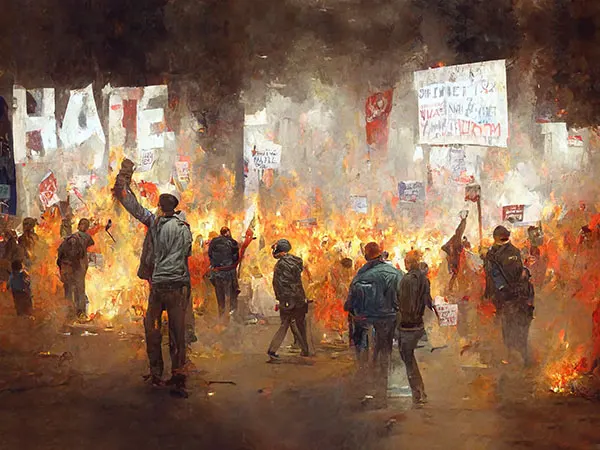
A troubling trend has developed among Western nations in recent years.
After several hundred years of mostly tolerant attitudes—and advocacy—for Judeo-Christian beliefs and practices, a surging tide of anti-Christian sentiment and even violence threatens the status quo.
Christian persecution, of course, is not new. Since the days when Jesus Christ walked the earth, His followers—just as He did—could expect persecution from individuals, governments, and even religious leaders.
However, as the nascent church of God began its expansion into Europe, most of the new Western nations forming there were—from their founding—culturally and politically steeped in varying degrees and forms of Christian teachings, though watered down and corrupted by man. The Roman Catholic Church dominated culture until the Reformation of the sixteenth century, when the Protestant movement challenged the religious and, by extension, the political norms of the Continent.
While great turmoil and many wars ensued throughout Western Europe, primarily ignited by the antagonism between the two major branches of Christianity, a belief in Jesus Christ was not typically a cause for persecution, Islamic incursions notwithstanding.
Following the Reformation and the Enlightenment of the seventeenth and eighteenth centuries, the great enmity between Catholics and Protestants began to wane slightly—at least in most nations. Further west in the New World, the United States fostered a new tolerance and ensured peaceful religious diversity, free from governmental interference, in its founding documents, including the Declaration of Independence and the Constitution. The world’s greatest religious refuge and a hub for modern, mainstream Christianity arose.
However, as America and Europe became contemporary havens not only for Christianity but also for many different forms of religious and political thought, the West has witnessed the inevitable rise of alternative religious practices and political philosophies that often conflict with mainstream Christian dogma. With these shifts in cultural and political disposition, a rise in anti-Christian sentiment was inevitable.
In Europe and Canada, anti-Christian passions have produced laws directed at restricting traditional religious expression. Church pastors even face constraints on their biblical teachings from the pulpit. An article by Gia Chacon on the National Catholic Register’s website opines:
In recent months, the West has witnessed a troubling rise in anti-Christian violence, a trend we can no longer afford to ignore. Attacks we once believed were isolated incidents overseas are now occurring frequently in our own neighborhoods, challenging America’s foundational identity of coexistence and religious freedom.
Across the European continent, public citation of biblical teachings has led to accusations of hate speech, as laws increasingly criminalize traditional religious expression. This legal hostility has created an environment where anti-Christian incidents have become normalized.
Vandalism and attacks on churches and their worshippers are common throughout the West. At the same time, the national news and entertainment media, aided and abetted by the halls of academia, focus their growing contempt on believers and mock all forms of Christianity. Of course, social media amplifies and inflates this harmful discourse.
In 2024, the Family Research Council (FRC) published a report entitled “Free To Believe? The Intensifying Intolerance Toward Christians in The West.” It concluded:
As the mainstream culture moves further and further away from a Christian worldview, Christian beliefs that contradict progressive secular values are increasingly denounced by the culture and wrongly portrayed as being hateful or bigoted.
Tony Perkins of the FRC also concluded:
It is shocking to see Western countries, the same ones we think of as free and open societies, take authoritarian measures against Christians simply trying to live out their faith. Hostility toward Bible-believing Christians is clearly and steadily rising in the West.
Perhaps, most frightening, is the rise of Islamic fundamentalism, which, on the surface, claims a friendly allegiance with Christianity, but upon deeper investigation, reveals a horrific anti-Christian fervor that wishes to eliminate all vestiges of the Judeo-Christian ethic, wherever it exists. (Our June 2025 article, “A Revival of Hatred,” notes a concurrent and alarming escalation in antisemitism around the globe, but especially in the West.) Nothing exposes this more clearly than the Open Doors World Watch List, which reveals that Islamic fundamentalists govern nine of the top ten nations where Christians faced the greatest persecution in 2025.
Most telling—and perplexing—is the tendency for left-wing liberal activists (including trans-activists) in the West to express solidarity with radical Islam, with nothing whatsoever in common except their hatred and disdain for Christians. Moreover, these same Islamists are committed to the eventual destruction of these same liberals.
Regrettably, it appears that both the modern, physical nation of Israel and the spiritual Israel of God (Galatians 6:16) can expect to be under assault as the end of this age draws near (Matthew 24:9-10). While there are efforts to restore biblical teaching to the public square and push back against the media, cultural, and political aggression, the damaging trend is unlikely to be fully reversed.
Even though the greater incidence and the most severe acts of persecution still exist outside the borders of the West, and are aimed primarily at mainstream Christian devotees, faithful and watchful Christians—the elect of God—should remain mindful of the admonitions of Jesus Christ and His apostles as storm clouds form on the horizon and over our shrinking refuge (John 16:33; Revelation 2:10; II Timothy 3:12).