


Filter by Categories
The Marriage of the Lamb
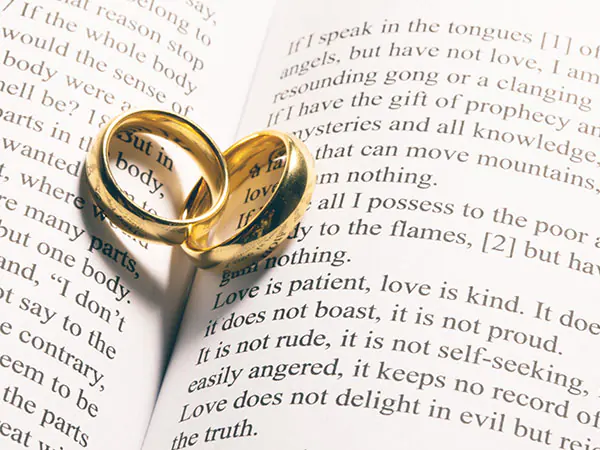
'Prophecy Watch' by StaffThe Marriage Supper of the Lamb, described mainly in Revelation 19:7-9, is the most important wedding ever, and all physical weddings are mere symbols of it. When the time arrives, gladness and rejoicing will resume and exceed anything ever experienced, shared with the Father, the Son, and all the angelic host. Christ's Bride, the church, will have made herself ready, allowing nothing to sidetrack her preparation. She will be granted fine, clean, white linen, which stands for the righteous acts of the saints. That linen is worn by angels, royalty, and priests, and it was used extensively in the Tabernacle. It fits those who will become like angels, kings, priests, and pillars in God's Temple. To be called is one of eternity's supreme blessings. Present will be God the Father and Jesus Christ, who do the inviting, together with the angels, archangels, twenty-four elders, four living creatures, and the resurrected and changed members of God's true church from all generations. Absent will be the five foolish virgins, who did not prepare adequately, and Satan and his demons, who will be banned from heaven. The timing of Revelation strongly suggests the wedding takes place in heaven, after the first resurrection and the 144,000 standing with the Lamb, and before Christ and His Bride and armies descend to earth, yet heaven is not the eternal dwelling of God's people. Since Christ is not bound by human time, the celebration might take only moments of earthly time. What matters is diligent preparation now, spending as much time as possible with Christ each day, and not letting Satan divert us.
Marriage—A God-Plane Relationship (Part Three)
CGG Weekly by Richard T. RitenbaughIn Revelation 19, marriage once again takes center stage as the Book nears its end, highlighting a far higher purpose than the physical union of a man and a woman. This passage prophetically portrays the ultimate marriage, where God's blessing extends to those who form the bride of Jesus Christ. The blessing in Revelation 19:9 provides the true context for the blessing given in Genesis 1:28, showing that human marriages are types of this greater spiritual union. The experiences within a blessed physical marriage are designed by God to prepare us for the intimate relationship with our Savior. Just as God will bless the union between His Son and the Bride, He also endows the physical marriage with the ability to fulfill its purpose of creating unity between partners, preparing them for union with God.
Marriage and the Bride of Christ (Part Nine)
Sermon by Martin G. CollinsA wedding is soon to take place between Jesus Christ and the Church, and God uses human marriage as a type of that coming marriage. The union of Christ and His Bride is a great and profound mystery, a spiritual oneness that the Church is part of: the Church is taken from Christ's wounded, bleeding side as Eve was taken from Adam's side, so that believers are members of His body, of His flesh and of His bones. This union, unlike human marriage, will last for all eternity. Christ left heaven, humbled Himself, and gave Himself for His Bride, purchasing her so that He might present her to Himself glorious, holy, and without spot, wrinkle, or blemish. In the ultimate sense the eternal Son's fullness is perfect and has always been complete. Yet as Mediator, Christ will not be full or whole until every saint for whom He died has been gathered in. The Church is the completion of His glorious marriage and the fullness of His dominion, just as Eve made up what was lacking in Adam. Bridegroom and Bride each have a reserved place in their hearts that only the other can fill. A husband who loves his wife as himself, and a wife who respects her husband, make their marriage a miniature picture of this coming union.
My Hour Has Not Yet Come
Feast of Tabernacles Sermon by Mark SchindlerJesus' response to His mother at the wedding—'My hour has not yet come'—was not disrespect but perhaps a challenge to attach real faith with mere knowledge.
Will You Marry Me? (Part Two)
Article by StaffThe story of Boaz and Ruth and the cup of betrothal at Passover ask us to consider: Are we committed to this wonderful relationship with our Fiance?
The Perfect Husband
Sermon by Richard T. RitenbaughHusbands need to imitate God's behavior as reflected through the life of Jesus Christ. Isaiah 54 reveals Yahweh (who became Jesus Christ) as the Husband of Israel.
Parable of the Ten Virgins (Part Two)
Bible Study by Martin G. CollinsThe Parable of the Ten Virgins is prophetic concerning the attitude of Christians at the end time. The wise and foolish virgins each have things to teach us.
Choosing to Have a Good Relationship
Sermon by Martin G. CollinsThe Bible emphasizes marriage as the primary bond of society. The purpose for the marriage relationship is to depict the marriage of Christ and His bride.
The Millennium and Union With Christ
Feast of Tabernacles Sermon by Richard T. RitenbaughThe millennial situation will resemble the behavior of our forebears; it will be our responsibility to lead them to hope, joy, character, and faith in God.

Standing on the Sea of Glass
Feast of Tabernacles Sermon by Martin G. CollinsThe Sea of Glass at God's throne reflects and symbolizes God's holiness and purity, peace and calmness, and His purposes of righteousness and love.
Maintaining Good Health (Part 3)
Sermon by John W. RitenbaughThe Bible contains 700 references to the act of eating. Eating reminds us that God's provision and human need also apply on a spiritual level.
God's Sea of Glass (Part 2)
Sermon by Martin G. CollinsAt the marriage supper of the Lamb, the resurrected saints, those who have faithfully kept God's commandments, will be allowed to assemble on the sea of glass.

Where the Eagles Are Gathered
'Prophecy Watch' by David C. GrabbeThe source never mentions the Marriage Supper of the Lamb by name, but it speaks of the wedding feast in connected terms. The Parable of the Ten Virgins and the Parable of the Wedding Feast describe the danger of being spiritually unprepared when Christ returns and being judged unworthy to enter the Kingdom. The foolish virgins assumed they had more time, let their reserves of oil run low, and were left outside the wedding feast (Matthew 25:10-12). Their lesson is that anyone who is not putting everything into his calling now may suddenly find he cannot get ready in time. Being left is the opposite of being "taken," a word (paralambano) that means being received near to Christ on earth and associated with Him intimately, even assuming an office. Those under judgment are left and not allowed to accompany Him, like the sons of the kingdom cast into outer darkness (Matthew 8:11-12). In stark contrast to the feast of the faithful, the birds are summoned to "the supper of the great God" to eat the flesh of the Beast's armies (Revelation 19:17-21).
The Teaching of Jesus and Prophecy
Sermon by Richard T. RitenbaughThe teaching of Jesus is the key to Revelation. The Olivet Prophecy (the testimony of Jesus) in Matthew 24 unlocks the meaning of the seals in Revelation.