


by John Reiss
CGG Weekly, January 23, 2026
"Symbols are powerful because they are visible signs of invisible realities."
—Augustine
Types in Scripture, especially those of Jesus Christ, give us insight into truths that we later see enacted in the antitype. God uses this teaching method throughout the Bible, not just to prophesy of things to come, but also to give His people another way to understand His revelation. In this regard, we will look at an early type of the sacrifice of our Savior and see how closely Abraham's interrupted sacrifice of his son, Isaac, prefigured the far greater offering of Jesus.
We find the story in Genesis 22:1-3:
Now it came to pass after these things that God tested Abraham, and said to him, "Abraham!" And he said, "Here I am." Then He said, "Take now your son, your only son Isaac, whom you love, and go to the land of Moriah, and offer him there as a burnt offering on one of the mountains of which I shall tell you." So, Abraham rose early in the morning and saddled his donkey, and took two of his young men with him, and Isaac his son; and he split the wood for the burnt offering, and arose and went to the place of which God had told him.
In the first verse, the narrative explicitly says that God tested Abraham. The word translated as "test" is the Hebrew nāsāh, which means "prove" by positive evaluation. God lays out His proposal for the test in His command, telling Abraham to take his only son to the land of Moriah and offer him as a burnt offering. Abraham readily obeys His Creator and leaves early the next morning.
Here we find the first comparison between this story and the sacrifice of our Savior two millennia later: Both Isaac and Jesus Christ were only sons. The word for "only" in Genesis 22:2 is yāhîd, which means "unique," and is sometimes translated as "precious." Isaac was special, one of a kind, because he was Abraham's only son by Sarah, born miraculously after God's promise to give him a son (Genesis 18:10).
The New Testament highlights this connection in Hebrews 11:17: "By faith Abraham, when he was tested, offered up Isaac . . . his only begotten son" (emphasis ours throughout). The apostle John uses this same Greek phrase to refer to Jesus as "the only begotten Son" five times, making a solid connection with Isaac. Clearly, Isaac is a type of Christ.
A second comparison is that both Isaac and Jesus carried wood to the place of sacrifice. "So Abraham took the wood of the burnt offering and laid it on Isaac his son; and he took the fire in his hand, and a knife, and the two of them went together." Of course, Jesus had to bear His cross, or the crossbeam, to Golgotha (John 19:17). In fact, it was so heavy that our beaten and bruised Savior collapsed under its weight, and the Romans compelled Simon of Cyrene to carry it for Him.
But what about the Old Testament calling Isaac a mere "lad"? The word is na'ar in Hebrew, a very flexible word. In Scripture, it refers to the baby Moses, the 17-year-old Joseph, and the full-grown adult Absalom. A lad, then, could be any male from a few months to forty years old!
The Jewish historian Josephus gives Isaac's age as 25, while rabbinic tradition says he was 36. Other commentators suggest he was 33. Because Isaac's life parallels the life of Christ to such an extent, it feels right that Isaac would have been 33 years old at this time. Luke 3:23 tells us that Jesus began His ministry at thirty years of age, and the time elements in the gospels, especially in the book of John, indicate that He was 33 years old when He was crucified.
A third comparison can be seen in the fact that God provided the lamb for the burnt offering:
But Isaac spoke to Abraham his father and said, "My father!" And he said, "Here I am, my son." Then he said, "Look, the fire and the wood, but where is the lamb for a burnt offering?" And Abraham said, "My son, God will provide for Himself the lamb for a burnt offering. So, the two of them went together.
Interestingly, Abraham did not say "a lamb" but "the lamb." John 1:29 contains a parallel: "The next day, John [the Baptist] saw Jesus coming toward him, and said, ‘Behold, the Lamb of God . . .." As Revelation 5:12 says, "Worthy is the Lamb who was slain . . .."
In the instructions for the burnt offering, Leviticus 1:4 shows us that the offeror placed his hands on the head of the sacrificial animal to indicate that it represented the offeror, "and it will be accepted on his behalf to make atonement for him." It continues in verse 9: "And the priest shall burn all on the altar as a burnt sacrifice, an offering made by fire, a sweet aroma to the LORD." The apostle Paul writes in Ephesians 5:2, ". . . Christ also has loved us and given Himself for us, an offering and a sacrifice to God for a sweet-smelling aroma."
A fourth parallel is that both Isaac and Jesus Christ voluntarily submitted themselves to be sacrificed. Genesis 22:9-10 reads:
Then they came to the place of which God had told him. And Abraham built an altar there and placed the wood in order; and he bound Isaac his son and laid him on the altar, upon the wood. And Abraham stretched out his hand and took the knife to slay his son.
Isaac was a young, healthy man who had just carried the wood for the burnt offering for many miles uphill (see Genesis 22:3-6). Abraham was well over a hundred years old, and to think that he overpowered his son to bind him is not believable. He must have allowed his father to bind and place him on the altar.
When Jesus offered Himself to be sacrificed, He was not overwhelmed by Roman soldiers and forcibly nailed to the cross. He volunteered Himself as our Redeemer: "I lay down My life that I may take it up again. No one takes it from Me, but I lay it down of Myself" (John 10:17-18).
A fifth parallel is that both were sacrificed on Mount Moriah. Abraham's interrupted sacrifice of Isaac occurred at the place he called the Mount of the LORD. Notice what is recorded in II Chronicles 3:1:
Now Solomon began to build the house of the LORD at Jerusalem on Mount Moriah, where the LORD had appeared to his father David, at the place that David had prepared on the threshing floor of Ornan the Jebusite.
Mount Moriah was the very place where King Solomon built the Temple of God, and Jesus was crucified just outside the city's walls. Those city walls would be close to the Temple on its east side because observers saw the veil in the Temple torn from the site of the crucifixion (Matthew 27:50-54; Mark 15:37-39; Luke 23:44-47). Jesus was sacrificed where Isaac would have been so many centuries earlier.
Finally, we cannot forget the fathers in these episodes. While the Bible contains many types of Christ, there is only one clear type of the Father: Abraham. While obedient to God's command to sacrifice his son, Abraham must have been in agony, mentally and emotionally, as he thought about having to slay his dear son. Then, thinking of the antitype, we must imagine how hard it must have been for God the Father to witness the suffering imposed on His Son. And the subsequent separation from Him must have felt like an eternity.
In Genesis 22:11-13, one can feel the exuberance that God had when He stopped Abraham from going through with the sacrifice:
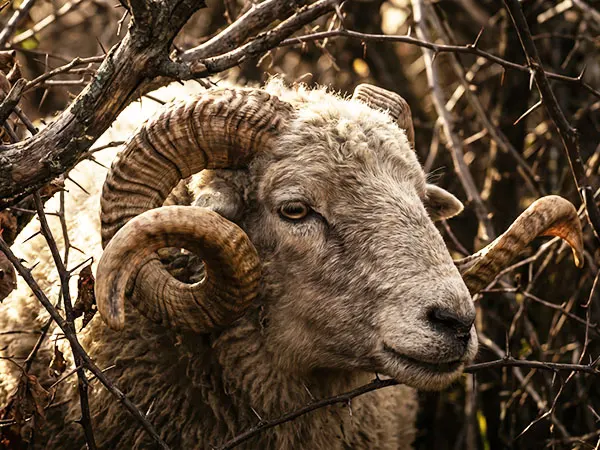
But the Angel of the Lord called [more properly, cried out or shouted] to him from heaven and said, "Abraham, Abraham!" So he said, "Here I am." And He said, "Do not lay your hand on the lad, or do anything to him; for now I know that you fear God, since you have not withheld your son, your only son, from Me." Then Abraham lifted his eyes and looked, and there behind him was a ram caught in a thicket by its horns. So Abraham went and took the ram, and offered it up for a burnt offering instead of his son.
In this manner, God not only shows His grace and mercy toward Abraham and Isaac—and us!—but He also reveals that He provides a substitute sacrifice, His own Son, to make atonement for our sins.
Abraham believed God, and his faith was accounted to him as righteousness (Genesis 15:6; Romans 4). In unwavering faith, we, too, must accept the sacrifice given for us and, in turn, surrender our lives as living sacrifices (Romans 12:1), growing in the image of Jesus Christ. Again, as Paul writes in Ephesians 5:1-2, "Therefore, be imitators of God as dear children. And walk in love, as Christ also has loved us and given Himself for us, an offering and a sacrifice to God for a sweet-smelling aroma."