


by Charles Whitaker (1944-2021)
Forerunner,
"Prophecy Watch,"
August 6, 2026
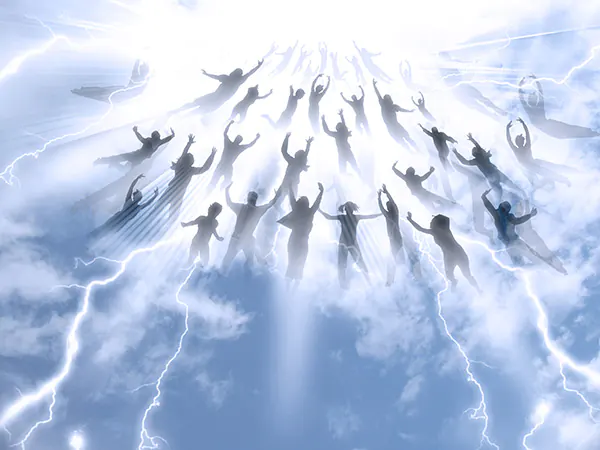
I Thessalonians 4:16-17 contains the prophecy that many fundamentalist evangelicals call “the Rapture.” Most people are not aware that a root of this false prophetic belief is antinomianism, the denial of God’s law. The purpose of this article is not to disprove the Rapture. For that, the reader can refer to the 1996 Forerunner article, “Caught Up in the Rapture.” However, I Thessalonians 4 provides an excellent avenue of approach to this anti-law concept.
For the Lord Himself will descend from heaven with a cry of command, with the voice of an archangel, and with the sound of the trumpet of God. And the dead in Christ will rise first. Then we who are alive, who are left, will be caught up together with them in the clouds to meet the Lord in the air, and so we will always be with the Lord. (I Thessalonians 4:16-17)i
Members of the church of God understand this to be a reference to the first resurrection at Jesus Christ’s return. What confuses many people in this passage is the verb phrase “caught up.” In Greek, it is not the usual word that is translated “resurrection.” “Caught up” is translated from an inflected form of the verb harpazo, which simply means “to be caught up.” It appears thirteen times in the New Testament, the first time in Matthew 11:12, where Christ is speaking:
From the days of John the Baptist until now the kingdom of heaven has suffered violence, and the violent take it by force.
The term “take it by force” is translated from an inflected form of harpazo. The verb connotes “violence,” “force,” or “abruptness.”ii
It is important to understand that historically, to a Roman Catholic, an Orthodox Catholic, and to some—but not all—Protestants, the word “rapture” means “resurrection.” However, to a subset of Protestants, especially fundamentalist evangelicals, the word “rapture” does not mean “resurrection,” but instead refers to an event different from, and prior to, the resurrection.
To these latter Protestants, “rapture” refers to a sudden, unexpected, “secret” snatching away of some people before the resurrection. These evangelical groups commonly believe that the resurrection follows the Rapture event by several years. Most evangelicals believe the Rapture takes place before the Great Tribulation, which they refer to as “the pre-Tribulation Rapture.”iii
The Origin of “the Rapture”
In virtually all references to I Thessalonians 4:16-17 before about 1800, the authors comment on the general resurrection, even though they may use the term “rapture.” The context of the biblical passage makes its overall subject obvious. For example, two American churchmen of the 1700s, Increase Mather and his son, Cotton Mather, use the word “rapture” where it clearly means the resurrection from the dead at Christ’s second coming. They use the terms “resurrection” and “rapture” synonymously. Though ignorant of the full theology of the resurrections, they essentially understood I Thessalonians 4 correctly.
So, where did the special meaning of the noun “rapture” come from? It likely originated from a Scottish churchman named Edward Irving in about 1825, about two centuries ago. However, it is that most sinister personage of all, Englishman John Nelson Darby, who popularized the concept of the Rapture as evangelicals came to understand it, just two years later, in 1827.
A young Scottish woman, Margaret MacDonald (1815-1840), thickens the soup of confusion. She became deeply involved in a charismatic movement sweeping Scotland at the time. In 1830, when she was about fifteen, she had a vision, and her utterances at the time have come down to us, albeit a bit garbled. A small part of this utterance goes like this: “‘Tis Christ in us that will lift us up—He is the light. ‘Tis only those that are alive in Him that will be caught up to meet Him in the air.”
To his credit, Darby, who met Margaret, considered her utterances to be demonic and gave them no credence. But Edward Irving considered them to be absolutely genuine—indeed, inspired. While no one can say Margaret MacDonald’s utterances led directly to the propagation of the new concept of the Rapture—after all, she spoke three to five years after Irving and Darby wrote about the Rapture—Irving certainly used her utterances to bolster his belief in it. The association of a demon-influenced MacDonald with the Rapture doctrine, though tenuous, places the teaching on a par with something like the Catholic Fatima deception.
What is so interesting about this is that an influential account of MacDonald’s utterance, published in 1861, left out two sections that argue against a pre-Tribulation Rapture. These two short sections demonstrate that MacDonald understood the rapture as a general resurrection, that is, as Protestants had historically understood it.
As best scholars can tell, these two passages were purposefully omitted from the quotation of her utterances. This purposeful omission—among other chicanery—led one writer, Dave MacPherson, to write The Rapture Plot.ivPublished in 1994, it is a detailed exposé of the notion of a pre-Tribulation Rapture. MacPherson argues that the concept of the Rapture did not spring so much from a misunderstanding of the Scriptures as from the outright suppression of the truth by unscrupulous churchmen.
These people did everything we tell our children not to do when they write an essay in school: They omitted obviously germane passages, plagiarized source material, and modified quotations to suit their purposes, all to push their point. In other words, they were simply intellectually dishonest, spiritual crooks.
Based on the dishonesty of those who advanced it, MacPherson rejects the concept of the Rapture. While we might not agree with all his comments, we would find his general reason for rejecting the Rapture interesting: He claims that many of the world’s clergy are, simply put, liars—not just deceived, but blatant deceivers.v
Scofield and His Reference Bible
By far and away, the Rapture doctrine got its biggest push from an edition of the Bible created by an American, Cyrus Scofield: the Scofield Reference Bible. Perhaps no edition of the Bible has so changed American evangelical Protestantism—and changed it for the worse.
Scofield was a real man of this world. Involved in all sorts of political corruption when he served as the United States District Attorney for Kansas, he later “got religion,” and in 1883, was ordained as a Congregationalist minister. His training was in law, never in theology; he never attended a seminary. In fact, though he later attached the letters “D. D.” (Doctor of Divinity) to his name, there are no records that any school ever granted him a divinity degree, either real or honorary. Most scholars believe he provided false information to his biographers and to Who’s Who.
He became wealthy from the royalties of the Scofield Reference Bible, first published when he was 67 and experiencing failing health. With it, he acquired several high-quality pieces of real estate. He also joined the prestigious Lotus Club, a New York organization whose members over the years included Andrew Carnegie, William Randolph Hearst, Samuel Clemens, Dwight Eisenhower, Orson Welles, and so on. Like William Carey and many other well-known churchmen, Scofield, so enmeshed in his business, hardly knew who his children were.
The Scofield Reference Bible is not a translation of the Bible but an edition. The text is the King James Version with extensive notes and cross-references penned by Scofield. In 1909, he published what came to be called the Old Scofield Reference Bible, and he revised it in 1917.vi Both versions are now in the public domain and can be readily accessed on the Internet. These editions are direct ancestors of The Oxford Study Bible, which many Christians have in their personal libraries.vii
Dispensationalism
While Scofield got a few things right,viii he also spread several false doctrines. One of these latter teachings was the Rapture, as Scofield fell head-over-heels for John Darby’s erroneous idea of dispensationalism, of which the Rapture was a hallmark.ix Though the Scofield Reference Bible does not comment on the Rapture in its note on I Thessalonians 4:17, its dispensational perspective—an interpretive framework heavily allied with prophecy—soon ushered in Darby’s views on end-time events.
Absolutely nobody did more damage to Protestantism than Darby. Of course, Protestantism, a rebellious daughter of Catholicism, was in error from the outset. Generally, Protestantism is founded on three propositions not supported in Scripture:
» It is Trinitarian in orientation.
» It maintains that Sunday is the proper day of worship.
» It declares the soul’s immortality, and as a corollary, that heaven was the reward of the saved.
However, part of the Protestant spectrum, most specifically the Puritan part of it, historically believed steadfastly in obeying the Ten Commandments—except for the fourth.x Before the nineteenth century, Protestantism at large, and Puritanism in particular, was basically moral. But Darby set ideologies in motion that changed all that forever.
At its most basic, his concept of dispensationalism held that God dealt with mankind differently in different eras of time. Taking its cue from Darby, the Scofield Reference Bible wastes no time in setting forth his seven dispensations: Innocency, Conscience, Human Government, Promise (the time of the Patriarchs), Law (Moses to Malachi), Grace (New Testament), Kingdom (Millennium).xi He viewed these dispensations as at least loosely connected to eight covenants, which he calls the Edenic, Noahic, Abrahamic (Genesis 15), Mosaic (the Old Covenant), Palestinian, Davidic, and New. He bypassed other obvious covenants, such as the Sabbath covenant.xii
The greatest difficulty with this is that dispensationalism denigrates the position of God’s law. While God has always saved people by grace (Ephesians 2:8), we understand law to have a place in all God’s covenants and in all history. For instance, even during the pre-Flood world, Noah knew about clean and unclean animals, as Genesis 7:1-3 demonstrates. When he left the ark, he built an altar and offered a burnt offering, so he also understood offerings (see Genesis 8:20). The law was no foreign concept to him.
Genesis 26:5 says that Abraham obeyed God’s commandments, statutes, and laws, quite a long time before Sinai. Looking forward to the Millennium, Isaiah 2:3 declares that the law will go forth from Zion. God’s law spans covenants and history.
Darby and Scofield believed the law related to only one so-called dispensation, the one they labeled “the Period of Law.” Worse, they both saw law as bad, something that God replaced with grace during what they called the Dispensation of Grace.xiii They concluded that, because we live in the epoch of grace, we do not need to obey the law, asserting a false opposition between the two.
The most telling inadequacy of Scofield’s notions of law and grace is a note appearing at Galatians 3. In part, he writes, “The law is, in itself, holy, just, good and spiritual . . .. Before the law the whole world is guilty.” So far, so good, but he cannot leave well enough alone. He continues, “And the law is therefore of necessity a ministry of condemnation, death, and the divine curse.”
The antinomianism so rampant today has its roots, at least partially, in Darby’s dispensational thinking. To a significant extent, it gained traction through the notes Scofield wrote in the margins of his popular Reference Bible. In Darby and Scofield, Satan had ready tools to knock the props out from under the more law-abiding and God-fearing Puritans. Today, most nominal Christians consider God’s law a curse rather than a blessing.
So, how did the Rapture become so popular in the evangelical mind? We can credit Darby and Scofield’s dispensational teaching, which took the world by storm with its easy grace and “end of the world” prophetic fervor, and the Rapture slipped in on its coattails.
End Notes
i Unless otherwise specified, all Scripture citations are from the English Standard Version.
ii Harpazo (Strong’s #726) is translated “catch up” four times, “take by force” three times, “catch away” two times, “pluck” two times, and “catch” and “pull” once each in the King James Version. An example of the violence associated with it appears at John 10:24:
He who is a hired hand and not a shepherd, who does not own the sheep, sees the wolf coming and leaves the sheep and flees, and the wolf snatches [harpazo] them and scatters them.
In his translation of the Bible into Latin, the Vulgate, Jerome uses the verb rapere in I Thessalonians 4:17, a verb that means “to snatch,” often violently. The English words “rape” and “rapine” derive from this verb.
iii A few evangelicals believe the Rapture takes place in the middle of the Tribulation.
iv For a bit more reasoned and scholarly study of the topic, see John Bray’s The Origin of the Pre-Tribulation Rapture Teaching.
v The more recent writings of Hal Lindsey and the Left Behind books (and films) are modern-day manifestations of this sales campaign.
vi Scholars refer to the 1917 edition as the New Scofield Reference Bible. Some scholars feel that Scofield himself had little to do with the changes made to the 1917 version.
vii In 1967, the original publisher, Oxford University Press, added material to the 1917 version and changed the original notes to create the popular Oxford Study Bible.
viii Scofield’s note on Genesis 1:1-2 indicates that he subscribed to Gap Creationism or Restoration Creationism, the idea that there was a long period of time between Genesis’ first verse and its second. He was a staunch believer in Creationism. Many conservative Christians of his day bought his edition simply because it advanced Creationism and rejected evolution.
ix Another manifestation of the master-servant relationship between Darby and Scofield is the latter’s teaching regarding the Letters to the Seven Churches in Revelation 2-3. One is right to expect individuals inclined to think dispensationally to advance the position that the seven churches represent seven successive eras in the history of the true church. Scofield, in his note to Revelation 1:20, writes that one of the four “applications” of the seven messages was “prophetic, as disclosing seven phases of the spiritual history of the church from, say AD 96 to the end.” He continues by briefly elaborating, placing each church in a historical timeframe. For example, he writes that “Sardis is the Protestant Reformation, whose works were not ‘fulfilled.’”
x That is why so many of the laws of the original North American colonies in the 1600s and early 1700s read as if they came directly from Deuteronomy.
xi Scofield, note on Genesis 1:28.
xii E. W. Bullinger was also an exponent of dispensationalism. His ideas on the subject fit into a system called “Ultra-Dispensationalism” or “Hyper-Dispensationalism.” To him, the dispensations are 1.) Edenic state of innocence, 2.) period “without law,” 3.) period under the law, 4.) period of grace, 5.) epoch of judgment, 6.) Millennial age, and 7.) the eternal state of glory.
xiii Theologians call this replacing of one thing with another “Supersessionism” or sometimes “Replacement Theology” or even “Fullfilment Theology.” There are other manifestations, such as the idea that the New Testament replaces the Old.