


Filter by Categories

The Lamb of Revelation (Part One)
'Prophecy Watch' by David C. GrabbeThe concept of the redemption of the firstborn holds significant weight in understanding the imagery of lambs in Scripture, particularly as it relates to Jesus Christ being called the Lamb in the book of Revelation. In Exodus 13, God declares His claim on all firstborns, both of man and beast, establishing the law of the firstborn even before Israel reached the Red Sea. This law, given among the very first instructions to His newly purchased nation, underscores the importance of redeeming the firstborn, a matter of great significance to God. He claimed Israel as His firstborn and redeemed her from Pharaoh, requiring the Israelites to redeem every firstborn male with a lamb, symbolizing the exchange of one life for another due to a prior claim of ownership. This usage of lambs for redemption, rather than atonement for sin, aligns more closely with the depiction of the Lamb in Revelation. Unlike sin offerings which address atonement, redemptions deal with ownership, as seen when God redeemed His people from Pharaoh to fulfill His promises. The pattern of redemption is evident in Abraham's life when God required him to sacrifice his firstborn, Isaac, and provided a ram for redemption due to Abraham's willingness to obey. Similarly, in the broader context of God's plan, redemption extends beyond forgiveness of sins to a future liberation from the power of the flesh, enabling believers to manifest the complete image and likeness of their Creator. Thus, the title of Lamb in Revelation evokes this profound theme of redemption and ownership, highlighting Jesus Christ's role in buying back and rescuing His people from bondage.
Is the Passover Just a Sin Offering? (Part Two)
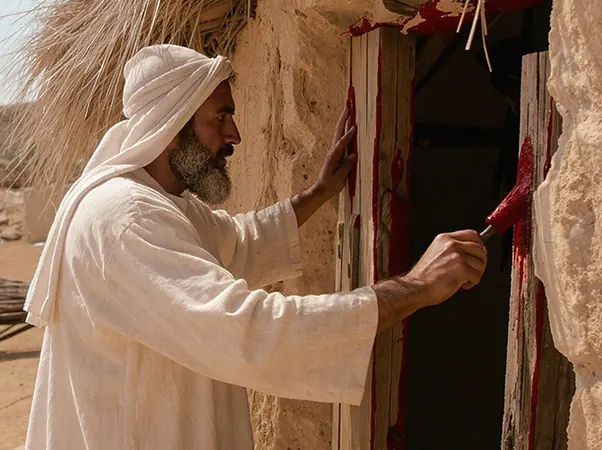
Article by David C. GrabbeThe Passover centers on the redemption of God's firstborn. God declared Israel to be His son, His firstborn, and threatened to strike every firstborn in Egypt when Pharaoh refused to release the people. The blood applied to the doorposts functioned as the required sign, causing God to pass over the Israelite houses and spare their firstborn from the destroyer. This sparing redeemed the nation from Pharaoh's legal claim, purchasing Israel out of Egyptian bondage because of the covenant God had sworn to Abraham. The instructions focus on selecting, preparing, and eating the lamb as a complete meal eaten in haste, with none left until morning. No reference to forgiveness or atonement appears in the account. The blood instead symbolizes the life of the lamb given to redeem those inside each marked house. God overlooked Israel's idolatry and other sins for His name's sake, granting an exemption rather than justification. This act of mercy aligned with His earlier promise to bring Abraham's descendants out of a foreign land with great possessions. The same principle later required a lamb to redeem every firstborn son and every unclean animal, tying the observance directly to the ongoing redemption of God's firstborn.

Holy Days: Passover
Bible Study by Richard T. RitenbaughGod's Plan of salvation for mankind is revealed through His commanded holy days, with the Passover symbolizing the initial steps toward communion with Him and His Son, Jesus Christ. The Passover lamb, chosen and killed by the Israelites, provided blood to mark their doorposts, serving as a sign for the Death Angel to pass over their homes, sparing their firstborn while the firstborn of Egypt perished. This act of marking the doorposts with blood represents not a covering for sin but the life of the lamb given to redeem or buy back those within the house. Scripture frequently speaks of the Passover in terms of purchasing or redeeming the children of Israel from Pharaoh, rather than forgiveness or atonement. Thus, the festival focuses on the ongoing fellowship God initiates with His called-out people, becoming a solemn yet joyful celebration of the peace and well-being we have in Christ.

The Lamb of Revelation (Part Two)
'Prophecy Watch' by David C. GrabbeIn the book of Revelation, Jesus Christ is frequently referred to as the Lamb, a title that encompasses more than His sacrifice. Before the instructions for sin offerings were given, God commanded the Israelites to use a lamb to redeem their firstborn males, buying them back from Him who claimed them for Himself. This theme of redemption, which involves transferring ownership, aligns closely with the events depicted in Revelation. The scroll in the heavenly vision bears the characteristics of a title deed for all creation, and only the Lamb that had been slain is worthy to take it and open its seals. This Lamb, with seven horns symbolizing perfect strength and power, and seven eyes connected to the removal of Israel's iniquity and the restoration of true worship, embodies the essence of redemption. When applying the theme of redemption to the mentions of the Lamb in Revelation, the imagery becomes clear. The Lamb's blood has redeemed individuals, forming them into a kingdom of priests, and He begins opening the seals not as a sin offering but as a redeemer claiming what belongs to Him. The scope of this redemption extends beyond Israel or the church, portraying Jesus Christ as the Creator, Heir, and Owner of all things. Despite resistance, as seen in the cataclysms akin to the plagues on Egypt during Israel's redemption, He ultimately succeeds, with the kingdoms of this world becoming the kingdoms of our Lord and of His Christ, reigning forever. The Lamb's wrath, evident in the Sixth Seal, reveals His zeal for what He possesses, which can include tremendous destruction when necessary, as Israel's history attests. Here, the Lamb focuses on demonstrating ownership and realigning His creation with His government. In Revelation 14, the Lamb stands on Mount Zion with 144,000 redeemed from the earth and among men. Before the final judgments in Revelation 15, those victorious over the beast sing the song of Moses and the song of the Lamb, echoing God's redemption of Israel from Egypt. In the closing chapters of Revelation, the Lamb and His Bride recall the redemption story of Ruth by Boaz. As the Firstborn over all creation and the firstborn from the dead, Jesus Christ, the Lamb of redemption, will redeem the church, Israel, Jerusalem, the Land of Promise, and all who have not rejected Him, fulfilling the groaning of creation for final redemption.
The Priesthood of God (Part Two)
Sermon by John W. Ritenbaugh (1932-2023)In the narrative of God's purpose for His people, the concept of the firstborn holds significant meaning, tied closely to redemption and responsibility. As revealed in Exodus 13:11-16, God commanded that all firstborn males, both of humans and animals, be set apart to Him upon entering the land of the Canaanites. This dedication served as a perpetual reminder of Israel's redemption from Egypt, where the Lord struck down the firstborn of the Egyptians, both man and beast, to secure Israel's freedom. The firstborn of a donkey was to be redeemed with a lamb, or else its neck was to be broken, while every firstborn son among the Israelites was to be redeemed, symbolizing that their lives and liberty belonged to God due to His act of deliverance. This practice of dedicating the firstborn existed before the Old Covenant and was not unique to Israel, as many nations historically appointed the firstborn son as family leader and priest. The redemption of the firstborn was a recurring event throughout the year, whenever a firstborn was born, ensuring that the Israelites continually remembered their ownership by God. Though the firstborn belonged to Him, they could be redeemed for five shekels, allowing the son to remain with the family, yet the underlying truth of God's ownership persisted. Later, as recorded in Numbers 3:6-13, God took the tribe of Levi in place of every firstborn among the children of Israel for direct duties at the tabernacle. This substitution did not end the dedication of the firstborn but shifted their responsibilities from direct religious service to leadership roles within their families and local communities. The Levites assumed the tabernacle duties, yet the firstborn retained their symbolic prominence and leadership outside the religious sphere, reflecting God's ongoing claim over His redeemed people.
Unleavened Bread and the Holy Spirit (Part One)
Sermon by John W. Ritenbaugh (1932-2023)Brethren, the subject of the Firstborn and their Redemption is a vital scriptural technicality that we must understand deeply, especially in relation to the Days of Unleavened Bread. In Exodus 13:1-2, the Lord spoke to Moses, saying, "Consecrate to Me all the firstborn, whatever opens the womb among the children of Israel, both of man and beast; it is Mine." From this moment, God claimed the firstborn as His own, marking a significant act of sanctification following the destruction of the firstborn in Egypt. While He took the lives of Egypt's firstborn, He set apart Israel's firstborn for Himself. This consecration ties directly to the command to eat unleavened bread, as seen in Exodus 13:3, where Moses instructs the people to remember the day they left Egypt, the house of bondage, for by the strength of His hand, the Lord brought them out. The eating of unleavened bread serves as a reminder not merely of coming out of sin, but primarily of what the Lord did in delivering His people. It reinforces the truth that their freedom was not by their own effort, but by His mighty intervention. Further, in Exodus 13:11-16, God elaborates on the redemption of the firstborn. Every firstborn male animal that opens the womb is to be set apart to the Lord, and for a donkey, it must be redeemed with a lamb, or its neck broken if not redeemed. Likewise, every firstborn son among the Israelites must be redeemed. This act of redemption is explained to future generations as a memorial of how the Lord, by strength of hand, brought them out of Egypt after striking down the firstborn of both man and beast in that land. It serves as a sign and a reminder of His power and purpose in their deliverance. In Numbers 3:9-13, we see a significant transfer of responsibility. The Lord declares that He has taken the Levites from among the children of Israel in place of every firstborn who opens the womb. The Levites are set apart as His, to serve in the priesthood, replacing the firstborn who were initially claimed as His after the events in Egypt. This shift underscores that the firstborn belong to Him, sanctified on the day He struck Egypt's firstborn, and now their role is fulfilled through the Levites' service. Brethren, the redemption of the firstborn is no minor detail in God's purpose. It is intricately connected to the Days of Unleavened Bread, reminding us that our coming out of bondage—whether from Egypt or sin—is primarily the work of God overcoming the world and its forces. We must keep this in focus, ensuring that we do not overlook the Father's central role in our salvation, for it is by His initiative and strength that we are set free.
Elements of Motivation (Part Four)
Sermon by John W. RitenbaughBecause we have been bought with an awesome price, we have no right to pervert our lives, but are obligated to look upon our bodies as vessels in His service.
Matthew (Part Thirty-One)
Sermon/Bible Study by John W. RitenbaughThe emotions Jesus felt were real, experiencing every agony, fear, anguish, disappointment, terror and temptation we all experience, yet without sin.