


Filter by Categories
Keeping Our Focus Through Stormy Seas
Sermonette by Ted E. BowlingDistractions of any type may cause us to shift our attention from our Creator, as Jesus' disciples did on that stormy night in the Sea of Galilee.
The Miracles of Jesus Christ: Walking on the Water (Part One)
Bible Study by Martin G. CollinsJesus' walking on the water of the Sea of Galilee and His calming words to the disciples unmistakably declared to them just who Jesus really was.
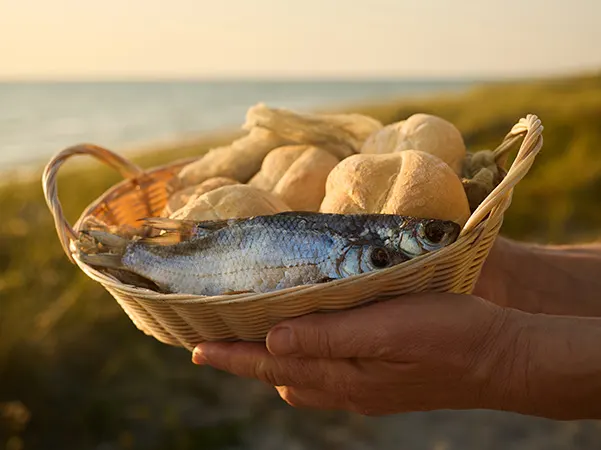
The Miracles of Jesus Christ: Feeding the Five Thousand (Part Two)
Bible Study by Martin G. CollinsThe feeding of the 5,000 tells us far more than that Jesus was a miracle-worker. It also reveals Christ's compassion on those who hunger, plus His ability to teach.
The Miracles of Jesus Christ: A Second Large Catch of Fish (Part One)
Bible Study by Martin G. CollinsGalilee is where Christ chooses to meet His disciples for His final miracle before the ascension, and on at least three occasions after His resurrection He directs them to go there (Matthew 26:32; 28:7, 10; Mark 14:28; 16:7). It is the site of the first great catch of fish in Luke 5, where He called Peter, John, James, and Andrew, so the setting invites comparison between the two miracles and brings the disciples full circle. Galilee is also the disciples' home, and their fishing boats are docked there. The Sea of Galilee, also called Lake Tiberias or the Lake of Gennesaret, allows an intimate gathering away from the crowds, as it did at the first miracle. It gives a feeling of solace and comfort after the crucifixion. When the disciples are troubled and uncertain about the future, they return to the familiar work of fishing on its waters, away from prying eyes and ears. There Christ teaches them that any activity undertaken without Him is fruitless.
Before Honor Is Humility: The Story of Andrew
Article by Martin G. CollinsThe apostle Andrew is a sterling example of humble service. Through Scripture contains only a little about him, his character should encourage us all.
The Miracles of Jesus Christ: The Great Catch of Fish
Bible Study by Martin G. CollinsIn performing the miracle of the great catch of fish, Jesus manifests His divine power over creation, forcing Peter to realize just who his Master was.
The Miracles of Jesus Christ: Stilling a Storm
Bible Study by Martin G. CollinsThe Sea of Galilee is the setting for the first of two miracles in which Jesus calms a storm. After a long day of teaching and testing, Jesus has His disciples take Him by small boat across the sea to the quieter region of Perea, away from the crowds. Worn out, He falls asleep on a pillow, and a sudden storm sends waves beating into the boat and filling it. The disciples panic and cry out to Him, yet He remains at peace because of His complete trust in the Father's care and His knowledge of His God-given power over wind and sea. Jesus rebukes the disciples for little faith, since the Father, who long ago shut in the sea with doors and said, "This far you may come but no farther" (Job 38:8, 11), would not let His faithful Son drown. When Jesus commands the sea, "Peace, be still!", the Greek phrase means "be muzzled," as though the storm were a maniac to be bound. This treats the storm as a rebellious force, since disorder in nature traces back to Satan, whose works Jesus came to destroy. The miracle contrasts nature's disorder with the Creator's power, order, and peace (Psalm 89:9). It also leaves the disciples in reverent awe. The waves of the world still rage against Christ's followers, but they will not be overwhelmed because Christ is in them.
John's Feeding of the 5,000
Sermon/Bible Study by Richard T. RitenbaughThe Sea of Galilee, also called the Sea of Tiberius, lies in the northern part of Israel, north of Judah. The Jordan River runs into it and then flows out of it down the east side of the land to the Dead Sea. Its Hebrew name, Kinneret, means harp, because the lake is shaped like one. Jesus went over to the northeast side of the harp, the area known today as the Golan Heights, which Israel holds and which Syria and Lebanon would like to have. He had been on the other side of the sea and tried to get away from the crowds, but a great multitude followed Him all the way around the shore because they had seen His signs of healing on the diseased. There, on the mountain near the lake, He sat with His disciples just before the third Passover of His ministry, and the feeding of the 5,000 took place. Philip, the local man from Bethsaida at the foot of the mountain, knew the town, its bakers, warehouses, and docks, which is why Jesus asked him where bread could be bought. Even with that knowledge, Philip could not see a physical way to supply so many.
Passing By in Glory
Sermonette by Richard T. RitenbaughJesus' walking on the water in the pitch-black darkness of early morning, revealing Himself to the disciples, alludes to the time God passed by Moses.
Matthew (Part Three)
Sermon/Bible Study by John W. RitenbaughJesus resisted Satan with the knowledge of God, resisting appeals to vanity, using power selfishly resisting to lust of the flesh, eyes, and pride of life.

The Parables of Matthew 13 (Part Eight): The Parable of the Dragnet
Bible Study by Martin G. CollinsThe penultimate parable of Matthew 13 uses the illustration with which Christ's disciples were very familiar: fishing in the Sea of Galilee.
John (Part Eleven)
Sermon/Bible Study by John W. RitenbaughThe storm on the Sea of Galilee instructs us that when we are in a trial and getting nowhere, if we invite Christ into the situation, we will have peace.
Are God's Holy Days To Be Kept Today?
Sermon/Bible Study by Martin G. CollinsIf we do not keep God's holy days, we will deprive ourselves of the knowledge of God's purpose. Jesus and the first century church observed and upheld these days.
Jesus Christ, Our Anchor: Steadfast and Sure
Sermonette by Ted E. BowlingThe anchor is perhaps the most important piece of equipment on a vessel, holding a ship in place as it is moored, keeping the craft from drifting.