


by Ryan McClure
Forerunner,
September 24, 2026
We can all agree that the world is not getting any better. The news headlines speak of terrorism, war, anti-Semitism, murder, fraud, endless sexual sins, and economic woes. It can be distressing and depressing to visit the prayer request page on the church’s website. Physical and spiritual trials have bombarded the brethren to where they are asking, “How long, O Lord?”
But we always have the Feast of Tabernacles to look forward to.
In the early fall, God’s people all over the world assemble before Him and celebrate the Feast of Tabernacles, which represents the Millennium, a time of restoration and healing, a time when the headlines will not look anything like what they are today. At that time, God’s people will not be scattered, keeping the Feast alone, in hospital beds, under danger of war, expecting a hurricane, or facing any other uncertain circumstance.
Of course, we hope to be among God’s firstfruits, resurrected and changed into immortal spirit beings, reigning with Christ for a thousand years!
You Shall Rejoice
God commands the observance of the Feast in Leviticus 23:33-36. We are to keep it for seven days beginning on the fifteenth day of the seventh month on God’s calendar. The first day is a holy convocation on which we are not to work. The Eighth Day is a separate holy day festival and holy convocation.
In verse 40, God adds more instruction:
And you shall take for yourselves on the first day the fruit of beautiful trees, branches of palm trees, the boughs of leafy trees, and willows of the brook; and you shall rejoice before the LORD your God for seven days.
Note the final command: “You shall rejoice before the LORD your God.” But as the years pass, and as troubles mount, rejoicing can become more difficult. From our human perspectives, we think, “What is there to rejoice about?” or “In these times, how can we rejoice?”
We should not downplay how difficult the times are for some, but to keep God’s command, we must rejoice at the Feast. It requires us to adjust our perspectives up from the troubles of this world. Our view needs to change to one that is “above the sun,” that is, one like God’s own. When we can do that, regardless of our physical situation, we can rejoice at God’s Feast because of the glorious future it represents!
We need to recall what God will be doing during the Millennium and beyond, which we can get a glimpse of from the prophecy in Isaiah 65:17-25:
“For behold, I create new heavens and a new earth;
And the former shall not be remembered or come to mind.
But be glad and rejoice forever in what I create;
For behold, I create Jerusalem as a rejoicing,
And her people a joy.
I will rejoice in Jerusalem,
And joy in My people;
The voice of weeping shall no longer be heard in her,
Nor the voice of crying.
No more shall an infant from there live but a few days,
Nor an old man who has not fulfilled his days;
For the child shall die one hundred years old,
But the sinner being one hundred years old shall be accursed.
They shall build houses and inhabit them;
They shall plant vineyards and eat their fruit.
They shall not build and another inhabit;
They shall not plant and another eat;
For as the days of a tree, so shall be the days of My people,
And My elect shall long enjoy the work of their hands.
They shall not labor in vain,
Nor bring forth children for trouble;
For they shall be the descendants of the blessed of the LORD,
And their offspring with them.
It shall come to pass
That before they call, I will answer;
And while they are still speaking, I will hear.
The wolf and the lamb shall feed together,
The lion shall eat straw like the ox,
And dust shall be the serpent’s food.
They shall not hurt nor destroy in all My holy mountain,”
Says the LORD.
God says that during this time, He will rejoice and joy in His people. He commands us to do what He says He will do. In this way, He is teaching us through His commands for His holy days how to be like Him. It is no wonder why Jesus says in John 14:15, “If you love Me, keep my commandments.” If we love Christ, if we want to be like Him, if we want to enjoy His blessings, if we want to be part of His Family, keep God’s commandments!
Future Feasts
So, as we keep the Feast of Tabernacles, we are to rejoice before the Lord our God for seven days. The Feast is not just for our age now, but it will also be kept in the age to come. We keep it now to proclaim what God will do when Christ returns, sets up His government, and works to restore all things across the new world, fulfilling these holy days. Keeping the Feast of Tabernacles in the future is prophesied in Isaiah 2:2-4:
Now it shall come to pass in the latter days
That the mountain of the LORD’s house
Shall be established on the top of the mountains,
And shall be exalted above the hills;
And all nations shall flow to it.
Many people shall come and say,
“Come, and let us go up to the mountain of the LORD,
To the house of the God of Jacob;
He will teach us His ways,
And we shall walk in His paths.”
For out of Zion shall go forth the law,
And the word of the LORD from Jerusalem.
He shall judge between the nations,
And rebuke many people;
They shall beat their swords into plowshares,
And their spears into pruning hooks;
Nation shall not lift up sword against nation,
Neither shall they learn war anymore.
This prophecy speaks of a future time when “many people” will go up to the mountain of the Lord to be taught. Just as much as we suit up and travel to the Feast each year, in the Millennium, God will command those who are living to travel up—the direction is telling—to the mountain of the Lord to be taught by Him. We can see this more specifically in Zechariah 14:16-19:
And it shall come to pass that everyone who is left of all the nations which came against Jerusalem shall go up from year to year to worship the King, the LORD of hosts, and to keep the Feast of Tabernacles. And it shall be that whichever of the families of the earth do not come up to Jerusalem to worship the King, the LORD of hosts, on them there will be no rain. If the family of Egypt will not come up and enter in, they shall have no rain; they shall receive the plague with which the LORD strikes the nations who do not come up to keep the Feast of Tabernacles. This shall be the punishment of Egypt and the punishment of all the nations that do not come up to keep the Feast of Tabernacles.
Even after they are fulfilled, God’s holy days do not end. In the Millennium, God will require those who call on His name to show up at the Feast of Tabernacles or face the consequences. Clearly, He has designed His holy days as a teaching mechanism. Here, the prophecy outlines a severe cause-and-effect or blessings-and-curses lesson for failing to obey His commands.
Going Up to Jerusalem
God shows that He requires us to respond with action to what He says. As the apostle James writes in James 2:20, 26, “Faith without works is dead.” We show our faith in God by obedience to His instructions, doing what He says is for our benefit. So, in the Millennium, Scripture indicates that people will have to travel to the Feast, to go up to Jerusalem to worship God there.
Today, we associate where we are going with direction. For example, when we go south for a visit, we typically say that we are going “down” there. If we go north for a vacation, we say we are going up.
This passage, however, indicates that the mountain of the Lord, where Jerusalem sits, is essentially “up.” Micah 4:1-2 provides some additional details:
Now it shall come to pass in the latter days
That the mountain of the LORD’s house
Shall be established on the top of the mountains,
And shall be exalted above the hills;
And peoples shall flow to it.
Many nations shall come and say,
“Come, and let us go up to the mountain of the LORD,
To the house of the God of Jacob;
He will teach us His ways,
And we shall walk in His paths.”
For out of Zion the law shall go forth,
And the word of the LORD from Jerusalem.
Further, Zechariah 14:10 mentions that, after Christ returns and defeats the armies that come against Him, “All the land shall be turned into a plain from Geba to Rimmon south of Jerusalem. Jerusalem shall be raised up and inhabited in her place . . ..” God will flatten the surrounding territory and exalt Jerusalem on the mountain of the Lord, making it the highest part of the land.
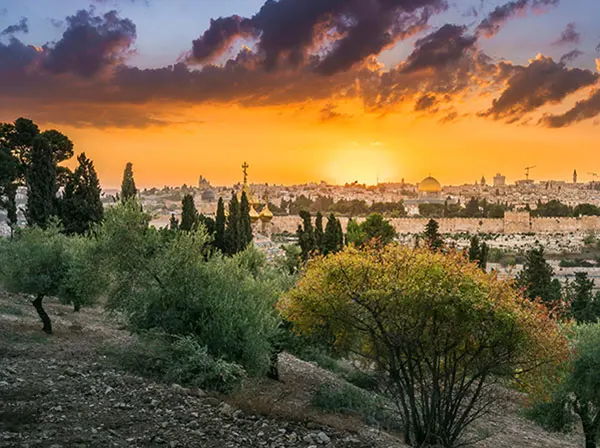
It will be, if you will, the only “high place.” In ancient Israel, people would construct idols and erect them on high places like the tops of hills and mountains. A righteous judge or king would come along, keep God’s commands, and tear down the high places. The new Jerusalem of the Millennium will sit on the land’s highest peak, and Christ will reign over the world from it. Nothing will be exalted above the King. Its height will ensure people will see it as they travel to and from the holy city for His feasts during the Millennium.
A Shift of Focus
God has commanded us, His people, to keep the Feast of Tabernacles. He instructs us to leave our homes and dwell in booths or temporary dwellings. He specifically commands us to rejoice because that is what God will do when the Millennial period finally arrives. The thousand years of Christ’s rule will be full of joy and rejoicing. And, as we have seen, He will require people in that time to keep the Feast. Other than for them to learn obedience, why does He insist on it?
Micah 4:2 provides the answer: “Many nations shall come and say, ‘Come, and let us go up to the mountain of the LORD, to the house of the God of Jacob; He will teach us His ways, and we shall walk in His paths.’” Going up to the Feast presents another concentrated opportunity to be taught by Almighty God. It gives those who will go up to the mountain of the Lord instruction on how to walk in His paths, how to live a life that is holy and acceptable to Him. And going up to the mountain of the Lord will demonstrate that God is above all, and His instruction higher—superior, more excellent—than all other teaching.
But that is then. God has commanded us to go up to the Feast and rejoice! It provides us with an opportunity to learn to rejoice even amid uncertain times, trial, sickness, and loss. Honestly, it is difficult to rejoice while dealing with these things.
To do that, God wants us to shift our focus both up and forward. He desires that we view these matters from His perspective, considering the peace and prosperity Christ will bring to this earth after His return. He wants us to contemplate the work of the firstfruits after God changes them to spirit in the twinkling of an eye (I Corinthians 15:51-52), as well as the work of those humans who survive the Day of the Lord to rebuild and restore throughout the thousand years of Christ’s reign. God expects us to reflect on a future time when there will be no more nasty politics, no more war, no more sickness, no more pain and suffering, and no more tears (Revelation 21:4).
What a wonderful time it will be when Christ reigns! All living at that time will not be able to resist rejoicing in what He has created and accomplished. It will also be a time of learning, when God will teach all peoples on earth to live in the most abundant way possible (John 10:10).
Paul writes in Philippians 4:4-7:
Rejoice in the Lord always. Again I will say, rejoice! Let your gentleness be known to all men. The Lord is at hand. Be anxious for nothing, but in everything by prayer and supplication, with thanksgiving, let your requests be made known to God; and the peace of God, which surpasses all understanding, will guard your hearts and minds through Christ Jesus.
So, let us go up to keep the Feast of Tabernacles. We go to appear before Him, to be taught by Him, to learn to rejoice, and to look forward in hope to the ultimate fulfillment of what the Feast represents, not just for us, but for all of God’s creation. Who could fail to rejoice in all that?