


Filter by Categories
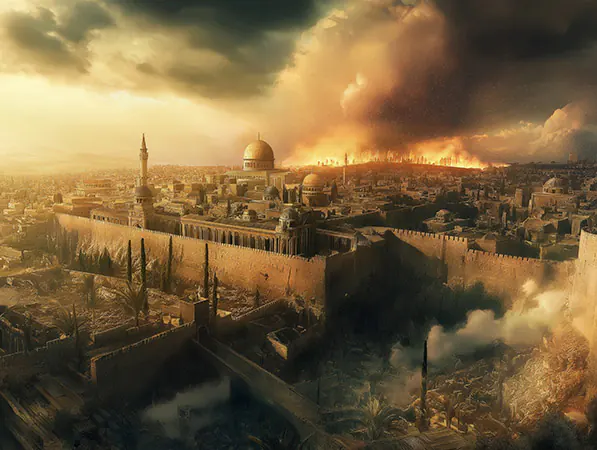
Jerusalem's Fall and Christ's Return
'Prophecy Watch' by Charles WhitakerJerusalem holds a central place in the prophecies concerning the Day of the Lord and the coming of the Son of Man. At the end of the Day of the Lord, a time of great wrath, Christ will be revealed and will assume the throne of David. At this time, He will establish Jerusalem as a city of worldwide acclaim and draw all peoples to Himself as nations flow to it. He will teach the law from Zion, marking the beginning of the Millennium, a time distinct from the destruction that characterizes God's wrath. In the Olivet Prophecy, Christ speaks of the fall of Jerusalem, but the destruction in AD 70 and earlier by the Babylonians are understood as types of a greater destruction yet to come. The intensely apocalyptic rhetoric, including references to clouds, points to a future day of the Lord's vengeance, not the events of AD 70 when redemption and such signs were absent. Christ emphasizes this as the days of vengeance, fulfilling all that is written about God's wrath in the Day of the Lord. Prophetically, Christ distinguishes the final attack on Jerusalem in the end time from past events by referencing multiple armies surrounding the city, unlike the singular Roman army in AD 70. This indicates a future fulfillment involving many nations, aligning with the broader scope of end-time prophecies.
Learn to Fear God
Feast of Tabernacles Sermon by John O. ReidJerusalem stands at the center of God's plan to reclaim Israel and restore all things. Prophecies describe the city first falling to invading nations that divide its spoil in its midst, yet at the moment of total defeat the Lord Himself goes forth to fight against those armies. His feet stand upon the Mount of Olives, which splits from east to west, opening a valley of escape for the remnant. Living waters then flow outward from Jerusalem in both summer and winter, one channel reaching the Dead Sea and transforming its lifeless expanse into a region of abundant fish and vegetation while the other flows westward, bringing healing wherever the river passes. The mountain of the Lord's house is established above all hills, exalted so that nations stream to it like rivers to receive instruction. Jerusalem becomes the financial capital of the earth, its latter glory surpassing the former as the wealth of the nations flows in. The city receives the name City of Truth and Holy Mountain. Old men and women sit in its streets and children play safely in its squares. From this restored center, redeemed Israel spreads outward, rebuilding waste places while the knowledge of the Lord fills the earth as waters cover the sea. These prophecies of Jerusalem's deliverance, healing, and exaltation form the visible outcome of learning to fear God now, for those who develop that fear are prepared to return with Christ and administer the very restoration the city pictures.
Shouting Gleanings and Singing Olives (Part Two)
Feast of Tabernacles Sermon by Charles WhitakerIsaiah's Apocalypse, comprising Isaiah 24 through 27, presents Jerusalem and Zion as the pivotal geographic center from which Christ's worldwide reign proceeds. While Isaiah 24 describes the Day of the Lord and the destruction of a worldwide civilization called the "world-city," the chapter concludes with Christ gloriously reigning on Mount Zion and in Jerusalem, His brilliance surpassing the moon and sun, seated before the elders who judge the twelve tribes of Israel. This establishes the crucial juxtaposition of Zion and Jerusalem: Christ does not rule from any symbolic or alternate location but specifically from Jerusalem, and from that city He governs the entire earth. Isaiah's Apocalypse fittingly closes in Isaiah 27:13 with the Lord reigning in the holy mount at Jerusalem, paralleling John's designation of Jerusalem as the Holy City in Revelation 21:10. Isaiah 25 develops this theme further through triple references to "on this mountain" or "in this mountain," identifying Mount Zion as the operational center for Christ's millennial work among the Gentiles. The prophet describes a feast the Lord of hosts will prepare for all peoples on this mountain, along with the destruction of the covering cast over all nations and the eventual swallowing up of death forever. This passage merges two major themes of Isaiah's Apocalypse: the worldwide scope of Christ's reconciling work and the centrality of Zion as its source. The world becomes the stage, while Zion serves as the director's chair, with Christ's rule emanating outward from Jerusalem even as New Covenant Israel increasingly serves as a light to the Gentiles, fulfilling Israel's original calling. Isaiah 25:10 offers a third mention of "this mountain," set near the beginning of the Millennium rather than at the ultimate end of time, when Christ settles unfinished business concerning Moab while established in Jerusalem, "in their midst." This phrase confirms that Christ has physically returned and reigns as King from that location. The prophet moves fluidly across centuries, from the immediate judgment on the terrible ones to the far future abolition of death itself, always anchoring his prophecy to Christ's continuous work proceeding from Zion. Isaiah 26 contains what may be understood as the very song the remnant sings in Jerusalem, referencing "a strong city" and framing salvation and divine protection in urban, Jerusalem-centered terms. Isaiah 62:11 reinforces this by proclaiming Zion's coming salvation, indicating that Christ's reconciling work only begins when He returns rather than concluding then. Isaiah 2:3 further emphasizes that the law goes forth from Zion and the word of the Lord from Jerusalem, establishing the city as the source of divine instruction and judgment among the nations. Micah 4:7 confirms this same pattern, declaring that the Lord will reign over His regathered people in Mount Zion forever, linking Jerusalem's prophetic significance to the everlasting kingship celebrated in the Song of Moses and echoed throughout Scripture wherever God's people rejoice over deliverance accomplished through their King reigning from His holy city.
The Doctrine of Israel (Part Thirteen): Jacob's Trouble
Sermon by Richard T. RitenbaughDuring Jacob's Trouble, a confederacy of gentile peoples (particularly the offspring of Ishmael and Esau) will destroy the nations of modern-day Israel.
Zephaniah (Part Three): Quick Destruction, Eternal Restoration
Feast of Tabernacles Sermon by Richard T. RitenbaughZephaniah has messages for the remnant of physical Israel, the house of David, and for the faithful remnant from the Israel of God.
The Harvest is Almost In
Feast of Tabernacles Sermon by John O. ReidWithout Jesus Christ ruling this earth, mankind cannot govern himself one iota. Good times are coming to the earth when God's governance will restore all things.
Why Are We Here? (2004)
Feast of Tabernacles Sermon by John O. ReidKeeping the Feast of Tabernacles includes temporary dwellings, rejoicing before God, and learning to fear God and faithfully keep His law.
The Return of the Clouds
Feast of Tabernacles Sermon by Charles Whitaker (1944-2021)Clouds can be an emblem of God's ability to hide Himself from some and reveal Himself to others. God is in total control of what He reveals and hides at any time.
How Long, O Lord?
Sermon by John W. Ritenbaugh (1932-2023)The Seventh Trumpet is a call to assemble, a call to battle, and announces the arrival of a new ruler, Jesus Christ, separating the wheat from the tares.
New Heavens and New Earth
Feast of Tabernacles Sermon by John W. RitenbaughFollowing Jacob's Trouble, God will regather a remnant of the outcasts, breaking their yokes and bringing them to repentance and rest in the Promised Land.

The Shout of a King
'Prophecy Watch' by David C. GrabbeThe Day of Trumpets had a first century, Messianic fulfillment that most of the Jews, then and now, completely missed.
The Shout of a King
Sermonette by David C. GrabbeThe prophecy in which the daughter of Jerusalem must shout to her king riding on a donkey was fulfilled when Jesus triumphantly rode into Jerusalem.
The Feast Brings Hope
Feast of Tabernacles Sermon by John O. ReidThe Feast of Tabernacles gives us hope that all the perversions will be destroyed, making way for God's righteousness to prevail upon the earth.
Going Up to the Mountain of the Lord
Sermonette byGod commands us to rejoice during the Feast of Booths. We make a journey to where He has placed His name, imitating the joy God continually experiences.
When the Trumpet Blows
Sermon by John O. ReidIn the context of biblical imagery and history, the sound of trumpets carries profound significance. For many, it evokes the longing to hear the trumpet that heralds the return of Jesus Christ, signaling the end of man's misguided rule influenced by satan, and the cessation of the pain inflicted on humanity. Biblically, in Israel's history, the trumpet often served as an immediate warning of imminent war, death, and destruction. It also recalls the intimidating blast that grew in intensity as the Ten Commandments were about to be given, and the commands in Numbers 10 where the sound of a trumpet directed the movement of tribes. Furthermore, there is a revealed insight among God's Family that a final trumpet will be blown, marking a critical moment of change and judgment, though the world remains unaware of the utter devastation that awaits until that sound is heard.

Zephaniah (Part One): The Day of the Lord Is Near!
Sermon by Richard T. RitenbaughZephaniah's prophecy is sharply focused on Judah and Jerusalem because they should have known better. They are ordered to keep silent and consider their sins.
Preparing To Rule
Feast of Tabernacles Sermon by John W. Ritenbaugh (1932-2023)How can a group of rag-tag upstarts with no experience—that's how the world's leaders perceive us—hope to succeed where they have utterly failed?

From Both Sides Now and the Feast of Tabernacles
Feast of Tabernacles Sermon by Mark SchindlerThe disillusionment experienced by all living under the sun can only be cleared up under the perfect government of Jesus Christ.
The Appointed Time for Israel
Feast of Tabernacles Sermon by Clyde FinkleaIn Leviticus 23, God's festivals are called appointed times. One appointed time for ancient Israel was the fulfillment of the 70 Weeks prophecy of Daniel.