


by Joseph B. Baity
Forerunner,
"WorldWatch,"
October 28, 2026
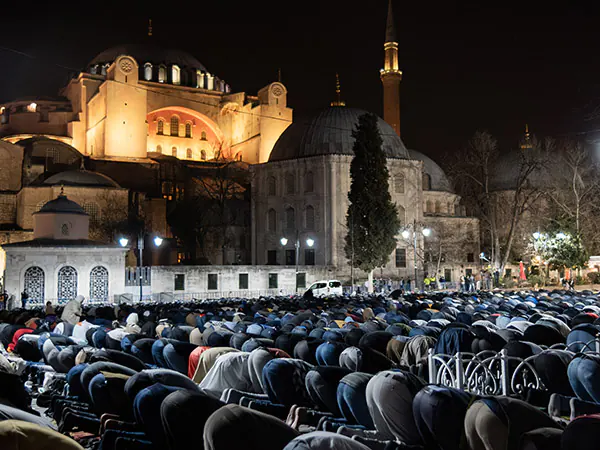
In July 2020, Turkish President Recep Tayyip Erdogan declared his government’s decision to convert Istanbul’s Hagia Sophia from a museum recognizing its Christian heritage into an Islamic mosque. For nearly a thousand years, the Hagia Sophia served as the largest cathedral in mainstream Christendom—the height of Byzantine architecture—and the spiritual center of Eastern Christianity.
In his declaration, however, Erdogan invoked boldly the name of the Ottoman Sultan Mehmed II, whose conquest of Constantinople in 1453 captured the Hagia Sophia (converting it into a mosque), ended the Byzantine Empire, and helped secure the Ottoman Empire’s eventual reign over a region spanning much of Southeastern Europe, West Asia, and North Africa. His brutal legacy of conquest and religious oppression, aimed particularly at Christianity, provided a haven for Jews fleeing oppression and persecution in Europe.
Significantly, after the Ottomans took control of the Islamic holy cities of Mecca and Medina in 1517, they also claimed the Islamic caliphate, a unified federal Islamic government for the Muslim world. Thus, their regime was recognized as a kind of Islamic capital of the world. For the next four centuries, the Ottoman Empire, with its power centered in the former city of Constantinople (renamed Istanbul), projected its influence throughout the civilized world, exploiting its location along trade routes connecting the Middle East, Asia, Africa, and Europe.
Fast forward to 1918. After years of slow decline, the Ottoman Empire, allied with the Central Powers led by Germany, fell to the Allied Powers in World War I. The victors partitioned its vast territories, leaving Istanbul and the territory now known as Turkey to the Ottomans, but under strict European economic control.
In 1923, Mustafa Kemal Atatürk, a former Turkish field marshal and popular WWI general, rose to power and helped found the Republic of Turkey, becoming its first president. Soon after, Atatürk led a nationalist movement to shed Allied/European control. He further cemented Turkey’s status as an independent, secular republic, moved the capital from Istanbul to Ankara, and converted the Hagia Sophia from a mosque to a museum, in part celebrating its Christian heritage. Most significantly, he then helped abolish the Islamic caliphate.
For just over a century, there has not been a widely recognized political caliphate for the Islamic world. However, many observers believe that a movement within Turkey aims to change that. After abolishing the Islamic caliphate in 1924, the Turkish Republic legally instituted a secular government, free from religious interference. However, with the 2014 election of President Erdogan, a slow, steady movement in Ankara has sought to weaken secular rule and reintroduce Islamic principles into Turkish life and politics.
Erdogan, who served as Turkey’s Prime Minister from 2003 until being elected president, has been the de facto leader of the Republic for over twenty years. He co-founded the Justice and Development Party (AKP) in 2001, which he has used as a launching pad to promote Islamic and socially conservative policy, while successfully purging most of the Turkish government and military of all secular influence.
A June article written for greekcitytimes.com quotes Erdogan from
. . . a fiery speech invoking Turkey’s Ottoman heritage and asserting Ankara’s independent and expansionist foreign policy. “Our ancestors, the Ottomans, were in Europe, Asia, Africa, and the Caucasus,” Erdogan declared, adding that Turkey is the successor to that vast empire. . . .
Erdogan praised the Ottoman Empire’s historical reach, stating that its “great tree proudly waved our flag for over 600 years across three continents.” He described the modern Turkish Republic as “the last state we established in these lands,” reinforcing a clear neo-Ottoman narrative.
Interestingly, Turkey’s main opposition leader, Kemal Kilicdaroglu, has expressed similar views, urging Turkey to return to its Ottoman-era geographic influence in the Middle East, the Mediterranean, and among Turkish-speaking nations.
An analysis from thediplomaticaffairs.com describes “Erdogan’s Vision for Turkey”:
Throughout his tenure, Erdogan has displayed a strong nationalist sentiment and a desire to assert Turkey’s influence both regionally and globally. In recent years, he has been promoting a concept known as “New Ottomanism,” which aims to revive the country’s historical legacy and position Turkey as a major player on the world stage.
Even more troubling is how Erdogan’s political philosophy aligns with the terrorist organization known as the Muslim Brotherhood. According to an article from fdd.org, “The Brotherhood’s overarching plan has been to revive the Islamic Umma by restoring a structure resembling the Ottoman Sultanate and reestablishing a unified Muslim polity” (italics ours).
Umma, also spelled ummah, is an Arabic term derived from the root words for “mother” and “nation,” symbolizing the worldwide community of Islamic believers who recognize the Prophet Muhammad as the legitimate messenger of Allah. It is often used to help signify a national identity for all Muslims who share common beliefs.
Since the de facto end of the Global War on Terrorism, Erdogan has openly welcomed members of the Muslim Brotherhood into Turkey while supporting their causes worldwide. An article from watchoutnews.com declares:
Erdogan’s rise to power, intertwined with his identification as a leader of the global Muslim Brotherhood, stirs a nostalgic yearning among some segments of Turkish society for the glory days of the Ottoman Empire. His administration has made bold moves toward re-establishing Turkey’s influence in the Middle East and beyond, often at odds with Western nations and their values.
Especially troubling has been Ankara’s growing hostility toward Israel, a nation once closely aligned with Turkey, prior to Erdogan’s ascendancy. However, the city of Jerusalem has long been considered critical to the Islamic cause, and Erdogan has made clear his intentions to reclaim it for Islam. In a recent speech to the Turkish Parliament, Erdogan proclaimed: “Jerusalem is our city, a city from us.” After publicly describing Israeli President Benjamin Netanyahu “like a relative of Hitler,” he later declared, “Turkey will not give even a single pebble belonging to Jerusalem to Israel.” Additionally, Erdogan has adamantly opposed the Israeli response to Hamas’ horrific and infamous October 7 massacre of Israeli civilians.
At this point, the Hagia Sophia, whose designation has historically served as evidence of political power in the region, returns to the conversation. An article from prophecynewswatch.com, “Turkey’s Ottoman Revival: A Warning for Christians and Jews,” refers to the historic conversion:
But Erdogan did not stop at restoring history. In his own address announcing the conversion, he declared, “The resurrection of Hagia Sophia is the harbinger of the liberation of Masjid al-Aqsa in Jerusalem.” He was explicit that Hagia Sophia was only the first step, and that Jerusalem was the intended destination.
“Masjid al-Aqsa” refers to the entire complex in the Old City of Jerusalem, on the Temple Mount, which includes a sacred Islamic mosque, the iconic Dome of the Rock, and the Western Wall (aka “the Wailing Wall”).
Finally, Erdogan just signed a mutual defense pact with Saudi Arabia and Pakistan, similar in nature to NATO, with historic implications. In an August article, The Daily Wire reported:
Turkey’s mutual defense pact with Saudi Arabia and Pakistan is a step toward the ultimate ambition of Turkish President Recep Tayyip Erdogan: to make Ankara a powerhouse across the entire territory of the old Ottoman Empire.
The agreement gives Turkey access to assets it could not easily replicate on its own: Pakistan’s implicit nuclear deterrent and military capabilities, Saudi Arabia’s vast financial resources and influence across the Arab and Muslim worlds. Egypt has also been floated as a possible new member.
The pact will help counterbalance Iranian regional power, but it will also position Turkey as the military and political leader of a “Sunni ring of fire,” advancing the Turkish president’s vision of a modern Ottoman sphere of influence, according to Chaim Silberstein, the chairman of the Jerusalem Center for Applied Policy.
“All these goals help him to progress and cement his position as the hegemon in the Middle East,” he said, arguing that the agreement helps resolve two significant obstacles to claiming leadership of the Muslim world, including not being a descendant of the Prophet Muhammad or an Arab.
Collectively, Erdogan’s efforts to advance Turkey’s influence in Jerusalem, the greater Middle East, and the former territories of the once-powerful Ottoman Empire are most concerning, with implications that may disturb not only Jerusalem but the entire globe. The past few decades have witnessed a worldwide awakening among Muslims desiring power, deference, and esteem as they seek to position the Quran as the world’s preeminent theological authority and Islam as the only religion practiced anywhere on earth. If their ambitions and efforts remain unchecked, faithful and observant Christians should anticipate times of great trouble that will only be resolved with the glorious return of Jesus Christ.