


Filter by Categories
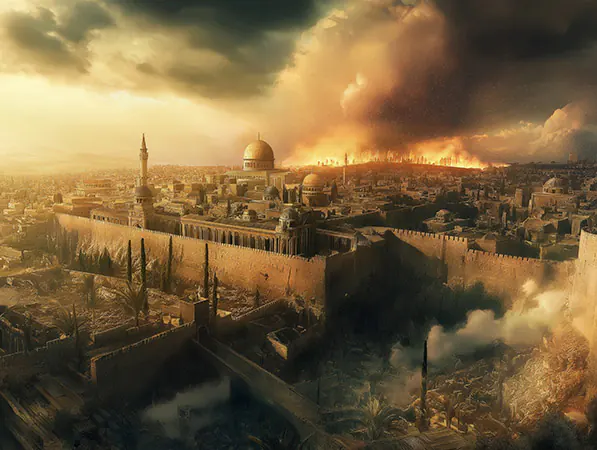
Jerusalem's Fall and Christ's Return
'Prophecy Watch' by Charles WhitakerThe return of Jesus Christ and the associated judgment are central to the prophetic timeline discussed. Christ's coming, often referred to as the "coming of the Son of Man," is linked to the Day of the Lord, a year-long period of great wrath and vengeance on His enemies, occurring as the final year of the time of Jacob's trouble. At the end of this Day of the Lord, Christ returns to rule, His wrath spent, and assumes the throne of David. At this time of His revealing, He will establish Jerusalem as a city of worldwide acclaim, regather scattered Israel, draw all peoples to Himself, and teach the law from Zion. His reward is with Him, and His work is before Him upon His return, marking the beginning of the Millennium, a time of peace distinct from the destruction of the Day of the Lord. In the Olivet Prophecy, Christ speaks of a future destruction of Jerusalem, not the AD 70 event, emphasizing the days of vengeance when all written prophecies will be fulfilled. The imagery of clouds and apocalyptic rhetoric points to the year of the Lord's vengeance, the Day of the Lord, as the true fulfillment of His coming. Additionally, in Matthew 26:64, Christ addresses the Sanhedrin, indicating they will see the Son of Man in a future event after the Day of the Lord, not tied to the fall of Jerusalem in AD 70. The Parable of the Unjust Judge in Luke 18 also connects to this theme of judgment and vengeance, aligning with the Day of the Lord's prophetic fulfillment.
What Does 'One Taken, the Other Left' Mean (Matthew 24:40-41)?
Bible Questions & AnswersChrist describes the Great Tribulation and the end-time events which would lead up to His return. In this respect the end time will be like the days of Noah. People will be living their usual lives, working in the fields, grinding at the mill, and so forth when end-time events fall upon them unexpectedly. This will be a time of such death and destruction that, unless God intervenes in world affairs, no one would survive. At the beginning of Matthew 24, Christ's disciples specifically ask Him for a sign of His return and the end of the age. Verses 40-41 can be taken to mean that at Christ's return a separation will take place between those who attain to the first resurrection and those who do not. However, a secret rapture is nowhere contemplated in either Matthew 24 or Luke 17, as some teach.
What Happens to Those Who Don't Obey the Gospel?
Sermonette by David C. GrabbeMankind has a problem with finality, especially the prospect of eternal death. Those who reject the Gospel are choosing the second death in the Lake of Fire.

Jesus and the Rebellious Son
Sermon by Richard T. RitenbaughThe law for stoning a rebellious son was never recorded as having been carried out, but ironically the nation put to death the maximally obedient Son.
Is It Salvational? (Part Three)
CGG Weekly by David C. GrabbeWhen Jesus returns, many will be prohibited from entering the Kingdom! They think they know Him, yet they are just using Him to make themselves important.
Our Time For War
Sermonette by Austin Del CastilloAs God's resurrected saints and part of the 144,000, we will assist the Captain of our Salvation to bring an end to Satanic world rule forever.

Do You Desire the Day of the Lord?
'Prophecy Watch' by David C. GrabbeAmos describes the Israelites as proud and secure in their special relationship with God, while God castigates them for presuming He approved of them.
Shouting Gleanings and Singing Olives (Part One)
Sermon by Charles Whitaker (1944-2021)Isaiah 24 prophesies that God will preserve a remnant made up of grape gleanings (the His Church) and of olives (national Israelites) who will sing together.
Psalms 90-100
Sermon/Bible Study by Richard T. RitenbaughPsalms 90-100 are prophetic, having a definite time progression, especially referencing the time frame between the Feast of Trumpets to the Last Great Day.
Don't Be Indifferent (2010)
Sermon by John W. Ritenbaugh (1932-2023)Labor-saving technology seems to have had the effect of separating us from each other and making us indifferent to things that should be important to us.

Make Sure of Your Focus!
Sermon by John W. RitenbaughDistractions produce a movement toward randomness and confusion, seriously endangering one's calling. We must sharpen our focus on God and His purpose.

'Unless Those Days Were Shortened . . .'
'Prophecy Watch' by David C. GrabbeIn Jesus' foretelling of the time just before His return, He describes a period of great tribulation unlike any since the beginning of the world, so severe that unless those days were shortened no flesh would be saved, yet they will be shortened for the elect's sake. Parallel prophecies in Jeremiah and Daniel employ similar language of unparalleled trouble and Jacob's trouble, confirming that the coming days will be the worst of times. Although human technological advances such as nuclear weapons, genetically modified pathogens, and artificial intelligence appear to threaten civilization, the biblical record points instead to a different overarching peril. Luke's parallel account of the Olivet Prophecy situates the turmoil in Jerusalem and Judea, where Gentile armies will surround the city, leading to desolation, flight, captivity, and trampling of the holy city until the times of the Gentiles are fulfilled. This passage explicitly identifies the period as the days of vengeance in which all things written will be fulfilled, paralleling the warning that no flesh would survive unless the days were limited. These days of vengeance fulfill long-standing divine warnings rooted in the covenant, particularly the promise in Leviticus to bring a sword that executes the vengeance of the covenant against unfaithful Israel and Judah. Throughout Scripture God has repeatedly sent Gentile nations as instruments of judgment against His people and then judged those nations in turn, a pattern that will culminate when iniquity fills every nation so completely that all flesh would deserve annihilation. Prophecies in Isaiah, Zechariah, and elsewhere depict God gathering the nations against Jerusalem, after which He fights against them, treading the winepress of His wrath. New Testament passages reinforce this sequence: Christ will return from heaven in flaming fire taking vengeance on those who do not know God or obey the gospel, and Revelation repeatedly portrays the outpouring of the wrath of God and of the Lamb through seals, trumpets, and bowls until the kingdoms of the world become the kingdoms of the Lord and of His Christ. Jesus' own synagogue reading of Isaiah 61, stopping short of the day of vengeance, indicates that this aspect of His ministry awaits His second coming. Although such vengeance may appear inconsistent with divine love, it arises from the Creator's desire to halt mankind's destructive rejection of His way and to settle accounts so that the righteous receive comfort while the wicked face everlasting destruction.

Four Warnings (Part Three): I Never Knew You
Sermon by Richard T. RitenbaughChrist's third warning in the Sermon on the Mount is to beware of hypocrisy, professing to do things in Jesus' name but habitually practicing lawlessness.
Will You Be Accounted Worthy for the Kingdom?
Sermon by John O. ReidLike businessmen reviewing plans, making forecasts, and anticipating accountability, God expects us to define and follow through on spiritual objectives.
Many Are Called, But Few Are Chosen (Part Twelve)
Sermon by Martin G. CollinsGoats are aggressive, sneaky and disobedient; they are loners, uncooperative, and stingy. The sheep enter God's Kingdom because they show compassion to others.