


Filter by Categories
The Book of Daniel (Part Three)
Sermon by Martin G. CollinsThe story of Daniel, the Prophet, powerfully demonstrates the strength of God's protective and saving promises amidst trials. Daniel's narrative begins with his interpretation of King Nebuchadnezzar's dream of a statue with a gold head, representing the glorious kingdom of Babylon, followed by lesser but stronger kingdoms of silver, bronze, and iron. Daniel revealed that the gold head symbolized Nebuchadnezzar's reign, but it would be succeeded by other kingdoms until a rock, representing the eternal Kingdom of God, would destroy them all and fill the earth. Nebuchadnezzar, displeased with this prophecy, built a massive gold statue, defying God's plan by asserting that his kingdom would endure forever. In Daniel 2:47, Nebuchadnezzar acknowledged Daniel's God as the God of gods and a revealer of secrets after Daniel interpreted his dream. However, his later actions showed rebellion against God's decree. In Daniel 1:1-8, Daniel purposed in his heart not to defile himself with the king's delicacies or wine, requesting exemption from such practices to remain faithful to God. This foundational conviction shaped his steadfastness in serving in Babylon. Daniel's absence during the incident involving the gold statue and his friends Shadrach, Meshach, and Abed-Nego suggests he may have been assigned elsewhere in the empire at that time. Later, in Daniel 4, Daniel interpreted another of Nebuchadnezzar's visions, this time of a great tree representing the king himself. Daniel explained that due to Nebuchadnezzar's pride, God would cut down the tree, symbolizing a loss of sanity for seven years until the king recognized that the Most High rules in the affairs of men. This prophecy came to pass as Nebuchadnezzar was driven to live like a beast, but eventually, his reason returned, and he praised the Most High for His everlasting dominion. Through these events, Daniel's unwavering faith and role as a prophet underscored God's supreme authority over human kingdoms.
The Book of Daniel (Part Two)
Sermon by Martin G. CollinsDaniel received wisdom, influence, and health from God at the close of his first chapter because of his faithful refusal to defile himself with Babylonian food and culture. These gifts appeared immediately threatened when Nebuchadnezzar's troubling dream led the king to order the execution of all wise men, a decree that included the young Daniel who had not even been consulted. Nevertheless, God sovereignly brought Daniel forward by granting him knowledge of the dream and its interpretation after Daniel sought mercies from the God of heaven together with his three companions. Daniel approached the crisis with remarkable faith, requesting an audience with the king before the revelation came and then directing all credit to the God of heaven who alone reveals secrets. In his prayer he praised God for the attributes of wisdom and power, acknowledging that He changes times and seasons, removes and raises kings, and discloses deep and hidden things. Daniel's humility remained consistent as he told Nebuchadnezzar that the secret had been revealed not because of any superior wisdom in himself but so that the king might understand what would occur in the latter days. The dream itself portrayed four successive world empires whose decline in glory and cohesion demonstrated that human kingdoms weaken over time until the God of heaven establishes an everlasting kingdom through a stone cut out without hands. This revelation confirmed God's control over history, His ability to fulfill His promises despite apparent reversals, and His plan ultimately to crush all earthly powers and fill the earth with His own unshakable rule. Daniel's experience therefore illustrates how the sovereignty of God turns threats into occasions for displaying divine wisdom and power while advancing His purposes for both His servants and the nations.
The Book of Daniel (Part One)
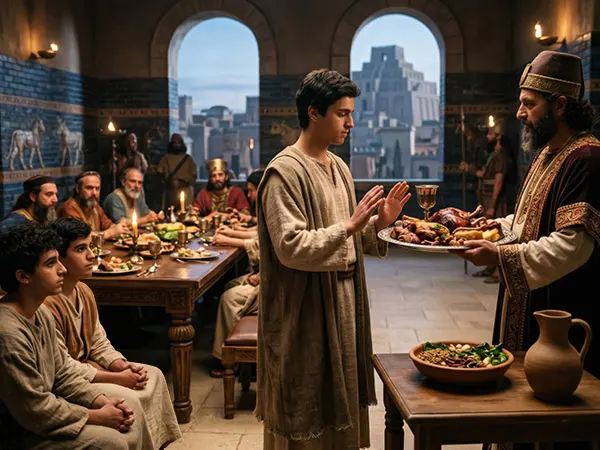
Sermon by Martin G. CollinsDaniel, the prophet, is presented as a godly young man taken into Babylonian exile during Nebuchadnezzar's first invasion of Judah, along with his companions Hananiah, Mishael, and Azariah. Their Hebrew names, each containing a reference to the true God, were changed to names honoring Babylonian deities in an effort to erase their heritage and reshape their identity. Despite this pressure and the surrounding secular culture, Daniel purposed in his heart not to defile himself with the king's delicacies or wine, requesting a simple diet instead. His faithfulness in this small matter led to visible health and superiority in wisdom, resulting in promotion and preservation under successive rulers. The account develops his character through trials that parallel the broader struggle between God's city and the secular city of this world. Daniel refused compromise when his friends faced the fiery furnace, where they declared trust in God's power to deliver yet remained obedient even if deliverance did not come. Later, Daniel himself was delivered from the lions' den. These events illustrate that God's sovereignty governs history, using even the overthrow of His people to display His control and to establish an eternal kingdom. Daniel's example shows that believers can live faithfully in ungodly times without adopting the world's idols or philosophy, excelling in public life while honoring God. This faithfulness connects directly to the book's central message that only those who embody the standards of God's kingdom make any lasting difference, as they trust Him to accomplish His purposes regardless of appearances.
The Book of Daniel (Part Seven)
Sermon by Martin G. CollinsDaniel's role as prophet centers on his intimate yet reverent relationship with God, demonstrated powerfully in his prayer of Daniel 9:4, where he addresses God as "great and awesome," a Hebrew term meaning dreadful and to be feared. This reveals that Daniel understood God not merely as near and involved in human affairs, but also as holy, transcendent, and independent of His creation—His throne secure regardless of earthly upheavals. This balanced view of God, echoed in Jeremiah 23:23-24, contrasts with those who emphasize only God's nearness while neglecting His majesty. Daniel's prayer, offered as the seventy years of Jerusalem's desolation neared completion, sought mercy and understanding about Israel's redemption and the Messiah's arrival. God's answer came through the archangel Gabriel, who imparted skill and understanding to Daniel, illustrating Daniel's emphasis on linking faith with intelligent comprehension rather than blind belief. This resulted in the seventy weeks prophecy (Daniel 9:24-27), a 490-year framework calculated from the decree to rebuild Jerusalem (457 BC) to the Messiah's baptism (27 AD), and ultimately to Christ's crucifixion at the midpoint of the seventieth week. This prophecy outlines six goals—finishing transgression, ending sin, making reconciliation, bringing everlasting righteousness, sealing up vision and prophecy, and anointing the Most Holy—all accomplished through Christ's ministry and sacrifice, with final consummation awaiting His return. Daniel's prophetic experience deepens in chapters 10-12, the longest unit in the book, where his mourning and prayer for Jerusalem's restoration precede an extraordinary vision. Daniel encounters a glorious angelic being, likely Gabriel, whose appearance terrifies his companions though only Daniel sees the vision. This messenger reveals that he was delayed three weeks by "the prince of the kingdom of Persia," a powerful evil spirit, until Michael the archangel intervened. This account exposes Daniel's unique contribution: a glimpse into unseen spiritual warfare surrounding God's people and purposes, paralleled elsewhere in Job, Zechariah, and Revelation 12. Daniel's personal humility and reverence—evident in his fasting, his address of the angel as "my lord," and his need for physical and emotional strengthening—model the proper posture for receiving divine revelation. The angel's repeated encouragement, "fear not, be strong," teaches that God supplies strength precisely when needed. Daniel learns that Michael serves as Israel's guardian prince, just as spiritual Israel today is watched over, reinforcing that individual faithfulness matters within God's sovereign, unfolding timetable. Through Daniel's example, the prophetic material demonstrates that God works through obedient people according to a fixed plan, assuring believers that despite Satan's real but limited power, God's word and Kingdom will ultimately prevail.
The Book of Daniel (Part Four)
Sermon by Martin G. CollinsSin, the real opiate of the people, makes us oblivious to danger, giving us a debased and reprobate mind. It is not static, but leads to destruction.
Prophets and Prophecy (Part Three)
Sermon by John W. RitenbaughJohn the Baptist fulfilled the prophecy of the 'Elijah to come.' We must apply duality of prophecy carefully and cautiously rather than indiscriminately.
The Book of Daniel (Part Eight)
Sermon by Martin G. CollinsSeveral types of the abomination of desolation have occurred in history, including the desecration of the temple by Antiochus Epiphanes and the Roman legions.
Authority and Government
Sermon by John O. ReidToo many feel that they are above the law, but paradoxically, laws proliferate when corruption prevails. We must be subject to all law, God's and man's.

Who Were the Wise Men?
Article by StaffThe wise men or magi have been mysterious figures since their appearance 2,000 years ago. The Bible's consistent revelation provides clues to their identity.
The Sixth Century Axial Period (Part Two)
Sermon by John W. Ritenbaugh (1932-2023)Prophets, even though they may bring new messages, stay consistent with existing Scripture and doctrine as they speak on behalf of God.
Are Your Beliefs Preferences or Convictions?
'Personal' from John W. RitenbaughConviction is vital to Christian living, sanctification, and faithfulness to God. The strength of our convictions will determine whether we compromise.
Two Sides of the Same Coin
Sermonette by Jarod RitenbaughEven though different situations might require various approaches, consistent righteous conduct remains a foundational principle.
Prophecy and the Sixth-Century Axial Period
'Personal' from John W. RitenbaughProphecy has many purposes, but it is never intended to open the future to mere curiosity. Its higher purpose is to give guidance to the heirs of salvation.
Ecclesiastes Resumed (Part Twenty-Nine)
Sermon by John W. Ritenbaugh (1932-2023)We are not privy to God's, but we must realize that He has the prerogative to impose both blessings and calamity, the latter in response to disobedience.
The Day of Israel's Calamity
Sermon by John W. RitenbaughAs a nation, we have rejected wisdom in favor of foolishness, bringing about major calamities: famines, pestilence, earthquakes, cosmic disturbances.
Spiritual Gifts, an Overview
CGG Weekly by Richard T. RitenbaughEach individual in the church has at least one spiritual gift. This fact has confounded many because they look at themselves and see nothing special.
Ecclesiastes Resumed (Part Twenty-Eight)
Sermon by John W. Ritenbaugh (1932-2023)Wisdom does not give us complete understanding into the ultimate purposes of God, but when accompanied with faith in God, it will brighten our countenance.
Faith and the Calendar (Part One)
Sermon by John W. RitenbaughThe issue is not mathematical or astronomical, but instead a matter of trust in God's faithfulness, authority, sovereignty, oversight, or ability to govern.