


Filter by Categories
Should a Christian Go To War? (Part 1)
Sermon by Martin G. CollinsIn the narrative of King Nebuchadnezzar's reign, the steadfast faith of Shadrach, Meshach, and Abed-Nego stands as a powerful testament to obedience to God over human authority. These three Jewish men, confronted by Nebuchadnezzar's command to worship a golden idol, resolute in their adherence to God's spiritual law against idol worship, refused to bow down, knowing full well the dire consequences of defying the king. When brought before Nebuchadnezzar, they boldly declared that their God was able to deliver them from the burning fiery furnace, and even if He did not, they would not serve the king's gods nor worship the image he had set up. Their unwavering faith was put to the ultimate test when the king, enraged by their defiance, ordered the furnace heated seven times hotter than usual and had them bound and thrown into the flames. Yet, miraculously, Shadrach, Meshach, and Abed-Nego emerged unscathed, walking freely in the midst of the fire with a fourth figure, whose appearance was like an angel. Witnessing this, Nebuchadnezzar himself called them out, acknowledging them as servants of the Most High God, and observed that the fire had no power over their bodies, leaving not even the smell of smoke on them. This extraordinary event forced Nebuchadnezzar to recognize the supremacy of God over human governments, though he did not fully yield to obey Him. Shadrach, Meshach, and Abed-Nego exemplified true faith—obedient, loyal, conscientious, dedicated, and truthful to God's Word—standing firm in the face of death, demonstrating that obedience to God must always take precedence, even when it becomes a matter of life and death.
Lessons From Esther: Mordecai Never Grew Weary
Article by Mark SchindlerShadrach, Meshach, and Abed-Nego are introduced alongside Daniel as young Hebrew captives serving under the Babylonians, known also by their original names Hananiah, Mishael, and Azariah. Their courage in facing the fiery furnace, together with Daniel's faith in the lion's den, has made them legendary examples of faith and boldness, regarded as towers of strength empowered by God to act decisively when confronted with mortal danger. Their exploits are held up as remarkable and worthy of imitation, representing faith that had already been firmly developed and was then displayed dramatically in a single tremendous event. These three men serve as a contrast to Mordecai, whose life exemplifies a different kind of faith—one lived day by day in patient faithfulness rather than in one dramatic moment of crisis. While Shadrach, Meshach, and Abed-Nego are remembered for a specific, climactic act of courage under threat of death, Mordecai's faith is shown through a lifetime of quiet, consistent obedience to God amid ordinary duties and slow-building trials. The distinction drawn is that the biblical record shows the three friends' faith in a singular defining incident, whereas Mordecai's character unfolds gradually over years of steady service, disappointment, and eventual vindication. This comparison serves to introduce the deeper focus of the material, which shifts from the well-known bravery of Shadrach, Meshach, and Abed-Nego to the lesser-known but arguably more historically significant faithfulness of Mordecai. The point is made that many believers may relate more readily to Mordecai than to the three friends, because his experience mirrors the daily striving to do right in small, unglamorous circumstances rather than in one moment of heroic testing. The three young men's story is thus used as a familiar reference point—representing bold, instantaneous faith—against which Mordecai's patient, enduring faithfulness is measured and shown to be equally, if not more, essential to God's unfolding purpose, since his day-by-day integrity ultimately played a decisive role in preserving the Jewish nation and, by extension, the messianic line.
Defining Trials
Feast of Tabernacles Sermon by John O. ReidTrials define who we are by placing choices before us, forcing us to have faith in God. Character is built by making right, though difficult, choices.
The Book of Daniel (Part One)
Sermon by Martin G. CollinsIf we look upon the Book of Daniel as a puzzle of prophecies, we miss the more important point that it gives strategies to remain godly in a godless venue.

Who Were the Wise Men?
Article by StaffThe wise men or magi have been mysterious figures since their appearance 2,000 years ago. The Bible's consistent revelation provides clues to their identity.
Confidence
Sermon by James BeaubelleShadrach, Meshach, and Abed-Nego are the three companions of Daniel known as Hananiah, Mishael, and Azariah. These men were captives in Babylon and demonstrated complete and unequivocal confidence in God when tested. King Nebuchadnezzar set up a statue for worship and gathered dignitaries to bow before the image. The three men refused to worship it and faced the threat of the fiery furnace after being accused by the Chaldeans. They defended themselves by pleading guilty and replied to the king with one voice. United together and holding fast in their beliefs, they spoke confidently over the roar of the fire. They affirmed that they serve one God only and that the outcome of the situation was for God to decide. Their conviction showed strong faith and provided an example of the Lord's oversight during trials. Only one of them was mentioned in Hebrews 11 among those who came through trials by great faith.
Who Is Your Adversary?
CGG WeeklyThe saints of God face a tireless, unremitting adversary. Our chief adversary, Satan the Devil, will always be present to challenge us.

Structure and Sovereignty in Daniel 2-7
Sermon/Bible Study by Richard T. RitenbaughDaniel chapters 2-7 form a chiastic (X shaped) structure. Chapters 2 and 7, 3 and 6, and 4 and 5 are paired and mirrored, reinforcing significant themes.
The Book of Daniel (Part Three)
Sermon by Martin G. CollinsWhen the commands of a secular state conflict with God's commands, we face the same dilemma as was faced by Shadrach, Meshach, and Abednego.
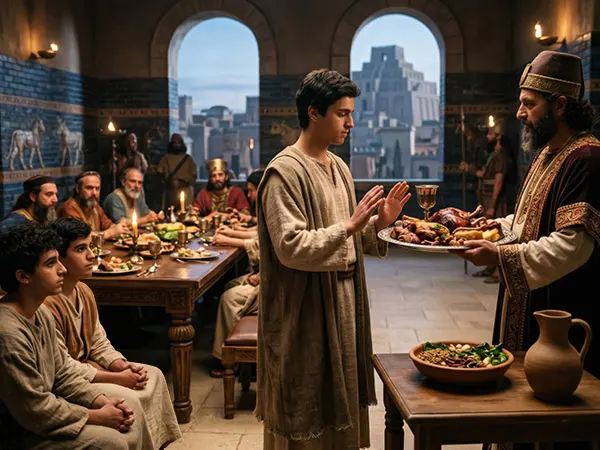
Are Your Beliefs Preferences or Convictions?
'Personal' from John W. RitenbaughConviction is vital to Christian living, sanctification, and faithfulness to God. The strength of our convictions will determine whether we compromise.
Faith to Carry Us to the Millennium
Feast of Tabernacles Sermon by Kim MyersHow do we get the faith we need to endure this present age? Living faith requires that we match hearing with productive works.
Faith to Face the Fire
'Ready Answer' by StaffWe sometimes mistake faith for certainty about God's will. However, faith is not knowing what God will do but trusting Him to do what is best for us.
God Has Faith in You
Feast of Tabernacles Sermon by John O. ReidIt can be encouraging to us that our patriarchs and the prophets had serious doubts, but God overrode all their fears in accomplishing His purpose.
Ecclesiastes Resumed (Part Twenty-Nine)
Sermon by John W. Ritenbaugh (1932-2023)We are not privy to God's, but we must realize that He has the prerogative to impose both blessings and calamity, the latter in response to disobedience.
God and Government
Feast of Tabernacles Sermon by Richard T. RitenbaughGovernment run by carnal men will never work, but those under the New Covenant, having God's law written on their hearts, can make any form of government work.
How Does God View Human Government?
Sermon by Martin G. CollinsAs obnoxious as tyrannical power may seem, we have the obligation to behave lawfully. Even the vilest of leaders has been allowed by God to rule.
Do You See God? (Part Two)
'Personal' from John W. RitenbaughConversion is a lifelong process in which we endeavor to see things as God does. We must understand and act on the fact that God is deeply involved with us.
Examining God's Judgments
Sermon by John W. RitenbaughThe fall holy days picture various judgments by God, bringing about liberty, reconciliation, regathering, and restoration.