


by Robin Fisk
Forerunner,
"Ready Answer,"
March 11, 2026
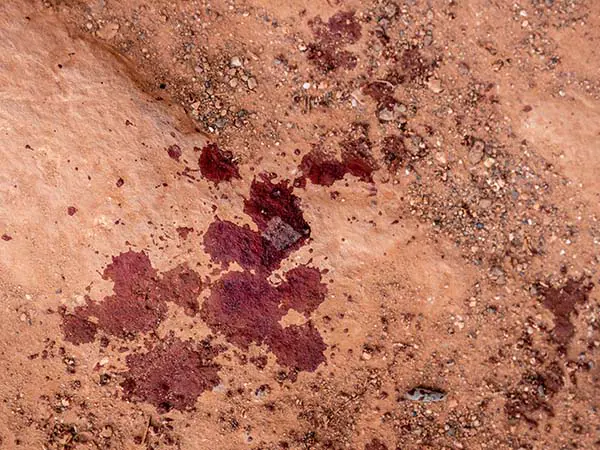
“And being in agony, He prayed more earnestly. Then His sweat became like great drops of blood falling down to the ground.” (Luke 22:44)
One of the great biblical descriptions appears in Luke 22:44, where Luke describes Christ’s agony as He prayed to the Father to remove the cup of His imminent suffering from Him: “And being in agony, He prayed more earnestly. Then His sweat became like great drops of blood falling down to the ground.” The King James Version [KJV] puts the matter slightly differently: “. . . and His sweat was as it were great drops of blood falling to the ground” (emphasis ours throughout).
Much religious debate and lengthy studies have tried to explain how Christ’s sweat literally “became blood” or “bloody.” Most commentators explain what happened that night before His crucifixion as Christ’s sweat “becoming as blood” or “mixed with blood” as being an example of a medical condition by the name of hematidrosis. A study of this topic should leave one with a good degree of skepticism about this rather vague condition.
This diagnosis is introduced to add credibility to the belief that Christ sweated blood. Powerlifters in competition, straining to their absolute maximum, their veins and eyes bulging and faces turning extremely red, to the point they indeed appear they could literally burst a blood vessel, do not sweat blood or even mingle blood with their sweat. People have endured horrendous torture and been scared witless, yet have not sweated blood. It is difficult to consider that a healthy Jesus Christ, who never Himself broke any law of health, would suffer from a very rare malady like hematidrosis.
A Metaphorical Phrase
Much of the confusion on this subject comes from a lack of understanding of the meaning of the English phrase “as it were” (KJV; or in modern usage, “like,” “as,” and “as if,” all of which indicate a comparison or similarity). This phrase is a shortened form of “as if it were.”
The English Language and Usage Stack Exchange explains the meaning of “as it were”: “In English, we often add ‘as it were’ to indicate that a phrase is not to be taken literally.” An example to help illustrate this explanation would be, “During the total eclipse of the sun, the day became dark as if it were night.” The phrase “as if it were” in fact reinforces that while the day may appear like night, it is in fact not night but still day. Use of this phrase dates to at least AD 1200, before the original King James translation.
Luke regularly uses the phrases “as [if] it were”and “as [if] it had been,” which characterize a distinctive style of picturesque speech in his writings, the gospel of Luke and the book of Acts. We will note a few examples found in the book of Acts:
» In Acts 6:15, when Stephen is taken before the Sanhedrin: “And all who sat in the council, looking steadfastly at him, saw his face as the face of an angel.” In the KJV, the final phrase is translated as “saw his face as [if] it had been the face of an angel.” His face was, in fact, not that of an angel but appeared to be so or looked similar to an angel’s face.
» In Acts 9:18, after Christ had blinded Saul on the road to Damascus, his sight is reinstated, “Immediately there fell from his eyes something like scales, and he received his sight at once . . ..” Again, the KJV uses the nonliteral phrase “as it had been”: “And immediately there fell from his eyes as [if] it had been scales: and he received sight forthwith.” Did scales literally fall from Saul’s eyes? His sight was originally taken in Acts 9:8: “. . . and when his eyes were opened he saw no one.” He is described as able to open his eyes, but he saw nothing. There is no mention of God placing scales over his eyes to cause his blindness.
» In Acts 10:11, referring to Peter’s vision before the calling of the Gentiles: “. . . an object like a great sheet bound at the four corners, descending to him and let down to the earth.” The KJV renders it: “. . . a certain vessel descending unto him, as [if] it had been a great sheet knit at the four corners, and let down to the earth.” As this great sheet appears to Peter in a dream, it did not literally come down to earth in this manner. In any case, it appeared to Peter like a huge sheet but was not one in actuality.
In all these examples, “as it had been” indicates that the statements should not be taken literally. After a little research, one will discover that some modern translations demonstrate a lack of understanding when they attempt to substitute more literal renditions.
For example, in referring to Saul’s sight being reinstated, the New American Standard Version reads, “. . . something like scales fell from Saul’s eyes.” However, God did not need scales or any other physical means by which to take away Saul’s sight. If scales did literally fall from his eyes, then the original translation should simply state, “. . . scales fell from his eyes.” Most likely, Paul used this metaphor to help Luke feel what he had experienced when his sight returned.
Following the true meaning of the phrase “as [if] it were” helps shed light on and provide a better understanding of all these passages, in which Luke’s unique picturesque style is portrayed. As the church of God has long taught, “Scripture says what it means and means what it says.” By this principle, we learn to put our total faith and trust in the truth of His Word (John 17:17).
Literary Description
It is perhaps natural, with Luke being a physician and familiar with blood, that he would describe Christ’s sweat—especially in the dark of night—to appear “like great drops of blood” (Luke 22:44). As far as we know, he was also the most educated and literary of the gospel writers. Hence, his narratives tend to be more descriptive than those of Matthew, Mark, or John.
In this case, he is the only gospel writer to mention this particular detail. John says the least, writing only that Jesus and His disciples went into a garden “over the Brook Kidron” (John 18:1). Both Matthew and Mark say that He went to pray and, after doing so, returned to find His disciples sleeping (Matthew 26:39-40; Mark 14:35-37).
Also, none of the three mentions that an angel came to strengthen Him (Luke 22:43), which happened just before His agony became so severe that “His sweat became like great drops of blood.” One would think that John and Peter (likely the chief source of Mark’s account), eyewitnesses to what happened, would have mentioned such miraculous or unusual things, but neither does.
The other gospel writers’ omission of this phenomenon lends credence to the idea that Luke’s description of Christ’s sweat as “like . . . blood” is metaphorical rather than literal. Had Luke wanted to tell his readers that Christ literally sweated blood, could he not have written that plainly as “His sweat became great drops of blood falling down to the ground”? But he wrote that it “became like great drops of blood.”
Another literary device we must consider is foreshadowing: “in literature, providing or suggesting advance indications; representing beforehand developments to come later in the story.” Luke may have used his description of Christ’s agony in the Garden of Gethsemane to point toward what He would literally suffer in the next hours. Christ would indeed pour out His lifeblood to cover the sins of those who would believe in Him.
Not Making Light of His Agony
In denying that Christ literally sweated blood, do we make light of the agony and anguish He undoubtedly suffered that night as He prayed earnestly, beseeching His Father? To the contrary, that entire Passover day, Christ demonstrated incomprehensible courage and determination. He faced arrest, fraudulent trials, beatings, scourgings, and other rough treatment such that “His visage was marred more than any man” (Isaiah 52:14). Then, at His crucifixion, to which He was forced in His weakness to carry a heavy crossbeam at least part way, nails were hammered through His flesh, and He had to hang from them for hours. Finally, He had to endure God forsaking Him as the weight of all human sin was placed upon Him.
Was this not the greater agony He endured? But no gospel writer mentions that He sweated blood during the physical, emotional, and spiritual agony He faced after His arrest.
We may never fully comprehend the extent of the emotional anguish He felt as He prayed to His Father, awaiting what would happen to Him in the coming hours. He was in true agony of mind, borne out by the fact that He did, in fact, sweat profusely, so much that it ran off Him in great drops.
In this episode of fervent prayer, Christ demonstrated the greatest example of human courage. Knowing what would happen, He willingly faced up to it all in a manner no other man could. He repeatedly says, “Nevertheless, not My will, but Yours, be done” (Luke 22:42). He later chides Peter, saying, “Shall I not drink the cup which My Father has given Me?” (John 18:11). He truly earns the title of our Savior and King, our greatest Hero.
Satan has made every effort to deceive humanity into believing his counterfeit version of the true Jesus Christ, relentlessly portraying Him as soft, weak, and effeminate, and not as a man to be greatly admired. To sweat blood in the face of adversity can be seen as more in keeping with Satan’s counterfeit version, a man so feeble that He nearly exsanguinates Himself at the thought of suffering.
The true Jesus Christ came as a human being to pay in our stead the death penalty we all have incurred, knowingly facing the most horrendous of deaths devised by men cut off from God. He did all this, demonstrating the greatest example of human courage like no other man ever could. We owe it to Him to portray Him in the light revealed in the truth of His Word.
By His sacrifice, He truly “washed us from our sins in His own blood” (Revelation 1:5). It is this blood, His shed blood, that we partake of at Passover as an eternal reminder of our Savior’s most loving, incomprehensible sacrifice.