


Filter by Categories
Faith and the Calendar (Part Five): Summary
Sermon by John W. RitenbaughThe Calculated Hebrew Calendar has been a consistent instrument used by the church of God and the Jews, fostering unity in the tracking and use of time. This calendar, essential for worship and service to God, is not fully detailed with precise rules in the Scriptures, indicating that its authority and structure were established in the past under divine oversight. God, as the Sovereign Creator, would not leave something so vital to chance or human whim, ensuring that His children have a reliable means to respond to Him in worship. Historically, there is no record of any era of the church of God rejecting the Calculated Hebrew Calendar in favor of a self-designed alternative. Proposals for new calendars often introduce inconsistencies, such as reliance on visual sightings of the new moon, which are impractical for a worldwide operation and lead to confusion and division. The Bible does not specify detailed rules for determining seasons, new moons, or intercalation, nor does it mandate specific geographical points like Jerusalem for calendar calculations. Such specifics, including postponements or adjustments, are necessary for maintaining a consistent and predictable calendar but are not explicitly provided in Scripture. Postponements in the Hebrew Calendar, often placed around the beginning of Tishri, are calendrical reconciliations made for astronomical and practical reasons, ensuring preparation days before holy days or Sabbaths. These adjustments reflect a merciful intent to facilitate worship without undue burden, aligning with God's desire for feast days to be times of joy rather than privation. Critics of these postponements often overlook their necessity and the lack of biblical specificity, while themselves introducing unscripted elements into their alternative calendars. The defining issue surrounding the calendar is faith in God's faithfulness to provide and preserve an essential tool for His church. To challenge or change the Calculated Hebrew Calendar is to question His providence and oversight, implying a failure on His part to equip His children adequately for worship across centuries. God, in His unchanging nature, has ensured that the calendar serves as a unifying force, and any deviation from it risks spiritual ineffectiveness and disunity within the church.
The Cancerous Calendar Controversy
Article by John W. RitenbaughThe controversy over which calendar should be used to set God's holy days remains a persistent issue within the church, sparking strong opinions and disagreements. Many publications advocate for a return to what they call God's calendar or the biblical calendar, asserting that the Hebrew calendar is not biblical. Key points of contention include determining the beginning of the year, identifying when a new moon is new, the use of postponements, intercalation, and the debate between observation and calculation. Some also object to the names of the months on the Hebrew calendar, claiming they indicate it is not of God. A calendar, as defined by standard dictionaries, is a system for fixing the beginning, length, and divisions of the civil year, arranging days, weeks, and months in a definite order. However, no such tabular register or clear table for setting holy days exists in the Scriptures. The closest approximation is the list of holy days in Leviticus 23, which serves as a schedule of events arranged chronologically, yet lacks an underlying system for precise placement. Critics of the Hebrew calendar often attack its postponements and calculated method, arguing that the Bible does not mention postponements and that the calendar should be set by observation. Observation involves setting the new year and months based on visual cues like the green ears of barley and sightings of the new moon, while the calculated method of the Hebrew calendar uses astronomical and mathematical computations based on average speeds of heavenly bodies. Although observation is inferred in the Bible and historically documented in ancient Israel, it is subject to variables like weather, which can disrupt planning for holy days. The fixed Hebrew calendar, using average speeds, incorporates postponements as adjustments to harmonize with the irregular movements of heavenly bodies, enabling consistent planning and preparation for God's holy days across diverse regions. The postponements are not about human comfort but are necessary adjustments to keep festivals, the moon, the sun, and seasons in harmony over extended periods. They also reflect a respect for Sabbath observance by ensuring preparation days fall appropriately, preventing holy days from interfering with each other. The Hebrew calendar, despite not being perfect, works remarkably well, maintaining unity in observance and proving its value through consistent use over centuries among God's people.
A Calendar Summary
Feast of Tabernacles Sermon by John W. RitenbaughDarryl Henson is using the calendar as a focal point to draw attention to himself and gain a following, claiming a conscience issue with it. He asserts that he and I will be reunited in the future to do the work of Joshua and Zerubbabel together, implying that I will repent and adopt his calendar. However, his calendar is just as wrong as the other eight or nine models circulating within the church of God. The issue of the calendar is far more serious than many realize. People are making critical decisions that may affect their salvation based on minimal research, often becoming victims of cleverly arranged treatises. There is a glut of information available, much of which is unreliable, and individuals must be cautious and patient in discerning the truth. Those advocating for calendar change often argue that the calculated Hebrew calendar is too complex and must be simple for common people to grasp. They also claim that the Jews deliberately manipulated the calendar with postponements to make festival timing more convenient, avoiding conflicts with preparation days or the weekly Sabbath. However, nowhere in the Bible does God indicate that the calendar must be simple. The creations of God, including His Word, are complex, and the calendar fits into this pattern of complexity, requiring understanding through yielding to Him. The calculated Hebrew calendar is the calendar of the nation of Israel, in existence since Israel's beginnings. God's purpose is worked out through Israel, and the church is seen as a part of Israel, an institution within it. The faithful God supplies all the needs of His people, including a calendar to keep the holy days and the weekly Sabbath, as evidenced from the time of Exodus when Israel already had a calendar distinct from Egypt's solar calendar. Historical evidence shows that the church, from the time of Herbert Armstrong, has consistently used the Hebrew calendar, even through various challenges and researches. No record exists of the church using any other calendar throughout its history. Despite minor adjustments, such as the correction of Pentecost counting, the underlying calendar system remained unchanged. Major spin-off groups from the Worldwide Church of God have independently decided to remain with the calculated Hebrew calendar, demonstrating a pattern of God's guidance in this matter. The calendar changers suggest that during the Tribulation, access to a calendar may be impossible, questioning how festivals can be kept. Yet, the Bible indicates that conditions during the Tribulation will be so severe that even keeping the weekly Sabbath may not be possible, underscoring that the issue is not simplicity but adherence to the correct calendar provided by God. The notion that the Jews have deceived God regarding the calendar for over 1600 years, only to be corrected now by these changers, is presumptuous. If multiple differing calendars exist within the church of God, it raises the question of whether God is divided or unfaithful in not providing one unified calendar. The issue is God's faithfulness, as these changers accuse Him of neglecting His church until their arrival. Evidence from the Talmud about some Jews not using postponements at the time of Christ is acknowledged, but the Talmud is a commentary, not the Bible, and contains conflicting opinions. Authority over the calendar resided with the Jerusalem rabbis, not the Babylonian rabbis who made such statements. Hillel II, of the Jerusalem school, published the rules used by the Jews and the church of God. In ancient Israel, the beginning of a new month was declared by the bet din in Jerusalem through signal fires to maintain unity and prevent individuals from deciding for themselves, a principle now undermined by multiple calendars in the church due to people doing what is right in their own eyes. The spirit of changing festival dates aligns with the spirit of the Beast, who seeks to change times, as noted in Protestant commentaries
Faith and the Calendar (Part One)
Sermon by John W. RitenbaughThe Hebrew calendar, as a critical element in observing holy days, has been a subject of significant discussion and study. Herbert Armstrong, baptized in 1927, initially followed the calculated Hebrew calendar while fellowshipping with the Church of God, Seventh Day, keeping Passover on the 14th day of Nisan and Pentecost on Sivan 6 until he corrected the Pentecost counting method without altering the calendar itself. In 1939-1940, a controversy arose when an elder published a different date for the year's start, prompting Armstrong to investigate and conclude that there is no calendar explicitly defined in the Bible, and thus no biblical authority for determining dates like the first day of the first month from the new moon nearest the spring equinox. Armstrong's research, supported by the Eugene church and other brethren, led to the consensus that God preserved the sacred calendar through the Jews, as stated in the 1940 Good News Letter and reiterated by Herman Hoeh in 1981. This preservation was affirmed despite reliance on secular sources by others, which Armstrong deemed unreliable. He emphasized that the oracles of God, including the calendar, were committed to the Jews, a responsibility upheld regardless of their faithfulness, as God's sovereignty ensures His will prevails. The complexity of the Hebrew calendar arises from its basis on both solar and lunar cycles, which do not align with full days, requiring intricate rules to synchronize the calendar with heavenly bodies. The solar year is approximately 365¼ days, necessitating adjustments like leap years, while the lunar month averages about 29.5 days, further complicating alignment. Armstrong recognized that the Bible lacks sufficient rules to establish a calendar independently, reinforcing the belief that God entrusted this task to the Jews. Later, with academic support from figures like Kenneth Hermann, trained in mathematics and astronomy, it was confirmed that the calendar issue is not merely mathematical or astronomical but fundamentally a matter of faith in God's authority. Hermann highlighted the numerous variables in timekeeping—such as when to begin a day, week, month, or year—and the lack of revelation outside of divine authority, leading to potential chaos without a unified standard. He argued that without God's assigned authority, every individual might devise their own calendar, undermining unity. Historically, the fixed Hebrew calendar, as known today, was reinstituted by Hillel II in AD 358-359 under Roman pressure, ending visual observation of new moons. This calendar has been consistently used by the true church for observing holy days like Passover, often aligning with Jewish dates. The responsibility for maintaining the calendar lies with the Levites, historically part of Judah, who proclaim the dates of holy convocations annually, a practice rooted in biblical commands to ensure the correct timing of God's feasts. The names of months on the Hebrew calendar, such as Nisan instead of Abib, reflect influences from Babylonian captivity, likely introduced by figures like Daniel and others in governmental roles, illustrating how the calendar adapted linguistically while retaining its structure. Ultimately, the Hebrew calendar is seen as a necessary attachment to the Old Testament for observing holy days, preserved by God's oversight through the Jews, specifically Judah and the Levites, as a testament to His faithfulness and authority over His creation.
Faith, Government, and the Calendar (Part Four)
Sermon by John W. RitenbaughGod has spoken very little in Scripture regarding rules for the calendar, leaving no distinct instructions on whether months should begin at the dark conjunction, the first faint crescent, or a full moon. As a result, individuals create calendars from personal assumptions and varying interpretations of vague generalities, producing multiple differing systems whose fruit is division and every man doing what is right in his own eyes. Such an approach fails to reflect the unity of the Spirit and cannot constitute worship that returns to God what He has given, since it originates in human judgment rather than His explicit word. God has instead supplied the calculated Hebrew Calendar through the centuries and is pleased when it is used in His worship. Bible dictionaries confirm that no complete calendar appears in Scripture, and the arrangement of the heavens renders perfect reconciliation of days, months, and years insoluble, thereby testing submission to God by faith. The oracles, including preservation of this calendar, were committed to Judah, which has remained faithful in this responsibility and continues to employ the calculated Hebrew Calendar as its national calendar alongside the Gregorian for external affairs. Changing the calendar constitutes a challenge to God's sovereignty and is linked in prophecy to the man of sin who intends to alter times and law. Believers therefore have no authority to alter what God has provided through Judah; they must submit to the calculated Hebrew Calendar as part of obeying His voice and recognizing His oversight of human government.
Faith and the Calendar (Part Two)
Sermon by John W. RitenbaughThe Hebrew calendar is not in Scripture as a set of rules; what Scripture gives is the assignment of responsibility for it. The oracles of God were committed to the Jews, most specifically the Levites, and the calendar is included in them because the holy days cannot be kept without it. The church, as part of the commonwealth of Israel (Ephesians 2), is subject to that assignment, just as believers are subject to civil authorities (Romans 13) and as Christ submitted to governmental authority and refused to intrude into responsibilities assigned to others. The critical issue is therefore not mathematical calculations, postponements, or suspicions about the Jews, but faith in God's sovereignty, His faithfulness, and His oversight of those He has assigned. The calculated Hebrew calendar was passed on through Herbert Armstrong, the apostle and father in the faith, who was commanded to guard what he received (I Timothy 6:20-21). It has been used by the church for at least 1600 years, and probably much longer by the Jews. To say it is defective is to claim that God has led His people into sin by failing to correct it, which contradicts His consistency (Malachi 3:6; Romans 11:29). Abraham's test with Isaac shows that the defect lies in human feelings, not in God's arrangements. Uzziah's presumption in the temple shows the danger of overstepping what God has assigned. Those who tried to change the calendar have not prospered, while its use has brought unity, so wisdom is justified by its fruit. Changes in what was received are what scattered the church, and the counsel is to return to the old paths and hold fast.
The New Moons
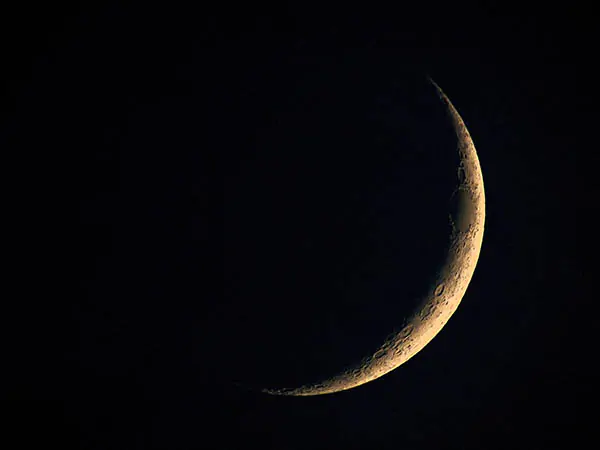
'Personal' from John W. RitenbaughThe Hebrew calendar is built on the new moons, which keep Israel aware of the passage of time and on target for the festivals of Leviticus 23. Though the festivals fall on the same dates each year (except Pentecost), those dates land on different days of the week, so the days must be calculated from a new moon. Passover falls fourteen days after the new moon of Abib (Nisan), which begins the sacred year. The Feast of Trumpets falls on the new moon of Tishri, the seventh month, and Atonement, Tabernacles and the Last Great Day follow ten, fifteen and twenty-two days later. Tishri and the fall festivals arrive six new moons after Abib. Abib then returns five or six new moons later, depending on whether it is a leap year, bringing the spring festivals again. God set the new moons apart by adding special sacrifices (Numbers 28:11-15), though He nowhere commands that they be kept as holy days, except for Trumpets. Because the festivals are still to be kept and their dating depends on the new moons, the new moons remain a useful tool, like the preparation day before the weekly Sabbath. At the very least, their coming and going should be carefully marked, and any custom built around them is a human custom, not God's command.
The Biblical New Year
CGG Weekly by Richard T. RitenbaughGod established the Hebrew calendar's starting point in Exodus 12:2: "This month shall be your beginning of months; it shall be the first month of the year to you." Because Passover and the Feast of Unleavened Bread are appointed times kept annually, Israel needed a calendar with a beginning. The first month is Abib (Exodus 13:4), from the Hebrew '&257;bîb, meaning young, tender, or green ear of barley, so it coincides with the start of spring. Nisan, a Chaldean name borrowed during the Babylonian exile, appears only in texts written after the return. Early on, Israel likely reckoned the month by watching the new moon against the barley crop: if the grain would reach the green ear stage by the next new moon, that moon began Abib; if not, the month was postponed by one. Later, the Levites, who oversaw the calendar, calculated new moons precisely from centuries of astronomical data, verified them by sighting, and the high priest sanctified the new moon for determining the holy days. Phrases in Ezekiel 40:1, Exodus 23:16, Exodus 34:22, and II Samuel 11:1 are sometimes taken to show a second, civil year beginning on Tishri 1 in autumn. Each can be answered. Ezekiel used the Babylonian spring-New-Year system, so the "head of the year" is Abib. The Feast of Tabernacles falls at the end of the agricultural year, not a calendar year. Springtime is simply when the year returns. Israel's New Year is Abib 1, grounded in God's clear statement, which also shows January 1 to be wholly erroneous.
The Lunar Sabbath or the Seventh-Day Sabbath: Which?
'Ready Answer' by Charles WhitakerThe recent Lunar Sabbath phenomenon is unbiblical and unworkable. The weekly Sabbath, observed every seventh day, is correct and in line with God's Word.
What Does God Really Want? (Part 1)
Sermon by John W. RitenbaughThe priorities in Matthew 6:33 indicates that the primary emphasis should be on repentance and overcoming rather than mastering a technicality.
John 7:37 Examined (Part Two)
Feast of Tabernacles Sermon by John W. Ritenbaugh (1932-2023)All of the events in John 8-10 occurred on the Eighth Day. Christ was crucified in 31 AD, and the postponement rules of the Hebrew calendar are accurate.
Faith, Hope, and the Worship of God (Part Three)
Sermon by John W. RitenbaughUsing assumptions, some have concocted some nine conflicting calendars. The preservation of the oracles has not been entrusted to the church but to the Jews.
Entrusted with Godly Holiness
Feast of Tabernacles Sermon by Mark SchindlerHoliness moves beyond godliness, demanding that we apply energy to living as God lives, seeking a relationship with God and conforming to His expectations.
Appointments
Sermon by Clyde FinkleaGod established the weekly Sabbath on the seventh day of Creation; He established His Holy Days (moedim) on the fourth day. These are His appointments.
The Year of Release
Sermonette by John W. Ritenbaugh (1932-2023)The land Sabbath is a type of the weekly Sabbath, wherein the land is given time to regenerate, and all debts (and grudges) are forgiven and slaves set free.

When Is the Year of Release (Shemitah)?
Sermon by David C. GrabbeThe anchor point of both the Shemitah and Jubilee is the Day of Atonement. Deuteronomy should be read at the Feast just after the year of release begins.
Pentecost and Time
Sermon by Richard T. RitenbaughBecause of our 'time-bound' state, unless we sync with God's timetable, we are squandering our God-given time to become members of His family.