


Filter by Categories

Holy Days: The Eighth Day
Bible Study by Richard T. RitenbaughThe Eighth Day, observed immediately following the Feast of Tabernacles, holds profound significance as the seventh and final festival of the year. It represents a time beyond the Millennium, a period of immense salvation when most of mankind—rich and poor, young and old, free and slave, men and women—will be resurrected with the opportunity to inherit eternal life. Billions will qualify to enter the God Family, while those who refuse to repent and submit to God's way will face the Lake of Fire and the second eternal death. This festival, occurring on the twenty-second day of Tishri, is intimately connected to the Feast of Tabernacles yet carries a distinct meaning. The number eight, tied to a Hebrew root word meaning fatness, implies abundance, fertility, and surplus, even touching on themes of rebirth, resurrection, and regeneration. As a sacred assembly, or atzeret, the Eighth Day signifies a closing and retaining of the holy day observances, urging worshippers to hold fast to the instructions received. The Eighth Day foreshadows the Great White Throne Judgment, a time when God will resurrect the vast majority of humanity to mortal life, offering them the chance to accept salvation. This period follows the conditions of the Millennium, continuing themes of God's government, peace, and prosperity. During this time, a second, massive resurrection will occur, raising to physical life all those from 6,000 years of human history who never had the opportunity for salvation. Both Israel and uncalled Gentiles will receive equal opportunities to satisfy God's judgment and potentially gain eternal life with spiritual bodies. Those who persist in rebellion will face the Lake of Fire, a merciful and permanent end. God will judge those in this second resurrection by the same standard as true Christians today, granting them time to learn, obey, and overcome. Following this judgment, God will create a new heaven and a new earth, a pure world where death, sorrow, crying, and pain will cease forever. Those who have accepted God's way will be glorified as members of the God Family, living eternally to create, beautify, and extend God's rule across the universe.
The Eighth Day (2019)
Sermonette by David C. GrabbeThe Eighth Day, though scarcely described directly in Scripture, reveals its meaning through patterns woven throughout God's Word. Leviticus 23 and Numbers 29 provide the only direct instructions, and even these show that the day is distinct from the seven preceding it: rejoicing and dwelling in booths are commanded only for seven days, and the sacrifices are dramatically reduced, from many bulls, rams, and lambs down to just one bull, one ram, and seven lambs. This scaling back signals a shift in focus from the Feast itself to something beyond it. The Hebrew word for eight carries the sense of abundance, overabundance, and complete satisfaction. Mathematically, eight is seven plus one, so it represents the perfection of seven with something added—superabundance. As the first day of a new week, eight also signifies new beginnings, regeneration, and renewal accompanied by abundance. This pattern of seven days followed by a distinct eighth day recurs throughout the Law. Circumcision, the sign of Abraham's covenant, occurs on the eighth day, marking a new beginning of covenant life. Firstborn animals remain with their mothers seven days before being given to God on the eighth. Lepers undergo seven days of cleansing before the eighth day brings offerings and restoration to society with regenerated flesh. Nazirites who touched a dead body were cleansed for seven days before dedicating themselves anew to God on the eighth. Most significantly, the priests were consecrated for seven days, confined to the Tabernacle, before God's glory appeared on the eighth day, consuming the offering and prompting the people's shouts of joy and worship. That same day, however, also brought judgment when Nadab and Abihu offered profane fire and were executed, teaching that God must be regarded as holy. These patterns illuminate the Feast of Tabernacles' Eighth Day. Like the priests eating before the Lord in His temporary dwelling, God's people eat before Him in their own temporary dwellings for seven days. The Eighth Day echoes God's appearance and acceptance after consecration—rejoicing arises naturally if the seven days have been spiritually fruitful, even without direct command. The reduced sacrifices suggest God's true portion is His people themselves, dedicated to Him as firstborn animals were. On this day, worshippers return to their homes spiritually renewed and empowered for service. This same seven-plus-one pattern extends to seven millennia followed by an eighth, marking judgment on Gog and Magog and Satan, alongside resurrection and God tabernacling with renewed humanity in ultimate abundance. A further connection concerns Christ's birth on the Feast's first day, making His eighth day of life—and thus His circumcision—coincide with the Eighth Day, symbolizing His entrance into Abraham's covenant in the flesh. Finally, the priestly blessing given in Leviticus 9 and recorded in Numbers 6—invoking the LORD's face, grace, and peace—is the same blessing pronounced over God's people on their Eighth Day, marking it as a day of blessing, dedication, and God placing His name upon His people.
Lessons From the Eighth Day
Sermonette by David C. GrabbeThe number eight carries deep significance rooted in its Hebrew meaning, derived from a root indicating abundance, overabundance, and complete satisfaction. Biblically, eight represents the number seven—symbolizing perfection—plus something additional, pointing to a state beyond mere completeness. Since the eighth day is also the first day of a new week, it inherently signifies new beginnings, regeneration, and renewal accompanied by great abundance. This pattern of seven days followed by a distinct eighth day recurs throughout Scripture in matters of holiness, consecration, and dedication to God. Circumcision, first commanded in Genesis 17:12, occurs on the eighth day, marking a new life under God's covenant with Abraham—a regeneration following seven days of being set apart. Similarly, the law concerning firstborn oxen and sheep in Exodus 22:30 required the animal to remain with its mother seven days before being given to God on the eighth, showing that the eighth day can represent God receiving His rightful portion. The cleansing of a leper in Leviticus 14 followed the same structure: seven days of separation and preparation, followed by an eighth day of restored fellowship and a new lease on life. The Nazirite vow in Numbers 6 likewise shows seven days of cleansing followed by an eighth-day offering marking a new beginning of dedication to God. The clearest parallel to the Feast of Tabernacles and its Eighth Day is found in the consecration of the priesthood in Leviticus 8-9. For seven days, the priests remained in the tabernacle, eating before the Lord, much as worshippers dwell in temporary booths during the seven days of Tabernacles. On the eighth day, the congregation assembled, offerings were made, and God's glory appeared, consuming the sacrifice and prompting the people's joyful worship. This eighth day was the true goal of the seven days of consecration—God's acceptance and appearance among His people. These patterns illuminate the meaning of the Eighth Day following Tabernacles. Just as the priests' consecration culminated in God's appearing and receiving His portion, the Eighth Day represents the true purpose behind the seven days of tabernacling with God. The rejoicing, dwelling in booths, and abundant sacrifices particular to the seven days are notably absent or reduced on the Eighth Day, signaling a shift in focus toward solemn reflection rather than continued celebration. This is reinforced by the Hebrew term Atzeret, meaning a sacred or solemn assembly, which conveys ideas of stopping, restraining, and retaining—urging worshippers to hold on to what has been learned during the preceding days. Extending this symbolic principle to a prophetic scale, seven thousand years of human history—corresponding to God's work of preparation, culminating in the millennial reign of Christ—are followed by an eighth millennium representing ultimate fulfillment. This future age, described in Revelation 21, will bring new heavens and a new earth, the end of death and sorrow, and full realization of God's dwelling with mankind. As with the priests' consecration, the eighth day signifies the completion of God's purpose: complete abundance, renewal, and satisfaction as mankind, made perfect and dedicated wholly to Him, becomes God's true portion.
The Eighth Day
Sermonette by James BeaubelleThe seventh Millennium will be a time of rest, when the suffering we experience today will be gone, enabling preparation for the Great White Throne Judgment.
Abraham (Part Eight)
Sermon/Bible Study by John W. RitenbaughThe number eight carries a veiled spiritual overtone tied directly to circumcision. God commanded that every male child among Abraham's descendants be circumcised when eight days old. This timing points to the seven days in which God created or refashioned the earth, marking the period of the physical and the carnal, the day of the first Adam, and the present world order. The eighth day therefore signals a new beginning and a new creation accomplished in Christ Jesus, the second Adam. Physical circumcision performed on that day thus serves as an outward sign of the inward circumcision of the heart that produces a new person. This spiritual circumcision leads to acceptance into the Family of God and to fellowship with the saints, confirming that the true sons of Abraham are those who undergo the circumcision made without hands rather than relying on the rite alone.
An Abundant Spiritual Offering
Sermonette by David C. GrabbeThe number eight signifies a new start with abundance abundance following a period of time (a week, seven years, or a millennium) of preparatory activity.
The Sacred Assemblies (Part One)
CGG Weekly by David C. GrabbeA couple of holy days ending week-long feasts are called 'sacred assemblies.' They warrant extra gravity, emphasizing retaining what was learned in them.
Kings and Priests
Sermonette by James BeaubelleThe Eighth Day is a dramatic, pivotal moment in God's divine plan of salvation, symbolizing new beginnings and the final phase of God's redemptive work.

Standing on the Sea of Glass
Feast of Tabernacles Sermon by Martin G. CollinsSolomon's temple contained eight classes of furniture in contrast to the seven listed for the tabernacle, the added item being the bronze sea. This eighth element carries symbolic weight into the discussion of the Sea of Glass before God's throne. The number eight derives from a Hebrew root meaning to superabound, denoting one who abounds in strength, superabundant fertility, and a numeral greater than seven, which signifies spiritual completeness. Eight therefore represents what is superabundant or satiating and marks a new beginning, since it initiates a fresh seven-year cycle. The eighth day of the Feast of Tabernacles is accordingly distinguished from the seventh as exceeding the perfection already attained. The bronze sea, cast as a large basin holding over seventeen thousand gallons and resting on twelve oxen, replaced the single laver of the tabernacle and multiplied the provision for washing, thereby illustrating the greater abundance associated with eight. This same abundance and newness of order connect directly to the Sea of Glass, which likewise embodies calm, purity, and the superabundant peace that replaces the chaos represented by the earthly sea.
Choosing the New Man (Part Two)
Article by Charles WhitakerEight signifies new beginnings because seven represents perfection and seven plus one restarts the cycle. The ritual of circumcision, performed on males according to God's law, takes place on the eighth day after birth. This timing conveys the message that the boy becomes a new man through the act. The eighth day of the week is Sunday, the actual start of a new week. The Last Great Day falls eight days after the Feast of Tabernacles begins and points forward to the time when God will make all things new. Paul connects this symbolism to the new man by noting that physical circumcision on the eighth day does not produce the renewal he describes. Instead, the new man arises through circumcision of the heart in the spirit, which renews the mind and enables walking in God's statutes. This spiritual renewal aligns with the New Covenant promise of a new heart and a new spirit that produces obedience.
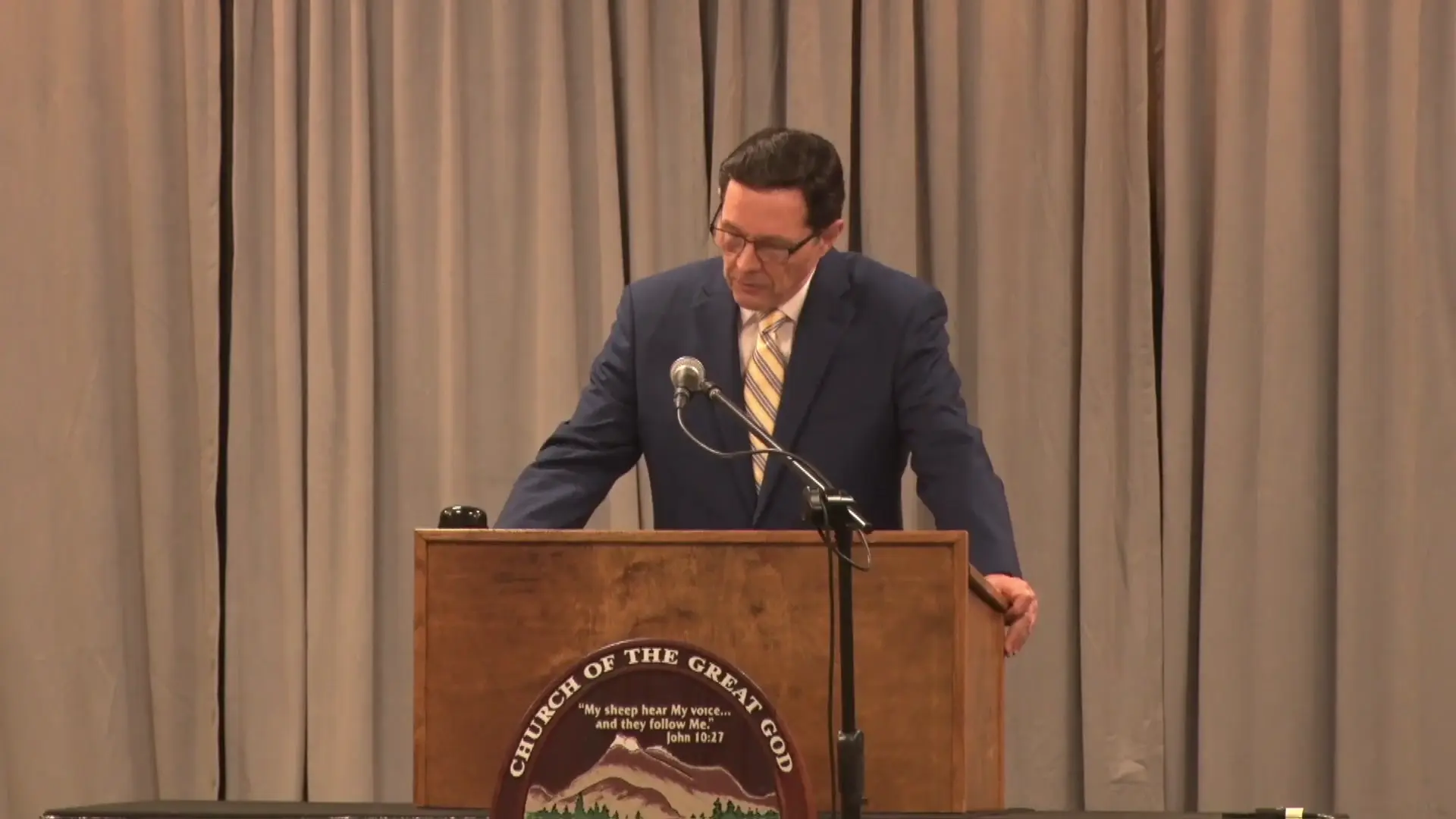
The Incomparable Great God!
Feast of Tabernacles Sermon by Martin G. CollinsGod exists in a transcendent category entirely His own, defined by four non-transmittable attributes—omnipotence, omnipresence, omniscience, and immutability—that collectively establish His absolute sovereignty over all creation. As Almighty God, He possesses the unrestricted power to execute His perfect nature; as Omnipresent Spirit, He permeates every corner of the universe while dwelling personally within believers; as Omniscient, He comprehends all actual and possible realities without diminishing human free will; and as Immutable, He remains constant in character and purpose, ensuring that His promises never waver despite shifting relational dynamics with humanity. These divine qualities are intrinsically linked to the Eighth Day festival and the final judgment, demonstrating that only such a God could orchestrate the resurrection of the uncalled and the eventual establishment of a new heaven and earth free from sorrow and death, thereby providing a secure foundation for complete trust in His ultimate redemption.