


by David C. Grabbe
Forerunner,
October 14, 2026
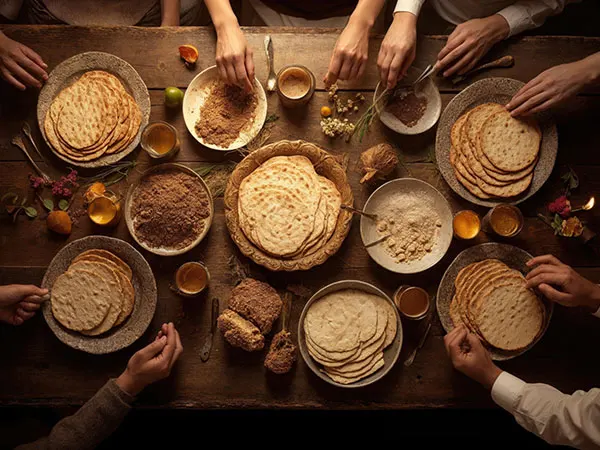
As the end of Part Three noted, Jesus taught that the Passover has not yet been completely fulfilled: “. . . for I say to you, I will no longer eat of it [the Passover] until it is fulfilled in the kingdom of God” (Luke 22:16; c.f. Matthew 26:29; emphasis ours throughout). Our Savior’s statement places the fulfillment at a time well beyond His crucifixion. His words may startle us, but if we accept them, they will help us understand more fully that evening’s Passover observance.
One critical point is that Jesus’ words further distinguish the Passover observance at the beginning of Abib 14 from the sin offering. He has already completely fulfilled the sin offering, for all time, as we commemorate on the Day of Atonement (see Hebrews 1:3; 7:27; 9:12-14, 26-28; 10:12, 18), yet He declares that the Passover has not yet been fulfilled.
A second point emerges when we combine Jesus’ pronouncement with what Paul wrote in I Corinthians 5:7: “For indeed Christ, our Passover, was sacrificed for us.” At first glance, this may seem to contradict what Jesus said about Passover’s future fulfillment. However, Jesus’ words show that Passover commemorates, not solely a past event, but also something ongoing, as we will see.
Complete Redemption
A major theme of the Exodus Passover is redemption (Exodus 6:6; 13:13, 15; 15:13; Deuteronomy 7:8; 9:26; 13:5; 15:15; 24:18; II Samuel 7:23; etc.). God redeemed the Israelites from the hand of Pharaoh and the house of bondage, buying back His firstborn nation while slaying the Egyptian firstborn. As shown in Part Two, even before leaving Egypt, God instructed the Israelites to use a lamb to redeem their firstborn sons, and He tied this to the perpetual meaning of Passover (Exodus 13:13-16; see Exodus 34:19-20).
The New Testament Passover follows this pattern, for Scripture shows redemption as something that began with Christ’s sacrifice but will not be complete until we have “put on incorruption” (I Corinthians 15:53-54) in His Kingdom. Thus, one redemption occurs when we accept Christ’s atoning sacrifice as our sin offering (Romans 3:23-25; Ephesians 1:7; Colossians 1:14). Redemption and atonement overlap in that specific instance.
However, Scripture also foretells a future redemption of those who are in Christ, one that takes place at Christ’s return when God resurrects (or changes) the faithful:
» “And there will be signs in the sun, in the moon, and in the stars; and on the earth distress of nations, with perplexity, the sea and the waves roaring; men’s hearts failing them from fear and the expectation of those things which are coming on the earth, for the powers of the heavens will be shaken. . . . Now when these things begin to happen, look up and lift up your heads, because your redemption draws near.” (Luke 21:25-26, 28)
» “Not only that, but we also who have the firstfruits of the Spirit, even we ourselves groan within ourselves, eagerly waiting for the adoption, the redemption of our body. For we were saved in this hope, but hope that is seen is not hope; for why does one still hope for what he sees? But if we hope for what we do not see, we eagerly wait for it with perseverance.” (Romans 8:23-25)
» “In Him you also trusted, after you heard the word of truth, the gospel of your salvation; in whom also, having believed, you were sealed with the Holy Spirit of promise, who is the guarantee of our inheritance until the redemption of the purchased possession, to the praise of His glory.” (Ephesians 1:13-14)
» “And do not grieve the Holy Spirit of God, by whom you were sealed for the day of redemption.” (Ephesians 4:30)
The Passover recalls past events, but it also carries great meaning for us now as we anticipate the Kingdom when Jesus will complete the redemption of His people. It teaches what Christ’s sacrifice means for us now in terms of our relationship with God and what that relationship is moving toward. In other words, Passover commemorates what past events have set in motion.
Consider that God could legally justify us by paying for our past sins, yet we would still not be worthy of the gift of immortality. Without a complete replacement of our fundamental nature, we would immediately begin defiling God’s Kingdom upon inheriting it. Thus, Paul states that
. . . flesh and blood cannot [become partakers of eternal salvation and] inherit or share in the kingdom of God; nor does the perishable (that which is decaying) inherit or share in the imperishable (the immortal). (I Corinthians 15:50, Amplified Bible)
God’s plan of salvation is to redeem mankind, not just from the death penalty, but also from a sinful nature (see Titus 2:11-14). God must redeem us from this flesh—“this body of death,” as Paul calls it in Romans 7:24—so we can fully manifest the image and likeness of our Creator and inherit His Kingdom. Thus, our final redemption occurs when we have fully taken on our Creator’s incorruptible nature, allowing unhindered fellowship because our minds will be just like His. At that point, the Passover will be fulfilled.
Christ’s Body
Like the Exodus Passover, Christ’s Passover before He was betrayed focused on eating (Matthew 26:17; Mark 14:12, 14; Luke 22:8, 11, 15-16; John 13:2), which separates it from the sin offering, as shown in Part Three. However, the New Testament scriptures emphasize the bread and wine more than the Passover’s other food. The bread and wine are not new symbols, though; they are the original elements of the fellowship meal between Melchizedek and Abraham (Genesis 14:18) on the eve of the historic covenant God made with Abraham (Genesis 15). In like manner, the Passover in AD 31 was a fellowship meal on the eve of the sealing of another much-anticipated covenant.
In the order of events of the New Testament Passover, the bread is shared first, followed by the wine (Matthew 26:26-27; Mark 14:22-23; Luke 22:19-20; I Corinthians 11:23-25). Matthew records, “And as they were eating, Jesus took bread, blessed and broke it, and gave it to the disciples and said, ‘Take, eat; this is My body’” (Matthew 26:26). Paul later expounds on the bread and body symbolism: “. . . The bread which we break, is it not the communion of the body of Christ? For we, though many, are one bread and one body; for we all partake of that one bread” (I Corinthians 10:16-17).
This series has highlighted several biblical symbols that have more than one facet, such as the symbols of lambs, blood, and sacrificial death, each one of which is used in multiple ways. Similarly, Jesus Christ’s body is another complex symbol. We must grasp how Scripture uses it to understand what we partake of during the Passover.
Because Jesus’ death was foreordained “from the foundation of the world” (Revelation 13:8), so was His physical, fleshly life. Psalm 40:6-8, quoted in Hebrews 10:5, foretells Jesus’ incarnation: “Therefore, when He came into the world, He said: ‘Sacrifice and offering You did not desire, but a body You have prepared for Me.’” As John 1:14 records, “And the Word became flesh and dwelt among us.” Because God made mankind of flesh and blood, Jesus “likewise partook of the same things” (Hebrews 2:14, English Standard Version). God’s plan required the Creator to partake of the same physical life and substance He had created. As it has been said, He became like us so that we can become like Him.
Because flesh is not immortal, death is always an aspect of human life, and Christ’s physical life was no different. At times, Scripture focuses on the death aspect of His fleshly body, such as in Colossians 1:21-22 and Ephesians 2:14-16, where Paul speaks of Christ’s dead body being the means of reconciliation. He bore our sins in His crucified body (I Peter 2:24). Ultimately, He partook of flesh and blood so
that through death He might destroy him who had the power of death, that is, the devil, and release those who through fear of death were all their lifetime subject to bondage. (Hebrews 2:14-15).
Imagery of Life
However, this is not the only sense in which Christ’s body and flesh are used. Scripture also uses Christ’s body and flesh as symbols of life. Paul writes to the Ephesians that “we are members of His body, of His flesh and of His bones” (Ephesians 5:30)—imagery of life rather than death. As the Body of Christ, the church is very much alive. The larger context is the church’s relationship with Christ—a relationship with a Being full of life.
While it is true that the church comprises those who were buried with Christ in baptism, we do not remain in the watery grave. We are raised to newness of life as we become members of His body. As we partake of Christ, we become one with the living Savior; He manifests His life in our mortal flesh (II Corinthians 4:11). His perfect life as a human becomes our pattern. Just as He was raised to eternal life, so will we be raised to immortality through His living in us (Galatians 2:20).
The unleavened bread that we eat on Passover represents Christ’s body. In Scripture, the symbolic usage of bread always pictures life rather than death. When it uses bread as a symbol for Christ’s body, it is consistently—even overwhelmingly—a symbol of life, even eternal life.
To understand the symbolism of the bread, we must recognize its general biblical significance. In ancient Eastern cultures, bread was a critical dietary staple. It was a primary food source, and other types of food functioned like accessories to it. Starting in the Garden of Eden, “bread” stands for food in general (Genesis 3:19). Because it is an umbrella term, when a verse mentions “bread,” it may include other things like fruit and meat. Bread was such a centerpiece of the diet that the word became synonymous with the word “food.”
In the East, including Egypt and Canaan, bread took on a sacred quality because almost all of life depended on the wheat and barley harvests. The grain harvest depended on the right amount of rain at the right time, and since rain was in the province of the divine, the people of the East considered bread to be a heavenly gift. Thus, the “breaking of bread” was a symbol of fellowship and friendship, but also of sharing the providence from above.
Because of the centrality of bread in the diet, and because mankind must eat to live, bread became a symbol for the substance of life. Psalm 104:15 reads that “bread . . . strengthens man’s heart,” and Genesis 18:5 and Judges 19:5 assert that bread refreshes the heart.
Understanding this, when God promises to lead Israel to “a land in which you will eat bread without scarcity” (Deuteronomy 8:9), He is promising to provide all they need to sustain life, even to have an abundant physical life. When David writes in Psalm 37:25, “I have not seen the righteous forsaken, nor his descendants begging bread,” he is referring to their entire sustenance. When God promises to take away bread because of disobedience (Leviticus 26:26; Isaiah 3:1; Jeremiah 5:17; Lamentations 1:11; Ezekiel 4:16-17), He signifies absolute desolation and famine. Because of what bread meant, its removal by God was a threat to Israel’s very existence.
Bread That Satisfies
God tells us in numerous places and ways that even though bread is necessary to sustain life, it cannot truly satisfy. Deuteronomy 8:3 is the well-known verse in which God tells Israel that His working with them in the wilderness, including the continual provision of manna, was to teach them that “man shall not live by bread alone; but man lives by every word that proceeds from the mouth of the LORD.” Jesus quotes this teaching when Satan tempts Him with something good and necessary for life but far less important than spiritual truth (Matthew 4:3-4).
Isaiah 55:1-7 teaches the same principle. In verse 2, God chides His people, asking, “Why do you spend money for what is not bread . . .?” The verse continues with a parallelism: “. . . and your wages for what does not satisfy?” This “bread” is not made from wheat or barley. One cannot purchase from a store, nor make from scratch, the bread that truly and eternally satisfies. Instead, the chapter speaks about seeking God, calling upon Him, and returning to Him in repentance. Here, the true bread comes from God, sustains life, and satisfies in a way physical bread cannot. As in other instances, the “bread” in Isaiah 55 is also tied to a covenant (verse 3).
Just as everyone must eat physically to survive, so also each person has an inner hunger, a sense that life should be about more than just eating and drinking. Those without the life-giving bread have a void longing to be filled. How people deal with that vacuum varies. Many people try to hide from it, distracting themselves to avoid facing the gnawing emptiness inside them. They attempt to cram different things into that emptiness to pretend it does not exist. They seek various activities, philosophies, and pursuits to mollify the emptiness inside, trying to fill that hole with metaphorical “bread” that does not truly satisfy and cannot sustain life as God meant us to live it.
However, nothing physical—no matter how thrilling, stimulating, distracting, or even wholesome—can ever fill the void or satisfy spiritual hunger. Yet the natural man sets his mind on the bread that seems like it will satisfy because it is exciting in the moment. The natural mind registers it as more exhilarating than what the Savior holds out: the bread that truly has the power to sustain and satisfy.
Those called by God know what our priority should be, yet our lives show what we actually value most. Can we truthfully proclaim with the psalmist, “O God, You are my God; early will I seek You; my soul thirsts for You; my flesh longs for You in a dry and thirsty land where there is no water” (Psalm 63:1)? If we are honest with ourselves, we will acknowledge that we often long for material things, experiences, circumstances, entertainments, achievements, and status more than we do for spiritual bread. If so, it is because we do not fully trust that the bread of life can satisfy and sustain us.
Christ’s Living Body
Therefore, Jesus declares:
Do not labor for the food which perishes, but for the food which endures to everlasting life, which the Son of Man will give you, because God the Father has set His seal on Him. . . . For the bread of God is He who comes down from heaven and gives life to the world. . . . And Jesus said to them, “I am the bread of life. He who comes to Me shall never hunger, and he who believes in Me shall never thirst. . . . Most assuredly, I say to you, he who believes in Me has everlasting life. I am the bread of life. Your fathers ate the manna in the wilderness, and are dead. This is the bread which comes down from heaven, that one may eat of it and not die. I am the living bread which came down from heaven. If anyone eats of this bread, he will live forever; and the bread that I shall give is My flesh, which I shall give for the life of the world.” (John 6:27, 33, 35, 47-51)
In these verses, Jesus speaks of bread that endures to everlasting life, the bread of God, the bread of life, and the living bread. Make note of this crucial point: When Jesus uses bread to represent His flesh or body—as He does here, as well as in the Passover observance—it is unambiguously a symbol of life. Verse 51, where Jesus says He is the “living bread,” shows that His flesh is not merely something that leads to eternal life, but within this metaphor, His flesh is living. The picture is of living bread, indicating living flesh and thus a living body. Therefore, the symbol of bread representing Christ pictures His living body, not His dead one.
As Isaiah 55 teaches, physical bread is inconsequential compared to the bread that sustains a person to the resurrection and eternal life. Jesus spoke about this shortly after feeding 5,000 men with food that briefly filled a need but did not satisfy them. He draws attention to the crowd’s seeking Him to satisfy a physical desire, even though He was offering something spiritual.
At the end of verse 51, He defines the bread that He gives as His flesh, which He would “give for the life of the world.” Because we so often hear about Jesus giving Himself for the sins of mankind, we commonly read this verse similarly—that He would give His flesh in exchange for the lives of all men. However, the sense of the verse—indeed, the whole passage—speaks to His giving His abundant, spiritual, eternal life rather than merely the payment for sin. He is not saying here that He would give His flesh as payment, but that He was living His physical life so that the world could likewise experience life as He lived it.
Saved by His Sinless Life
Another quality about Christ’s life adds to this picture. The basis of the bread of life’s ability to provide true satisfaction and eventual immortality is its absolute purity and sinlessness. The bread of life symbolizes the sinless life Jesus lived and offers to His followers. His sinless flesh grants us access to the spiritual Holy of Holies. We are cleansed by His blood, and we can then approach the Father because He accepts us based on Christ’s sinlessness. Hebrews 10:19-20 makes this clear:
Therefore, brethren, having boldness to enter the Holiest by the blood of Jesus, by a new and living way which He consecrated for us, through the veil, that is, His flesh . . ..
When we symbolically partake of Christ’s flesh, we are taking in and being joined to His sinless life, not a dead body. Before we can take the Passover, we must be baptized into His death, but we are saved by His life (Romans 5:10). Eating the bread symbolizes the living Savior abiding in us, and our abiding in the living Savior.
Jesus lived sinlessly, and we are accepted into God’s presence because of Christ’s sinless flesh. Our acceptance is based on His sinless life, for only a body undefiled by sin has blood worthy to pay the death penalty for us. But He had to live a flawless life for that sacrifice to be effective.
At Passover, we symbolically join ourselves to that perfect life. We eat living bread to continue our connection to Jesus Christ and others who are also eating of the living bread. While Jesus’ death was necessary to pay for sin, eternal life—which the bread represents—comes from knowing the Father and Him (John 17:3). Eating the bread is about the ongoing relationship, not the payment for sin.
John 6:57 in J.B. Phillips’ translation reads, “The man who eats [M]y body and drinks [M]y blood shares [M]y life and I share his.” The life He gives us not only sustains us through the grave but also imparts the true well-being and fulfillment that this world cannot give. The Passover commemorates the abundant, eternal life God has graciously made available to us, which will culminate when the Passover is fulfilled in the Kingdom.
He Lives in Us
Having our sins forgiven does not, by itself, give us eternal life. Justification means Christ has paid the death penalty for us, and we are now in alignment with God’s law. But something else must happen for us to have a satisfying life that will be sustained beyond the grave. Such is the “bread” Jesus spoke of. A major reason He came in human flesh was to give eternal life after He wipes the slate clean.
As we ingest Him—symbolically at Passover, and in reality through consuming and applying His Word, thus supporting His indwelling (see John 14:23)—He lives His life in us. If we remain faithful to this feeding process, He sustains us throughout this life, and He will give us everlasting life in the resurrection. As Romans 5:10 teaches, we are reconciled to God through Christ’s death, but “much more, having been reconciled, we shall be saved by His life.” Eternal life comes through the living Savior abiding in us, and thus the bread of Passover is a symbol of divine and dynamic life.
I Corinthians 11:26 says that at Passover we proclaim Christ’s death, and certainly, aspects of the Passover do picture death, such as the wine representing shed blood. Likewise, a lamb had to die to become the Passover meal, just as the peace offering requires the death of an animal to provide an occasion for harmonious fellowship. But the bread symbolizes life. It is the life He gave—by living in sinless, devoted service—so the world can have life. It is this life that He offered to the disciples at that momentous Passover. He is now living in our flesh as He abides in us.
The next article will continue to examine the New Covenant Passover, focusing on the symbol of the wine.