


by David C. Grabbe
Forerunner,
June 24, 2026
Part One highlighted the critical need to dig deep into Scripture and “rightly [divide] the word of truth” (II Timothy 2:15), particularly regarding the meanings of the annual feast days. Even as God provided multiple views of the life of Jesus Christ in the four gospels, so also Christ’s death holds multiple facets. His sacrifice accomplished much more than simply paying the penalty for sin. While it is common to think of Passover as a sin offering, largely because Jesus was crucified on Passover day (and His death is the means of our propitiation), a careful study shows that much more is involved in the evening Passover observance.
The instructions for the first named Passover observance provide a foundation for understanding this festival:
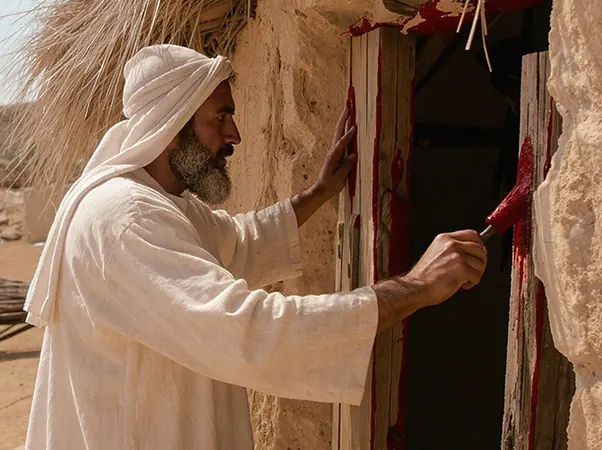
Speak to all the congregation of Israel, saying: “On the tenth of this month every man shall take for himself a lamb, according to the house of his father, a lamb for a household. And if the household is too small for the lamb, let him and his neighbor next to his house take it according to the number of the persons; according to each man’s need you shall make your count for the lamb. . . . And they shall take some of the blood and put it on the two doorposts and on the lintel of the houses where they eat it. Then they shall eat the flesh on that night; roasted in fire, with unleavened bread and with bitter herbs they shall eat it. Do not eat it raw, nor boiled at all with water, but roasted in fire—its head with its legs and its entrails. You shall let none of it remain until morning, and what remains of it until morning you shall burn with fire. And thus you shall eat it: with a belt on your waist, your sandals on your feet, and your staff in your hand. So you shall eat it in haste. It is the LORD’S Passover. For I will pass through the land of Egypt on that night, and will strike all the firstborn in the land of Egypt, both man and beast; and against all the gods of Egypt I will execute judgment: I am the LORD. Now the blood shall be a sign for you on the houses where you are. And when I see the blood, I will pass over you; and the plague shall not be on you to destroy you when I strike the land of Egypt.” (Exodus 12:3-4, 7-13)
Notice that the lamb was much more than just a blood sacrifice; it was a meal. God begins with instructions to ensure that every person would have enough meat, and that it would not be wasted. He continues with details about this unique meal, specifying when it should be eaten, how it should be prepared, what should be eaten with it, what should be done with the remains, and even how the Israelites should be dressed.
Exodus 12:11 encapsulates the meal instructions with the statement, “It is the LORD’S Passover.” The bulk of God’s instructions concern the specially prepared lamb they were to eat. The repeated emphasis in both Old and New Testament Scripture is on the eating of the Passover meal (Exodus 12:43, 48; 34:25; Numbers 9:11; II Chronicles 30:18; Ezra 6:21; Matthew 26:17, 26; Mark 14:12, 14, 22; Luke 22:8, 11, 15, 19; John 13:2; I Corinthians 11:23-26; see John 6:31-58). This stress on eating begins to set it apart from a sin offering (as a future article will show).
The Blood Is a Sign
Verse 13 explains that “the blood shall be a sign for you on the houses where you are” (emphasis ours throughout). Later, when Moses relates God’s instructions, he adds:
For the LORD will pass through to strike the Egyptians; and when He sees the blood on the lintel and on the two doorposts, the LORD will pass over the door and not allow the destroyer to come into your houses to strike you (Exodus 12:23).
The blood of the lamb was the all-important sign for the Israelites, but a sign of what? It is easy to conclude that the blood is a sign of atoned sins. However, just as Christ’s life and death had multiple facets, and just as lambs were used in a wide variety of ways within the sacrificial system, so also blood is used as a symbol in more than one way. Not all blood was for atonement, just as not every lamb was a sin offering.
In Genesis 9:4, God commands that “you shall not eat flesh with its life, that is, its blood.” God reiterates this principle of blood containing life in later instructions:
» For the life of the flesh is in the blood, and I have given it to you upon the altar to make atonement for your souls; for it is the blood that makes atonement for the soul. (Leviticus 17:11)
» . . . for it is the life of all flesh. Its blood sustains its life. Therefore I said to the children of Israel, “You shall not eat the blood of any flesh, for the life of all flesh is its blood. Whoever eats it shall be cut off.” (Leviticus 17:14)
» Only be sure that you do not eat the blood, for the blood is the life; you may not eat the life with the meat. (Deuteronomy 12:23; see also I Samuel 19:5; Psalm 72:14; 94:21; Ezekiel 3:18; 33:5.)
Blood is symbolic of—even synonymous with—life itself (see Psalm 30:9). This correspondence is why blood is used in some circumstances to represent the forgiveness of sins: It can symbolize a life-debt being paid, either directly or through a substitutionary sacrifice. Yet the fundamental symbol of blood is to represent life, and sometimes—though not always—the symbolism indicates life given to pay for sins.
In addition, blood is also used to symbolize the sealing of a covenant. In this usage, rather than life being given as a payment, the blood represents life being given (in whole or in part) as a pledge of faithfulness. (This will be discussed more in subsequent articles.)
Finally, I John 5:7-8 shows that blood can also be a testimony or witness.
Redeemed from Pharaoh
Which of these usages best fits the blood on the doorposts? The least likely is that it was a sign of sins being cleansed, for within the context of any Old Testament Passover, there is a conspicuous and noteworthy absence of any mention of forgiveness or atonement. (The first sin offering in Scripture is not mentioned until Exodus 29:14, when Aaron and his sons were consecrated.)
Instead, the Scriptures speak frequently of the Exodus Passover in terms of purchase or redemption. However, Israel is nowhere said to be redeemed from sin through the Passover, but only purchased from Pharaoh (Exodus 6:6; 15:13, 16; Deuteronomy 7:7-8; 9:26-29; 13:5; 15:15; 21:8; 24:18; II Samuel 7:23-24; Psalm 74:2; 77:15; 78:42-43; Isaiah 43:3; 51:10; Micah 6:4).
To understand the Exodus Passover—particularly the blood on the doorposts—we must remember Israel’s condition at the time. God redeemed the Israelites from Pharaoh because he had a legal claim on them. Egypt and all it contained belonged to Pharaoh, and the Israelites sojourned there as resident aliens. It was not their land, and they were subject to Egypt’s power.
Joseph was a great ruler of Egypt, but even he was still subject to Pharaoh (Genesis 41:40). Under Joseph’s pragmatic management, Pharaoh became the sole owner of all land, seed, and people (Genesis 47:13-25). Though the household of Jacob enjoyed a favorable position while Joseph was alive, after Joseph’s death,
there arose a new king over Egypt, who did not know Joseph. And he said to his people, “Look, the people of the children of Israel are more and mightier than we; come, let us deal shrewdly with them, lest they multiply, and it happen, in the event of war, that they also join our enemies and fight against us, and so go up out of the land.” Therefore they set taskmasters over them to afflict them with their burdens. (Exodus 1:8-11)
Israel’s gradual subjugation by the Egyptians may have been because of idolatry (Ezekiel 20:5-10; 23:2-4). In the course of time, God heard the groaning of the children of Israel and remembered His covenant with Abraham (Exodus 2:23-24). At the burning bush, God told Moses that He had seen the oppression of His people and intended to deliver them and bring them to the land of promise (Exodus 3:7-10).
The very first message God had for Pharaoh is critical to understanding the shed blood of Passover: “Israel is My son, My firstborn. So I say to you, let My son go that he may serve Me. But if you refuse to let him go, indeed I will kill your son, your firstborn” (Exodus 4:22-23). Moses later warns Israel that
all the firstborn in the land of Egypt shall die, from the firstborn of Pharaoh who sits on his throne, even to the firstborn of the female servant who is behind the handmill, and all the firstborn of the animals (Exodus 11:5).
Though the Israelites are not directly mentioned, they would fall under the scope of “all the firstborn in the land of Egypt.” The threat against them was real, and they had to demonstrate their desire to be separate from the Egyptians through the sign of the blood. Shortly after this pronouncement are the main Passover instructions, including the part where God says, “Now the blood shall be a sign for you on the houses where you are. And when I see the blood, I will pass over you . . .” (Exodus 12:13). Without the blood, the Israelite firstborn would have shared in the same judgment as the Egyptian firstborn. But with the blood, there was life.
This history teaches that the Exodus Passover was about the redemption of Israel as God’s firstborn nation, including the redemption of the firstborn in each family (which were later replaced by the Levites as God’s portion; see Numbers 3:11-13; 8:16-18). Even before they left Egypt, God instructed Israel that they were to use a lamb to redeem both unclean animals and sons, which He tied to the perpetual meaning of Passover (Exodus 13:13-16; see Exodus 34:19-20).
No Payment for Sins
While redemption and atonement can overlap in the specific instance of a man being redeemed from the death penalty, not every redemption was also an atonement. The consistent explanation of the Israelites’ redemption was that God was buying them back from Pharaoh, not paying for their sins. Therefore, the blood on the doorposts represents the life of the lamb given to redeem those within each participating house, not to symbolize forgiveness. The mention of hyssop points to ceremonial cleansing before eating the Passover, as God explains later (Numbers 9:6-13; see also II Chronicles 30:17-20). But the Exodus Passover does not show Israel’s sins being taken away.
God does not draw attention to the Israelites’ sins in His Passover instructions, even though the Israelites were sinning—grievously, in fact. Ezekiel 20:5-9 shows that many of the Israelites in Egypt were unabashed idolaters, and God nearly destroyed them, then and there:
Say to them, “Thus says the Lord GOD: ‘On the day when I chose Israel and raised My hand in an oath to the descendants of the house of Jacob, and made Myself known to them in the land of Egypt, I raised My hand in an oath to them, saying, “I am the LORD your God.” On that day I raised My hand in an oath to them, to bring them out of the land of Egypt into a land that I had searched out for them, “flowing with milk and honey,” the glory of all lands [See Exodus 3:13-17; 4:29-31]. Then I said to them, “Each of you, throw away the abominations which are before his eyes, and do not defile yourselves with the idols of Egypt. I am the LORD your God.” But they rebelled against Me and would not obey Me. They did not all cast away the abominations which were before their eyes, nor did they forsake the idols of Egypt. Then I said, “I will pour out My fury on them and fulfill My anger against them in the midst of the land of Egypt.” But I acted for My name’s sake, that it should not be profaned before the Gentiles among whom they were, in whose sight I had made Myself known to them, to bring them out of the land of Egypt.’”
This passage brings up more questions. Why would God determine to destroy one nation of idolaters (Egypt) and deliver another nation of idolaters (Israel)? God’s displeasure here is obvious, and He gives no hint that He was providing atonement through the blood of the Passover. Rather, the Hebrew word for Passover, pecach (Strong's #6453), means—according to Strong’s—“a pretermission; i.e., exemption.” A pretermission is an omission; to pretermit means “to let pass without mention or notice.” “Pretermission” is hardly used today, but it is akin to “mercy” or “grace.” When Israel was in Egypt, God passed over them without mentioning or drawing attention to their idolatry or other sins. Moses explains this in Exodus 12:27:
It is the Passover [pecach—exemption] sacrifice of the LORD, who passed [pacach—skip over; spare] over the houses of the children of Israel in Egypt when He struck the Egyptians and delivered our households.
However, this exemption—this sparing; this act of mercy rather than justice—is not the same as providing atonement or removing their sins. God overlooked their sins in Egypt rather than providing atonement, even in type. The Passover is a demonstration of God’s gracious acceptance rather than legal justification.
God Remembered His Covenant
God had every right—as well as a significant inclination—to slay Israel rather than deliver her, yet He stayed His hand “for [His] name’s sake,” as Ezekiel 20:9 reads. The mention of God’s name helps us to grasp what happened. Put simply, God allowed the Israelites to continue to exist because of His covenant with Abraham. If He had not promised Abraham concerning his descendants, He would have been under no obligation to spare them. But for the sake of His name—because of His faithfulness to their father, Abraham—God devastated one nation in judgment while protecting and delivering a nation involved in many of the same abominations.
In Romans 9:15-18, Paul refers to God’s mercy toward Israel during the Exodus events:
For He says to Moses, “I will have mercy on whomever I will have mercy, and I will have compassion on whomever I will have compassion.” So then it is not of him who wills, nor of him who runs, but of God who shows mercy. For the Scripture says to the Pharaoh, “For this very purpose I have raised you up, that I may show My power in you, and that My name may be declared in all the earth.” Therefore He has mercy on whom He wills, and whom He wills He hardens.
Though He was clearly merciful toward the Israelites (Numbers 14:19), He makes no mention of atonement or forgiveness in the context of this Passover. He only references His covenant with Abraham, part of which includes His deliverance of Abraham’s descendants. God promised the patriarch that he would become a great nation (Genesis 12:2) and that He would “curse him who curses you” (verse 3). We see this fulfilled in the Exodus story: The Egyptians cruelly oppressed the nation God produced through Abraham, and God intervened because of His covenant, cursing the Egyptians through a series of plagues. Notice:
Now it happened in the process of time that the king of Egypt died. Then the children of Israel groaned because of the bondage, and they cried out; and their cry came up to God because of the bondage. So God heard their groaning, and God remembered His covenant with Abraham, with Isaac, and with Jacob. And God looked upon the children of Israel, and God acknowledged them. (Exodus 2:23-25)
God also foretells this in Genesis 15:13-14, 16, promising Abraham that his descendants
will be strangers in a land that is not theirs, and will serve them, and they will afflict them four hundred years. And also the nation whom they serve I will judge; afterward they shall come out with great possessions. . . . But in the fourth generation they shall return here, for the iniquity of the Amorites is not yet complete.
God had decreed in advance not only the judgment on Egypt, but also that Abraham’s descendants would “come out with great possessions.” This promise includes an implicit assurance of his heirs’ continued existence. God makes no mention of the spiritual state of Abraham’s offspring because His promises here were not dependent on their righteousness or legal standing. The promises were based simply on God’s grace in overlooking for the sake of what He was working out. Moreover, He had also promised a specific land to Abraham’s descendants (Genesis 12:7; 13:15; 15:7, 16, 18-21; 17:8).
It was because of God’s covenant with Abraham that God chose to pass over Israel when He was disposed to blot her out. The covenant was a significant motivating factor for God to act with grace toward Israel (Exodus 6:4-6).
Redemption of God’s Firstborn
God’s faithfulness to deliver Abraham’s descendants also aligns with Moses’ explanation of the Passover meal:
And it shall be, when your children say to you, ‘What do you mean by this service?’ that you shall say, ‘It is the Passover sacrifice of the LORD, who passed over the houses of the children of Israel in Egypt when He struck the Egyptians and delivered our households.’” So the people bowed their heads and worshiped. (Exodus 12:26-27)
God “passed over” and redeemed one nation while judging the afflicting nation, and He did this because of His faithfulness to what He had said centuries earlier.
We may infer a symbolic cleansing in the following week, when the Israelites were baptized in the Red Sea (I Corinthians 10:2). Later still, God added a sacrificial law “because of transgressions” (Galatians 3:19; see Jeremiah 7:22-23), which would serve as a “reminder of sins” (Hebrews 10:3). A major aspect of that law was the ceremony on the Day of Atonement involving two goats, which was for the express purpose of providing atonement (Leviticus 16:30, 34).
But while God’s mercy is evident in temporarily overlooking the sins of Israel, the blood on the doorposts was a sign of their redemption from Pharaoh and deliverance from his affliction, not of atonement. The blood on the doorposts was a sign of God’s promised protection, not absolution, of the nation through which He would fulfill His promises to Abraham. It was a sign of God’s pledge to redeem His firstborn from their bondage to Pharaoh, based on His covenant with Abraham.
The next article will show that the instructions for the Passover sacrifice are at irreconcilable odds with God’s instructions for a sin offering. Instead, the Passover resembles another type of offering altogether.