


Filter by Categories
The Return of the Clouds
Feast of Tabernacles Sermon by Charles Whitaker (1944-2021)There are unique clouds associated with the Day of the Lord, distinct from ordinary clouds or those tied to human events. These clouds, created by God, serve as a protective canopy over His people in Jerusalem, as depicted in Isaiah 4, echoing the protective cloud of the Exodus. God uses these clouds to both reveal and conceal Himself, controlling the extent of His presence by adjusting their thickness, ensuring no one approaches too closely. In Psalm 97:2, clouds and thick darkness surround Him, enveloping His majesty. Psalm 18 describes these clouds as supernatural, carrying coals of fire and serving as God's covering. Nahum 1 portrays clouds as the dust under His feet, emphasizing their extraordinary nature, often accompanied by fire and smoke. These elements make God's clouds unique, acting as lenses for His glory, as seen in Isaiah 4:5, and evident during the dedication of Solomon's Temple where His presence filled the cloud. At the Transfiguration in Matthew 17, God's cloud hides Him to protect from the brightness of His glory while facilitating revelation to the disciples. Zephaniah 1, Joel 2, and Ezekiel 30 link clouds with the Day of the Lord, portraying widespread impact across nations. Psalm 104:3 sees clouds as God's chariot, a means of transportation, further detailed in Ezekiel 1 and 10 where His portable throne is described amidst clouds, displaying His glory without smoke to allow clearer revelation. In Isaiah 19, God moves swiftly on a cloud, showcasing His ability to traverse the earth cloaked in it. At Christ's ascension, a cloud hides Him from sight, and angels affirm He will return in the same manner, linking clouds to His return on the Day of the Lord as noted in Matthew 24 and 26, and Revelation 1:7. In Luke 17, during the Day of the Lord, Christ will be hidden in clouds yet revealed globally, mirroring His actions during Noah's flood, presiding over destruction and renewal from His enthroned cloud. For a year during the Day of the Lord, Christ will ride His cloud, searching out enemies, taking vengeance, and terraforming the earth with earthquakes and river changes, while protecting chosen individuals to build a new civilization. Isaiah 4 describes this protective cloud as a shelter from heat and storms, just as He remembered Noah during the flood.

'Behold, He is Coming with Clouds'
'Prophecy Watch' by David C. GrabbeThe Day of Trumpets heralds the return of Jesus Christ as King of kings, a moment of profound anticipation and hope. Among the few scriptural descriptions of this event, a recurring detail emerges: the presence of clouds. This element, though seemingly minor, is consistently noted, suggesting a deliberate significance in God's inspired words. Clouds are not mere background; they carry meaning tied to the return of our Savior to earth. The first biblical mention of clouds, following the Flood, links them to God's promise, symbolized by the rainbow, that He will never again destroy all flesh by water. Here, clouds frame a context of mercy, underscoring God's faithfulness in preserving humanity despite past judgment. This backdrop of divine restraint sets a tone for their symbolic role throughout Scripture. In later accounts, clouds serve as a veil for God's overwhelming glory. When He descended on Mount Sinai to covenant with Israel, He shrouded Himself in dense clouds, allowing the people to hear Him without being consumed by His presence. Similarly, as He led the Israelites through the wilderness, He dwelled among them in a cloud, tempering His radiance to sustain their existence. This act of confinement within clouds reveals His willingness to bridge the vast gap between His holiness and human frailty. At the time of the end, when Christ returns, clouds remain integral. For those not yet transformed at His appearing but deemed worthy to live into the Millennium, He will still manifest in clouds, obscuring His full glory to protect them. In His mercy, He veils Himself, ensuring that pitiful man is not erased by His brilliance, while working toward the day when all His children can behold His face in full glory and live.

Clouds (Part One): A Really Special Cloud
'Prophecy Watch' by Charles WhitakerClouds, as part of God's creation, serve as a bespoke emblem of His nature, symbolizing His sovereign choice to hide information from some while revealing it to others. They teach us about both the presence and absence of God, reflecting His gracious willingness to reveal and His determination to conceal. Unlike ordinary clouds, God's clouds are supernatural, issuing coals of fire alongside moisture, and they reflect His glory, acting as a lens focusing His presence. When God's clouds are near, He is near, signaling His presence and often providing protection for His people, as seen in prophecies about Jerusalem in the last days where His glory within the cloud offers shelter and refuge. God's cloud embodies a paradox, serving as a vehicle for revelation, through which He communicates with mankind, as when He spoke to the children of Israel from within the cloud. It guided them, showing the way they should go, as recounted by Moses, with the cloud by day and fire by night. At the same time, the cloud allows God to cloak Himself, concealing information as an act of love, protecting from harmful or fatal knowledge, such as when He hid His face from Moses to prevent his death. God's sovereignty determines how He uses His cloud, choosing what to reveal and what to hide, demonstrating His divine prerogative over knowledge.

Clouds (Part Three): The Revealing of Christ
'Prophecy Watch' by Charles WhitakerGod employs His cloud both to conceal and to unveil, reflecting the varying density of clouds. Thin clouds permit light, symbolizing knowledge, while thicker clouds become impenetrable, blocking human sight no matter the intensity of the gaze. In prophecy, particularly concerning the Day of the Lord—a year-long period ending with Christ's return to the Mount of Olives—clouds play a significant role. Joel describes this day as one of darkness and gloom, a day of clouds and thick darkness, spreading over the mountains like morning clouds. Ezekiel similarly portrays the Day of the Lord as a day of clouds, a time of doom for the nations, with God covering the heavens and darkening the sun with a cloud, obscuring the moon's light. In Acts, a cloud takes Christ out of sight during His ascension, illustrating how clouds can obscure and hide, yet convey God's presence. Angels affirm that Christ will return in the same manner, descending in a cloud. This aligns with Christ's own words in the Olivet Prophecy, where He speaks of returning on the clouds of heaven, a depiction echoed by John in Revelation, stating that every eye will see Him coming with clouds, causing mourning among the tribes of the earth. During the Day of the Lord, Christ, enthroned on His cloud, will oversee events much like He did during the great Flood, presiding over destruction and restoration simultaneously. For the better part of a year, He will ride His portable throne in gloom and darkness, searching out His enemies and taking vengeance, while also terraforming the earth—leveling mountains, raising valleys, and altering rivers. Throughout this period, He will protect those chosen to help build a new civilization, displaying precise judgment by destroying some and saving others. Isaiah depicts a smoking cloud over Jerusalem in the last days as a glorious canopy, sheltering His people from heat and storms, just as He remembered Noah during the year in the ark.

Clouds (Part Two): God's Cloud as His Chariot
'Prophecy Watch' by Charles WhitakerGod possesses His own cloud, enwrapping Himself in it. His cloud, as described by David in Psalm 18:12, is supernatural and spectacular, discharging rain, fire, hail, and smoke. From His magnificent yet terrifying cloud, God reveals His secrets to some according to His sovereign will, while hiding Himself from others by the same will. His cloud facilitates both revelation and concealment, and He is present within it, often associating it with His glory. Exodus 16:10 notes that the glory of the Lord appeared in the cloud, and Exodus 24:16 reports that His glory rested on Mount Sinai, with the cloud covering it for six days. The cloud announces God's presence and obscures enough of His glory to protect humans from destruction. In the gospels, during the Transfiguration, the cloud hides God to shield people from the brightness of His glory, while also providing the opportunity for the Father to reveal important truths to the disciples about His Son. God's cloud also serves as a means of transport, often depicted as His chariot in Psalm 104:3. Ezekiel 1 and 10 describe God's portable throne with references to clouds, fires of coal, and lightning, though smoke is notably absent, possibly to allow Ezekiel a clearer view of never-before-understood secrets about His cloud. Psalm 18:11 poetically describes God riding His portable throne, cloaked in darkness and thick clouds. Isaiah 19:1 portrays the Lord riding on a swift cloud to come into Egypt, and Daniel 7:13 offers another example of God transporting Himself within His brilliant cloud. Additionally, as recorded in Isaiah 4:5-6, God promises a smoking cloud in Jerusalem as a covering for shade, a place of refuge, and shelter from storm and rain, reminiscent of the protection provided to the children of Israel under His cloud during their wilderness wanderings.
The Fall of Jerusalem and the Coming of the Son of Man
Sermonette byThe formula 'the coming of the Son of Man' is code for 'the Day of the Lord.' The formula does not refer to the fall of Jerusalem in 70 AD, but the days ahead.
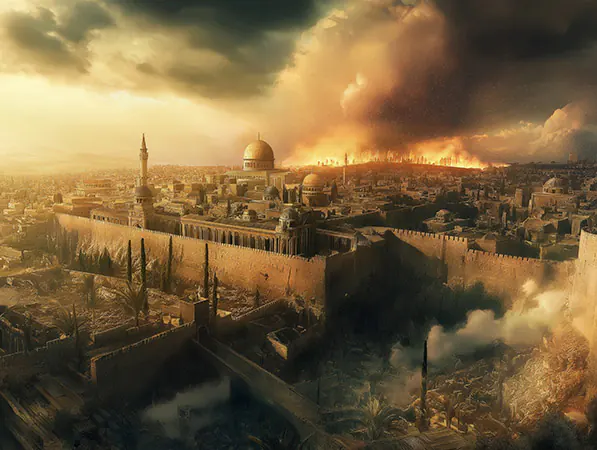
Jerusalem's Fall and Christ's Return
'Prophecy Watch' by Charles WhitakerClouds appear as a significant prophetic marker within the discussion of the "coming of the Son of Man" formula, particularly in the Olivet Prophecy as recorded in Luke 21:25-27. In this passage, Christ describes cosmic disturbances—signs in the sun, moon, and stars, distress among nations, the sea roaring, and men's hearts failing from fear—before stating that people "will see the Son of Man coming in a cloud with power and great glory." This apocalyptic imagery, especially the mention of clouds, points to something far beyond the destruction of Jerusalem in AD 70. Notably, there were no significant clouds recorded over Jerusalem on August 30 of that year when the Romans captured the city, undermining the preterist claim that this passage describes that historical event. Instead, the intensely apocalyptic language, including the reference to clouds, signals the Day of the Lord's vengeance, a distinct and future prophetic period. The cloud imagery connects to a broader pattern of "coming of the Son of Man" language that consistently points to the Day of the Lord rather than to the fall of Jerusalem. This is reinforced by Matthew 24:36-39, where Christ links His coming to the days of Noah rather than to any first-century event, indicating a cataclysm of much greater scope than the catastrophe of Jerusalem's fall. The clouds mentioned in Luke 21:27 also relate to the concept of Christ's portable throne, described in Ezekiel 1-10, which conjecturally makes its way to Jerusalem during the Day of the Lord itself—a period distinct from Christ's later revealing and establishment of the Davidic throne. This portable throne, associated with clouds, is different from the throne of glory mentioned in Matthew 25:31, which pertains to a later judgment during the White Throne Period rather than to the Day of the Lord. Thus, the cloud imagery in the Olivet Prophecy functions as a key piece of evidence against the preterist interpretation, which claims all prophecy was fulfilled by AD 70. The absence of literal clouds over Jerusalem during its historical destruction, combined with the vivid apocalyptic cloud imagery Christ uses, demonstrates that His words point toward a future, far more dramatic day of divine vengeance rather than a past historical event. This reinforces the broader argument that the "coming of the Son of Man" formula, including its association with clouds, functions as prophetic code pointing to the still-future Day of the Lord, not to the Roman destruction of Jerusalem.

From Both Sides Now and the Greatest Day
Feast of Tabernacles Sermon by Mark SchindlerThe concept of clouds opens with a personal account of a flight through a snowstorm that rose above the clouds into moonlit clarity, setting the stage for a broader meditation on perspective. This experience connects to a film watched during that flight, A Walk in the Clouds, which becomes the bridge to the true story of Philippe Petit, the French tightrope walker who spent six years planning his 1974 walk between the Twin Towers, literally stepping into the clouds 1,368 feet above New York City. Petit's account of overcoming an "inner howl" through faith, knowing both his starting point and his destination, is presented as a human illustration of a much greater reality: God's eternal project, which has been carefully planned for thousands of years, far surpassing anything a mere man like Petit could design. This human "walk in the clouds" is then contrasted with Joni Mitchell's song "From Both Sides Now," in which clouds represent confusion and futility, symbolizing this world's inability to find meaning in life without divine perspective. Those without God's calling see clouds only as obstacles or illusions, whether idyllic or stormy, and conclude that life is without lasting purpose. This worldly view of clouds "from both sides" is set against the perspective God grants to those He has set apart, who are called to keep their eyes fixed "above the clouds" on Christ rather than being trapped by the limited, earthbound view of the carnal mind. The theme deepens through the biblical concept of the Shekinah glory, described as a brilliant light enveloped in a cloud, which visibly represented God's presence over the tabernacle and in Solomon's temple. This cloud of glory was absent from the second temple, causing the older generation to weep at its dedication, since the tangible evidence of God's presence institutionally was gone. This absence sets up the significance of Jesus Christ's declaration on the last, greatest day of the Feast of Tabernacles, when He promised that after His glorification, the Holy Spirit would restore that divine presence, not merely hovering visibly over Israel, but now dwelling within all who believe. Ultimately, the various uses of "clouds" converge: the literal clouds encountered in flight, Petit's daring walk in the clouds achieved through faith and precise planning, the confused human perspective of clouds as futile or illusory, and the cloud of God's own glory that once rested over Israel and is now given through the Spirit to the called. The unifying message is that believers are to keep their vision "above the clouds," fixed on Christ's glory rather than on the world's confused view from both sides, trusting that God's vast project, like Petit's single, carefully planned walk, moves forward with absolute certainty toward its determined completion.

From Both Sides Now and the Feast of Tabernacles
Feast of Tabernacles Sermon by Mark SchindlerThe disillusionment experienced by all living under the sun can only be cleared up under the perfect government of Jesus Christ.
Trumpets and Hope
Sermon by Richard T. RitenbaughOur hope is founded on Jesus rising from the dead. If there is no resurrection, our faith is worthless; if Christ did not rise, we are still under condemnation.
Thy Kingdom Come
Sermonette by Ronny H. GrahamMost professing Christians hold to the pagan belief that heaven is the reward of the saved, imagining that they will waft off to heaven at death.
Jesus Christ's Ascension
Sermon by David C. GrabbeThe cloud that received Christ out of the apostles' sight on the fortieth day was the same Greek word used for the divine cloud at the Transfiguration and for the cloud that led the Israelites. Every description of Christ's return states that He will come on the clouds of heaven. This was not an ordinary cloud but one suited to power, strength, honor, glory, and blessing, a cloud for a King. The ascension was visible, and the return will occur in the same visible manner. In the vision of Daniel, one like the Son of Man comes with the clouds of heaven to the Ancient of Days. Christ's ascension took Him above the heights of the clouds. The Israelites had the pillar of cloud and fire, yet believers now lack that visible sign.
Dominion and Glory and a Kingdom
Sermonette byWhen Jesus told the religious leaders they would see Him seated at God's right hand and coming on the clouds, He did not mean they would be alive at His return.

Dominion and Glory and a Kingdom
'Prophecy Watch' by David C. GrabbeChrist's words at His trial regarding sitting at God's right hand and coming on clouds sound like His return, but they have another fulfillment altogether.
Sovereignty, Election, and Grace (Part One)
Sermon by John W. RitenbaughGod, as Creator, takes the initiative (as the potter over the clay) for the elect's salvation, enabling us to build the repertoire of habits called character.
The Pattern of Creation
Feast of Tabernacles Sermon by Mike FordGod has a pattern that we can use for planet formation, a skill He will teach us after we assume a glorified spirit body following our resurrection.
Lamentations (Part Four; 1989)
Sermon/Bible Study by John W. RitenbaughThe prophets and the religious leaders bear the greatest blame for the destruction by providing a quasi-religion and not teaching the Law of God.
Rain
Sermon by Richard T. RitenbaughWeather disasters expose the moral weaknesses of a nation. We need to patiently and obediently wait for the early and latter rains that God will provide.