


by Joseph B. Baity
Forerunner,
"WorldWatch,"
February 11, 2026
“There is nothing I dread so much as the division of the republic into two great parties, each arranged under its leader, and concerting measures in opposition to each other. This, in my humble apprehension, is to be dreaded as the greatest political evil under our constitution.” —John Adams, 1780
Since its founding, the United States has often faced disagreement, debate, and division among its leaders and their constituents. Though many disagreements have sparked impassioned debates over the years, rarely has the vitriol between opposing sides reached the level we see today.
History tells of the infamous duel (a practice common in the day) between Alexander Hamilton and Aaron Burr in July of 1804, which culminated a long-standing political feud over, among other things, Federalism and Democratic-Republicanism. Their altercation exacted a steep price when Burr killed his Federalist opponent, Hamilton.
Fast-forward nearly sixty years, and a similar battle (over many of the same ideas—Federalism versus Republicanism, or a strong central government versus states’ rights) played out writ large in the War Between the States, aka the American Civil War. Tragically, approximately 800,000 lives were lost in what remains the bloodiest war in American history.
When the dust settled and the bodies were buried, Union troops had defeated the “states’ rights” Confederacy, and the battered nation lived on. Sadly, America paid another consequential price when John Wilkes Booth, an embittered supporter of the Confederacy, assassinated President Abraham Lincoln.
Thankfully—in time—most Americans learned to favor the art of compromise, settling their domestic differences with words and votes, rather than bullets and bloodshed. At the same time, more high-minded politicians dominated the national, state, and even local halls of governance, esteeming statesmanship and compromise over violence.
Fast-forward again, this time into the 1960s, when America found itself in the most domestically tumultuous decade since the Civil War.
Americans, agitated and aroused, angrily took to the streets protesting the U.S. involvement in the Vietnam War, along with an issue only partially resolved by the Civil War and the outlawing of slavery: racially discriminatory customs and laws, including legally mandated segregation in public schools and the public square. Cities burned amidst violent confrontations and rioting. People died. Just as it had during the early years of nationhood and the Civil War, the body politic of America strained, but ultimately held. Compromise and cooler heads prevailed.
It is worth noting, though, the commonality shared by all three of these periods: Each side in the respective disputes presented its contentions as existential in nature. To put a finer point on it, the issue was their ideological struggle to coexist—to live in proximity and interact without harming one another. At stake were the existential questions of governance: How do we define our nation? How do we determine right and wrong? How do we want to govern and be governed? These are questions that need to be asked from generation to generation, and the search for answers can help strengthen our ties to one another while further establishing our place and role in a larger world.
Fast-forward to 2026, and once again America finds itself in the midst of great civil turmoil. Though the issues and debates are manifold, they seem less ideological in nature, designed purely for division, with no easy compromise—no easy resolution—in sight. The radical elements on either side of a given debate are less concerned with our necessary struggle to coexist than with promoting a stiffer refusal to coexist at all. The assassination of Charlie Kirk and the attempted assassinations of President Trump exemplify the root problem: Compromise is welcome only if the other side is doing the compromising.
The fight seems bigger and more consequential. There is less talking and more shouting, and few want to consider their opponents’ point of view. Ultimately, the lines are drawn today—primarily, often unwittingly—between Nationalists and Globalists. Nationalists desire a more traditional approach to governance, living within well-defined, restricted borders with well-defined laws and values, private property ownership, and a commitment to maintaining American sovereignty. On the other hand, Globalists wish to eliminate or blur the significance of national and state borders to promote unfettered immigration and the near elimination of all private property. At the same time, they are abandoning traditional, Western, Judeo-Christian values and governance, eliminating all national sovereignty.
For many decades, but particularly from 2021 through 2024, America suffered an unsustainable influx of illegal immigrants. In these four years alone, an estimated eleven to twenty million persons crossed our southern border that globalist-leaning, liberal politicians virtually erased.
In addition to the untold billions of taxpayer dollars required to manage the stampede of illegal immigrants, widespread fraud within the immigration “industry,” likely in the hundreds of billions of dollars, is apparently being uncovered. It is claimed that much of that fraudulent windfall lines the pockets of those same globalist-leaning, liberal politicians, providing financial support for their nefarious causes.
The current White House, while fomenting unprecedented levels of acrimony with its crude and unrestrained attacks on the political left, is determined to deport as many of these illegal immigrants as possible and to investigate the alleged fraud. This policy serves to increase the animosity from the opposition, while allies demand that it stay the course.
Joining the fray are the American people, some well-intentioned and informed, others less so but in ever-increasing numbers. Monies and political backing pour in from supporters on both sides to ensure a long-lasting clash, while politicians and media, claiming a desire to ease tensions, only stir up more angst.
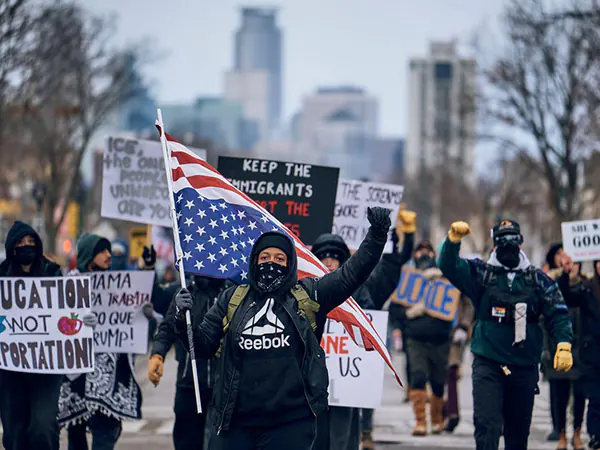
Little wonder, then, that we are witnessing so many fierce, fiery, and fervent clashes on America’s streets between, on the one side, the United States Border Patrol (CBP) and Immigration and Customs Enforcement (ICE), and on the other, illegal immigrants and their political and civilian allies.
Many states, including Minnesota, Washington, California, Illinois, New York, and Oregon, and municipalities like San Francisco, Chicago, Boston, New York City, and Minneapolis, have declared themselves as sanctuaries to illegal immigrants, obstructing ICE’s deportation efforts in direct opposition to the current administration’s edicts. The political vitriol is deafening. Lawsuits are piling up, as are calls for violent upheaval. State and federal courts and legislatures are wrestling with what some call the greatest Constitutional crisis since the Civil War. Some observers wonder if we are crossing, or at least approaching, a line—a point of no return—on our way to another bloody Civil War.
Many observers believe this is the Globalists’ desired outcome. Such a violent conflict would severely weaken America, but a weakened U.S. would be less able to oppose them and perhaps even become a willing participant in their international movement, greatly accelerating their ultimate goal of a one-world government. In the meantime, other pundits declare globalism is dead—at least in America.
The question that remains, however, is whether Americans are ready—do they possess the will—for a protracted and bloody conflict to resolve their political differences. Or, as has usually been the case, will cooler heads prevail?
Regardless, faithful Christians should keep aware of these events. While it is understandable to express a preference for the ultimate winner of this current round of national skirmishes, it is wise to do so quietly and from a distance, always praying for guidance and understanding from our great and sovereign God (see Amos 5:13).
We can learn much from America’s struggles as we witness the divide among its people grow. After all, division has been a key element in the history of the nation of Israel and its modern-day descendants. Today, as the Israel of God, the church awaits a time when the divide between God’s sovereignty and Satan’s rulership over wayward mankind will become more pronounced than ever and for all to see before resolving in a glorious, eternal victory and a harmonious coexistence with God for most of humanity—especially for the forces and Family of Jesus Christ!