


Filter by Categories
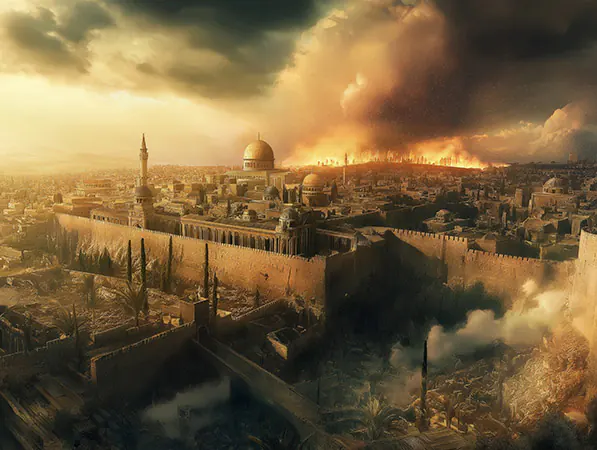
Jerusalem's Fall and Christ's Return
'Prophecy Watch' by Charles WhitakerThe concept of Cataclysm, as it pertains to the Day of the Lord, embodies a time of great wrath and vengeance. This period is understood as a year-long duration during which Christ takes vengeance on His enemies, marking the final year of the time of Jacob's trouble, a three-and-a-half-year period of intense tribulation. At the end of this Day of the Lord, Christ's wrath is spent, and He comes to rule, establishing a stark contrast to the destruction that defines this cataclysmic time. In the prophetic timeline, the Day of the Lord is characterized by catastrophic events, as depicted in Revelation 16 with the seven Vials or Bowls of God's Wrath, signifying a time of divine judgment. The Olivet Prophecy in Luke 21 further illustrates this cataclysm, where Christ speaks of a future destruction of Jerusalem, far beyond the historical events of AD 70, marked by apocalyptic signs and the days of vengeance to fulfill all that is written. These days of vengeance align with the intense rhetoric of clouds and divine intervention, pointing to the year of the Lord's vengeance. Moreover, in Matthew 24:36-39, Christ connects His return to the days of Noah, emphasizing a sudden and overwhelming cataclysm that parallels the unexpected nature of the flood. The use of plural armies in prophecies about Jerusalem's final attack in the end-time, as seen in Luke 21:20 and Matthew 22:7, indicates a cataclysmic convergence of many nations, distinguishing it from singular historical sieges. This portrayal of widespread destruction underscores the global scope of the Day of the Lord's cataclysmic impact.

Clouds (Part Three): The Revealing of Christ
'Prophecy Watch' by Charles WhitakerDuring the cataclysm of Noah's Flood, the enthroned God, whom we know as Jesus Christ, oversaw events from His cloud, presiding over the destruction of a violent and corrupt civilization worldwide. For the better part of a year, He virtually obliterated the ante-Diluvian world, leaving little evidence of its existence, while simultaneously terraforming a new world. Vast currents of water shaped plains and carved out landscapes like the Grand Canyon, as He directed rebuilding almost immediately after destruction. Enthroned on His cloud, He orchestrated this dual process, viewing restoration as concomitant with destruction. When the clouds finally scattered, and Noah set foot on terra firma, the geography and topography were substantially different, marking the emergence of a new world. As it was in Noah's day, so it will be on the day when the Son of Man comes, with Christ spending a year in His cloud during the Day of the Lord, destroying and creating virtually simultaneously, protecting those He chooses, and displaying precise selectivity in His righteous judgment.
The Love of Christ
Sermon by Martin G. CollinsBefore the return of Jesus Christ, a cataclysmic event will unfold, marked by great tribulation unlike anything seen since the world's beginning, nor ever to be seen again. This time of unparalleled horror will bring destruction and war beyond human experience, threatening the very existence of all life. Immediately after this tribulation, cosmic disturbances will terrify humanity, with the sun darkening, the moon losing its light, the stars falling from heaven, and the powers of the heavens shaking. Men's hearts will fail from fear of what is coming upon the earth. The Day of the Lord, as described, is a process culminating in Christ's return, a day of darkness and gloominess, of clouds and thick darkness, where a great and strong people will bring devastation, leaving the land desolate. Fire will devour before them, and a flame will burn behind, with the earth quaking, heavens trembling, and celestial bodies dimming. The Lord will give voice before His army, for the day is great and very terrible, and who can endure it? Yet, amidst this cataclysm, Christ's love shines as He intervenes to prevent total annihilation, offering hope and redemption as the sign of the Son of Man appears in heaven, heralding His return in power and glory.
The Days of Noah
Sermon by Richard T. RitenbaughBefore the flood, Satan had attempted to corrupt mankind, probably through massive demonic possession. The same demonic threat will occur at the end-time.
How Long, O Lord? (1994)
Sermon by John W. RitenbaughThe references to trumpets suggest an announcement of a specific event or an alarm of what is to follow. Typically, the events themselves are figurative trumpet blasts.
Lessons From a Sandpile
Commentary by David C. GrabbeInspired by a sandpile, physicists developed a computer model to simulated the critical juncture when a single grain of sand would cause an avalanche.