


Filter by Categories
The Olivet Prophecy Paradox
Sermon by David C. GrabbeIn Matthew 24, known as the Olivet Prophecy, Jesus provides a detailed progression of end-time events while speaking to His disciples on the Mount of Olives. After shocking them with the prediction that not one stone of the Temple would remain upon another, the disciples ask Him when these things will occur and what will be the sign of His coming and the end of the age. Jesus responds with a dual-layered answer, addressing both events of the first century and those still to come at the end of this age when He returns. He describes early fulfillments such as false messiahs, wars, famine, persecution, martyrdom, and the preaching of the gospel, alongside an Abomination of Desolation that led to the Jerusalem church fleeing before the city's destruction. However, the ultimate fulfillment, including significant heavenly signs and His return, remains in the future. Jesus foretells intense pressure leading to betrayal and hatred among God's people, indicating a low spiritual state where many may betray others to save themselves. This environment fosters false prophets and widespread deception, as people seek relief from hardship through misleading teachings. Consequently, lawlessness abounds, causing the love of many to grow cold due to a disregard for God's commandments. These conditions signal that the end is near when observed among God's people. Two concrete signs are highlighted by Jesus. First, in Matthew 24:14, He states that the gospel of the Kingdom will be preached in all the world as a witness to all nations before the end comes, a fulfillment still ahead despite partial realization in the first century. Second, in Matthew 24:15, He mentions the Abomination of Desolation standing in the holy place, referencing prophecies in Daniel. Past fulfillments involved desecrations of the Temple by foreign powers, and a future occurrence will similarly involve idolatry in a place dedicated to the true God, though the exact nature remains uncertain. Jesus describes the time just before His return as the greatest tribulation in history, a period of such peril that unless God shortens the days, no flesh would survive. Yet, for the sake of the elect, a limit is set. Contrasting this, He also likens this time to the days of Noah and Lot, where people engaged in normal activities like eating, drinking, marrying, buying, selling, planting, and building, unaware of impending destruction. This apparent paradox underscores that His return will be unexpected, despite the intense trouble, as people will continue routine life oblivious to the coming judgment. The Olivet Prophecy further connects this great tribulation to a time of divine vengeance, paralleled in Luke's account as the days of vengeance when all written prophecies are fulfilled. This period threatens all flesh, both Israelite and Gentile, with God's wrath so intense that survival hinges on His intervention to limit the duration. Jerusalem and its environs are depicted as the epicenter of this turmoil, trampled by Gentiles until their time is fulfilled, highlighting the global and severe nature of the end-time events Jesus foretells.

The Duality of Prophecy
'Prophecy Watch' by Earl L. HennThe Olivet Prophecy, recorded in Matthew 24, Mark 13, and Luke 21, is one of the best examples of a dual prophecy, containing both a type and an antitype. The destruction of Jerusalem in AD 70 is the type, and the Great Tribulation immediately preceding Christ's second coming is the antitype. Reading the prophecy as referring only to Jerusalem's destruction produces confusion. A commentator who held that view could not explain why Christ said His coming would occur immediately after the tribulation of those days (Matthew 24:29). Understanding that Christ prophesied two events resolves the difficulty. Many early Christians did not grasp the duality and expected Christ to return after Jerusalem fell. When He did not appear, some became disappointed and disillusioned, and some lost faith and stopped believing. That disappointment was a major factor in the early church's fall into apostasy in the closing decades of the first century. The Olivet Prophecy shows how vital the principle of duality is for understanding Scripture. It also carries an urgent warning for those living in the end time: Christ's command to watch, since no one knows when the Master of the house is coming, lest He find them sleeping (Mark 13:35-37).
The Teaching of Jesus and Prophecy
Sermon by Richard T. RitenbaughThe Olivet Prophecy, found in Matthew 24, is a crucial text where Jesus lays out end-time events. It serves as the foundation for understanding these events, as it comes directly from Jesus. In this prophecy, Jesus explains that the first seal, often misinterpreted by others as the spread of the gospel, actually refers to false Christianity deceiving many in His name. This deception leads to a sequence of events including wars, famines, and pestilences, each building upon the other. Jesus also clarifies the abomination of desolation, indicating it begins with Jerusalem being surrounded by armies and ends with an abominable image in the Holy Place. This understanding was vital for the early Christians who, guided by Jesus' words, fled to Pella before the Roman siege of Jerusalem in 70 AD, thus being spared the ensuing destruction. The Olivet Prophecy underscores that Jesus' teachings are the key to unlocking the mysteries of prophecy, providing a clear baseline for interpreting end-time events.
This Generation Shall Not Pass
Commentary by Richard T. RitenbaughIn the Olivet Prophecy, Christ declares that "this generation will by no means pass away till all these things are fulfilled" (Matthew 24:34; Mark 13:30; Luke 21). Joined with the statement that unless those days were shortened, no flesh would be saved (Matthew 24:22; Mark 13:20), this points to the generation that lives in the age of the atomic bomb, which can wipe all life from the earth. That generation, the WWII or G.I. Generation, is dying out. Its members were born between 1901 and 1924, and if the last of them lives as long as the oldest known person, about 116 years, the generation ends around 2040. That leaves roughly 21 years, about the length of an average generation, so Christ's return could come within a short span. Yet the Olivet Prophecy forbids date setting. No one knows the day or hour, because that time is in the Father's hands, and Christ says He will come when His disciples do not expect Him. Believers can still read the signs of the times. God is pushed to the margins as never before, and the world is ready to give its allegiance to a human savior who promises power, prosperity, and peace on carnal terms. This sets up the crisis at the close of the age. The prophecy therefore calls for readiness for the unexpected: for the Great Tribulation, the Day of the Lord, Christ's return, and the rule that follows, in which believers serve in His government.
How Many Wars?
Commentary by John W. Ritenbaugh (1932-2023)The Olivet Prophecy focuses on an admonition to disciples to be alert and prepared. The comments begin in general terms and become more specific as they proceed through the chapter. Jesus states that disciples will hear of wars and rumors of wars but that the end is not yet. These comments serve as indicators that the return draws closer. All of these signs represent the beginning of sorrows. The signs may be compared to Braxton Hicks pangs that signal the birth of the Kingdom of God. Jesus indicates that a dramatic increase in the number of wars will occur. This series of events must take place at a time when disciples can hear of them through worldwide rapid communication. Historical records show periods of peace between wars that averaged twenty three years and four months until a change occurred near the end of the nineteenth century. Conflicts then began to occur at shorter intervals. Many operations continue at present and involve multiple nations.
What Does 'One Taken, the Other Left' Mean (Matthew 24:40-41)?
Bible Questions & AnswersAt Christ's return, a separation will take place between the righteous and the wicked. However, a secret rapture is nowhere contemplated in Scripture.
Where the Eagles Are Gathered
Sermonette by David C. GrabbeThe Olivet Prophecy foretells a gathering of eagles or vultures in anticipation of God's judgment. Will they mistake us for the nearly-dead?
Trumpets: Soon To Be Fulfilled?
Sermon by Richard T. RitenbaughThe Olivet Prophecy forms the theme of Matthew 24. Jesus Christ sat on the Mount of Olives when the disciples asked Him privately when these things would be and what would be the sign of His coming and of the end of the age. He answered by giving sign after sign of the last days. One sign appears in Matthew 24:22, which states that unless those days were shortened no flesh would be saved but for the elect's sake those days will be shortened. The same prophecy appears in other versions in Matthew 24:32-35 and Mark 13:28-31 as the Parable of the Fig Tree. In Luke 21:29-30 Jesus Christ spoke a parable about the fig tree and all the trees. When they are already budding one sees and knows that summer is now near. He addressed this directly by saying in Luke 21:31 that when one sees these things happening one knows that the Kingdom of God is near. Luke 21:32-33 adds that this generation will by no means pass away till all things take place and that heaven and earth will pass away but His words will by no means pass away. The interpretation is that the generation that sees these things happening will be the generation to which Jesus Christ returns.

The End Is Not Yet
'Prophecy Watch' by Richard T. RitenbaughWe must make sure that our understanding and interpretation of natural disasters and heavenly spectacles align with what the Bible says about them.
Are These the Last Days? (Part 1)
'Prophecy Watch' by Richard T. RitenbaughThe Olivet Prophecy establishes that the last days will be identified by specific, observable signs that culminate in Christ's return. Central to this is mankind's newly acquired ability to annihilate all life, as Jesus states that unless those days were shortened no flesh would be saved. This capacity, realized only with the development of nuclear weapons after 1945, marks the present era as the time when the prophesied events can occur. Jesus further defines the generation that witnesses these signs as the one that will not pass away until all things are fulfilled, narrowing the focus to those who have seen the escalation of deception, war, famine, disease, and natural disasters that form the beginning of sorrows. These preliminary events must precede the Tribulation, the martyrdom of the saints, and the persecution of the church. Within this sequence the prophecy places the worldwide witness of the gospel immediately before the end, indicating that this final proclamation will be accomplished by the Two Witnesses during the Great Tribulation rather than by any earlier ministry. The same prophecy also requires a falling away from the truth before the day of Christ arrives, confirming that departure from sound doctrine is itself an indicator that the predicted time has come. Together these elements demonstrate that world conditions and the church's condition align with the Olivet Prophecy's description of the period immediately preceding the establishment of God's Kingdom, urging readiness for the sudden fulfillment of all that remains.

Watch What?
'Prophecy Watch' by Pat HigginsJesus does not specify in so many words what we are to watch. The evidence points to the fact that watching has everything to do with spiritual preparation.
The Fall of Jerusalem and the Coming of the Son of Man
Sermonette byThe formula 'the coming of the Son of Man' is code for 'the Day of the Lord.' The formula does not refer to the fall of Jerusalem in 70 AD, but the days ahead.

Will Deceive Many (Part One)
'Prophecy Watch' by Pat HigginsJesus Christ wants His people to look for and recognize the signs of the times, including rampant deception in the world and, sadly, even in the church.
Enduring to the End
Sermonette by Ryan McClureThe antidote to post-Feast blues is to get our heads in God's Word, meditating on the topic of endurance, thinking about what it takes to endure to the end.
Do You Recognize This Man? (Part Five)
Sermon by Richard T. RitenbaughIn Exodus 19, there are 12 parallels with Christ's dramatic return illustrated in Matthew 24. All of these events will culminate in a blast of a trumpet.
Why Isn't Harold Camping Right?
Commentary by John W. RitenbaughMany are woefully ignorant biblically. Christ warned that no one will know the day or hour of His return, and that many will try to deceive about this event.
Matthew 24:34: 'This Generation'
Sermon by Richard T. RitenbaughThe Olivet Prophecy (Matthew 24, Mark 13, Luke 21) is still future, and preterists err in treating it as fulfilled by the destruction of Jerusalem in AD 70. Their whole case rests on Matthew 24:34, "this generation will by no means pass away till all these things take place," which they read as the generation of the disciples. Yet all three synoptic gospels record the statement almost word for word, so it cannot be a scribal error, and three witnesses place it beyond contradiction. Jesus introduces it with "Assuredly, I say to you," backs it with the emphatic "by no means," and follows it with the assurance that His words will not pass away. If He meant His hearers' own generation, He would be a liar, because the gospel has not yet been preached to all nations, the Great Tribulation has not come, the heavens have not been shaken, Christ has not returned, and the elect have not been gathered. Jesus speaks in what may be called prophetic tense, where God's view of time shifts audience and era without markers, as Moses does in Deuteronomy 29-30. The key is verse 22: unless those days were shortened, no flesh would be saved. Only since the 1940s has mankind possessed the means to destroy all life, so "this generation" is the generation of possible human extinction. Because the statement sits within the Parable of the Fig Tree, it gives only a general sense that the end is near, not a date. That period is marked by distraction, self-indulgence, and the cares of life, so believers must watch and be ready for the Son of Man at an unexpected hour.
The Appointed Time of the Resurrection
Sermonette byThe time of Christ's return appears to be soon in the light of recent events. Watch for the gathering of armies around the future capital of the world.

'Behold, He is Coming with Clouds'
'Prophecy Watch' by David C. GrabbeThe passages that describe Christ's return in power and glory contain the same detail: that He will come in, on, or with clouds. Here is the significance.
Land of Milk and Honey
Sermonette by Ronny H. GrahamJesus Christ will accomplish what no politician has ever been able to accomplish, to drain the putrid corrupt swamps of all failed man-made government.

Where the Eagles Are Gathered
'Prophecy Watch' by David C. GrabbeJesus' statement that 'Wherever the carcass is, there the eagles will be gathered together' is a warning that He will judge those who resist Him.
Coming to Know Him
Sermon by Richard T. RitenbaughWhen the fulfillment of the Feast of Trumpets occurs, we will see God directly when Jesus Christ returns, an event which will get everyone's attention.
The Love of Christ
Sermon by Martin G. CollinsOnly with the help of God's Holy Spirit are we able to fathom the dimensions of width, breadth, length, and depth of Jesus Christ's and the Father's love.
How Long, O Lord? (1994)
Sermon by John W. RitenbaughThe references to trumpets suggest an announcement of a specific event or an alarm of what is to follow. Typically, the events themselves are figurative trumpet blasts.

Establishing Our Hearts Before Christ's Return
Sermon by Martin G. CollinsJames emphasizes patience five times, suggesting that it is a capstone of saintly character, encompassing long-suffering, forbearance, and self-restraint.
What Should We Do While Waiting for Christ's Return?
Sermon by Richard T. RitenbaughThough Scripture does not reveal the day or hour of Christ's return, it clearly teaches how believers should prepare. Here are ten ways.
Jerusalem's Fall and Christ's Return
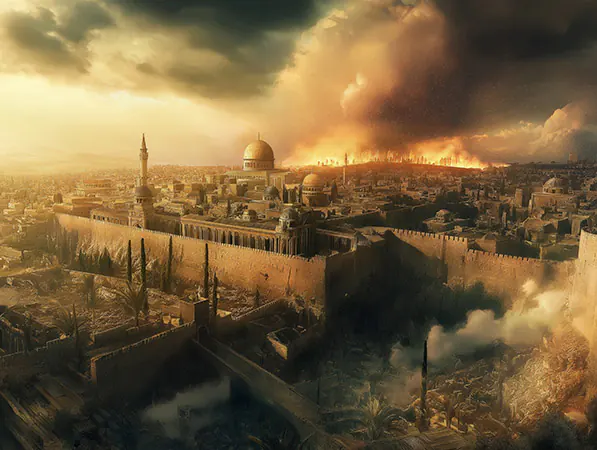
'Prophecy Watch' by Charles WhitakerThe Olivet Prophecy holds most of the prophetic uses of the phrase "coming of the Son of Man": five in Matthew 24, one in Mark 13, and one in Luke 21. Christ speaks of the fall of Jerusalem there, but the AD 70 destruction, like the Babylonian one centuries earlier, is only a type of a destruction yet to come. Luke 21:25-27 shows this. The distress is among nations, not one nation. The Son of Man is seen coming in a cloud with power and great glory, and redemption draws near. None of this happened around Jerusalem in AD 70, when there was neither redemption nor clouds. Christ's plural "armies" also points to the end-time attack by many nations, not Titus's single army. In Luke 21:22 He calls these "days of vengeance," which uses the same Greek word for vengeance as the Parable of the Unjust Judge, so the coming of the Son of Man is the Day of the Lord. In Matthew 24:36-39 Christ compares His coming to the days of Noah, not to Jerusalem's fall. The Flood was a worldwide cataclysm, far beyond the catastrophe of one city, and it is a type of the day of the Lord's vengeance. Preterists therefore misread the Olivet Prophecy by fixing its fulfillment in AD 70.
Jihad in Our Streets
CGG Weekly by Richard T. RitenbaughThe spirit of jihad has jumped its bounds, eagerly infecting a generation of deluded, mis-educated American youth to take to the streets in a new holy war.
Christ's Second Coming
Sermon by Richard T. RitenbaughThe Feast of Trumpets memorializes God's deliverance of Israel beginning with Joseph, and looks forward to Christ's return when God will deliver His people.
A Government to Fear (Part Four): Apathy
Commentary by John W. Ritenbaugh (1932-2023)Americans are apathetic to religion, politics, morality, and civic responsibility, while devoted to hedonism, sports, entertainment, and narcissism.
The Book of Daniel (Part Eight)
Sermon by Martin G. CollinsSeveral types of the abomination of desolation have occurred in history, including the desecration of the temple by Antiochus Epiphanes and the Roman legions.
Death, or Not A Hair of Your Head?
Sermon by Martin G. CollinsOur challenge in the wake of the terrible things we witness now is to retain confidence that God is in control, even though our faith will be sorely tested.
Shock and Awe - and Speed
Sermon by Richard T. RitenbaughThe world will experience the ultimate 'shock and awe campaign' at the second coming of Christ. When these events start, they will occur at meteoric speed.
A Place of Safety? (Part 1)
Sermon by John W. RitenbaughGod has the ability to protect and save in a variety of methods. The Scriptures reveal various purposes for intervention, protection, and prudent escape.
Intensity is Increasing: Are You Listening?
Feast of Tabernacles Sermon by John W. Ritenbaugh (1932-2023)It is far more important for God's called-out ones to be ready than to know the time of Christ's return, an event to which even He is not privy.
The Days of Noah
Sermon by Richard T. RitenbaughBefore the flood, Satan had attempted to corrupt mankind, probably through massive demonic possession. The same demonic threat will occur at the end-time.
Matthew (Part Thirty)
Sermon/Bible Study by John W. RitenbaughThe events in Matthew 24 parallel the six seals of Revelation 6 and the seventh seal of Revelation 7, showing a definite chronological progression.
Let No One Deceive You
'Prophecy Watch' by Richard T. RitenbaughIncreasing knowledge and other modern factors lend themselves to deception, yet this is one of the primary end-time trends that Jesus warns us against.
A Place of Safety? (Part 5)
Sermon by John W. RitenbaughObsessing about the Place of Safety is a sure way to disqualify oneself from it. God calls some faithful, zealous ones for martyrdom during the Tribulation.
God and Reality
Sermon by John W. RitenbaughWhat God puts us through is designed to reveal reality to us. Accepting His doctrine without looking for loopholes will keep us true.

The Four Horsemen (Part One): In the Saddle?
'Prophecy Watch' by Richard T. RitenbaughThe Olivet Prophecy (Matthew 24; Mark 13; Luke 21) is the key to interpreting the Four Horsemen of Revelation 6, because the same Revelator communicated both prophecies and they run parallel. Jesus' disciples asked when these things would be and what would be the sign of His coming and of the end of the age. He answers mostly the second question, giving a series of signs of the end. The closest He comes to answering "when" is verse 14: the end will come when the gospel has been preached in all the world as a witness to all the nations, and only He knows when that goal will be reached. Revelation, a disclosure from Jesus Christ of things that must shortly take place, covers the same end-time ground, from Christ's return to the new heavens and new earth, so the two must be compared. Matthew 24:8, "All these are the beginning of sorrows," separates His comments on the first four seals from His comments on the fifth seal, the tribulation and martyrdom of the saints (verses 9-10). The Four Horsemen therefore commence the time of sorrows, and a considerable length of time may pass between the fourth seal and the opening of the fifth. Jesus' wording in verses 4-7 suggests the Horsemen were let loose long ago.
The Sixth Seal and Israel
Sermonette byEach depiction of the Sixth Seal also shows God's involvement with physical Israelites. John's vision precedes a glimpse of 144,000 of the tribes of Israel.
The Handwriting Is on The Wall (2003)
Feast of Tabernacles Sermon by John W. RitenbaughEven as Paul admonishes us about the night being far spent, we must make careful and judicious use of our time in anticipating the return of Jesus Christ.
We Must Believe!
Sermon by John O. ReidWe are asked to believe in a Being nobody has directly seen or heard, whose written word has been vilified and scorned. Without faith, we can't please God.
Places of Safety (Part One)
Sermonette by Ryan McClureGod see His Holy Days (include the weekly Sabbath) as typical places of safety. Such occasions foreshadow a time when the wolf and lamb dwell together.
The Beast and Babylon (Part One)
'Personal' from John W. RitenbaughEurope is not uniting as we once thought it would. How does this affect our interpretation of the prophecies?
Matthew (Part Twenty-Two)
Sermon/Bible Study by John W. RitenbaughThe transfiguration prefigured the Kingdom of God, with the disciples only seeing Jesus in the end, showing salvation is through Him alone.
Hope to the End (Part Two)
Feast of Tabernacles Sermon by John W. Ritenbaugh (1932-2023)We need these horrific times and conditions to learn the consequences of foolish decisions in order to ensure that nothing like this ever happens again.
A Clean, Well-Lighted Place
Sermon by David F. MaasAs ambassadors, we have the responsibility to be lights, quietly modeling God's Law in our lives by exemplifying the fruits of the Spirit continuously.
The Great Retreat
Sermonette by Joseph B. BaityWhen we withdraw from fellowship, we deprive ourselves of the blessing of sharpening one another. God demands active and practical engagement with His people.
The Beginning of Sorrows
Sermon by Clyde FinkleaThe "last days" began with Christ's resurrection, when Satan was formally deposed as ruler of earth. God made His kingdom available at that time.
Hope to the End (Part One)
Sermon by John W. Ritenbaugh (1932-2023)The church must forcefully deal with the overwhelming feeling of hopelessness or it too will succumb to the terrifying vortex of despair.
Hope to the End (Part Three)
Feast of Tabernacles Sermon by John W. Ritenbaugh (1932-2023)Faith, hope and love are spiritual gifts which safeguard us from discouragement and depression, giving us a mature perspective that will last eternally.