


Filter by Categories
The Lamb of God
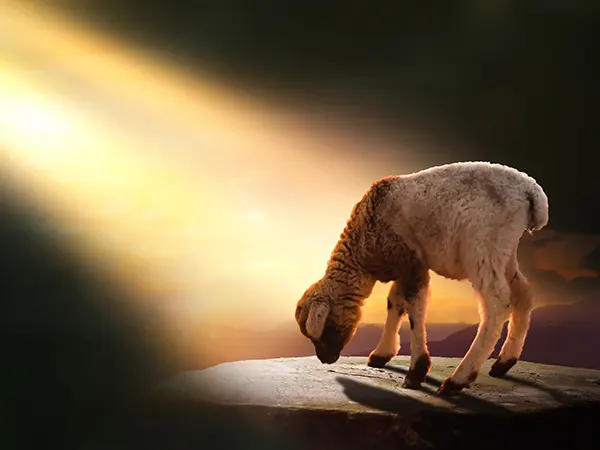
Sermonette byJohn the Baptist, upon seeing Jesus, declared, "Behold the Lamb of God who takes away the sin of the world," as recorded in John 1:29. The following day, standing with two of his disciples, he repeated, "Behold the Lamb of God," emphasizing this unique identification of Jesus as He began His ministry. This description as the Lamb of God highlights a gentle, sacrificial nature, reflecting an attitude of humility and submission, even amidst suffering and abuse, where He remained silent, as foretold in Isaiah 53:7. Unlike portrayals of power or might, this initial depiction underscores Jesus' approach as one of restraint and sacrifice. The symbolism of a lamb, familiar to the audience of that era who often kept small herds of sheep, evokes traits of quietness, helplessness, and sensitivity. Lambs, being less than 300 days old, are predisposed to characteristics of sheep such as being gregarious, needing a leader, and being vulnerable to fear and enemies, while relying entirely on the shepherd for protection and guidance. Jesus, as the Lamb of God, embodies this gentle and submissive demeanor, showing a need for God's protection and guidance, setting an example for His followers. In Revelation 5:5-6, Jesus is described both as the Lion of the tribe of Judah and the Root of David, indicating His power and authority, yet immediately portrayed as a Lamb as though it had been slain, reinforcing His willing submission and sacrificial role. This duality illustrates that while He possesses immense power, He chose to come to Earth as a lamb, gentle and submissive, to fulfill God's plan. This example encourages His followers to emulate such qualities, living peaceably and humbly among others, as instructed in Titus 2:13-14 and 3:1-2, to be subject to authorities, to speak evil of no one, and to show gentleness and humility to all.

The Lamb of Revelation (Part One)
'Prophecy Watch' by David C. GrabbeIn the book of Revelation, Jesus Christ is predominantly referred to as the Lamb, with this title appearing in twenty-eight instances, far surpassing other designations such as Christ or Son of God. Amidst the apocalyptic visions of beasts, plagues, and destruction, where Jesus is unveiled as King of kings against the resistance of men and demons, He is consistently identified as the Lamb. This title stands in stark contrast to the expected imagery of judgment and ruin, as lambs are typically associated with passive, uncomplaining submission, even in suffering. While lambs are often linked to sin offerings within broader contexts, this symbolism does not fully align with the Lamb described in Revelation. Beyond sin offerings, Scripture reveals lambs used in various contexts such as morning and evening sacrifices, peace offerings, sanctification of the priesthood, cleansing rituals, and annual festivals. A significant usage appears in the Passover and the law of the firstborn, where lambs symbolize redemption, not atonement. God claimed Israel as His firstborn, redeeming her from Pharaoh, and required the Israelites to redeem every firstborn male with a lamb, emphasizing ownership over atonement. This theme of redemption extends to personal application, where Christ's blood redeems believers from the power of death and the control of the devil. Yet, a future redemption is also necessary, liberating from the flesh and a corrupt nature to fully manifest the image of the Creator. Thus, the Lamb in Revelation embodies a profound symbol of redemption, reflecting a divine claim and the transformative ownership by God over His people.
The Lamb of Revelation
Sermonette by David C. GrabbeIn Revelation, John refers to Christ as the Lamb more than any other designation because of His role of Redeemer, which is different from a sin offering.
Death of a Lamb
Article by StaffDuring the Passover season, the members of God's church reflect on the Old Testament symbolism of the slaughter of lambs, a representation that remains deeply relevant to modern-day Christians. The ancient ritual of sacrificing the Passover lamb, though no longer practiced, embodies enduring spiritual principles. The prime age for butchering a lamb, typically between eight and twelve months, underscores the tenderness and innocence of the young lambs used in these sacrifices. The sacrifice of the Lamb of God carries profound significance, culminating in the ultimate fulfillment of its purpose. As we keep the Passover, we are reminded of the terrible agony He endured for His brothers and sisters, looking forward to the day when there will be no more death, sorrow, or pain, and the joy of God's Family will be complete.

The Lamb of Revelation (Part Two)
'Prophecy Watch' by David C. GrabbeThe book of Revelation frequently refers to Jesus Christ as the Lamb, emphasizing His role in redemption rather than atonement or propitiation. Before the instructions for sin offerings, God commanded the Israelites to use a lamb to redeem their firstborn males, buying them back from Him who claimed them for Himself. In Revelation, the Lamb is depicted as the only One worthy to take the scroll, which appears to be the title deed of all creation, and open its seals. This Lamb, with seven horns symbolizing perfect strength and power, and seven eyes connected to the removal of Israel's iniquity and the restoration of true worship, underscores His role in future redemption. When the theme of redemption is applied to the Lamb in Revelation, the imagery aligns clearly. Revelation 5:9-10 speaks of those redeemed by the Lamb's blood, formed into a kingdom of priests. In Revelation 6:1, the Lamb opens the seals, not as a sin offering, but as One redeeming what belongs to Him, portraying Jesus Christ as the Creator, Heir, and Owner of all things. The opening of the seals brings cataclysms akin to the plagues on Egypt during Israel's redemption, as not all accept the Lamb's claim. Yet, Revelation 11:15 declares His ultimate success, with the kingdoms of this world becoming the kingdoms of our Lord and of His Christ, who shall reign forever and ever. The Sixth Seal reveals the Lamb filled with wrath, demonstrating His zeal for what He possesses, which can include tremendous destruction when necessary, as seen in Israel's history and anticipated by humanity in the future. Here, the Lamb focuses on demonstrating ownership and realigning His creation with His government. Revelation 14 shows the Lamb standing on Mount Zion with 144,000 redeemed from the earth and from among men, singing before Him. In Revelation 15, those victorious over the beast sing the song of Moses and the song of the Lamb, echoing God's redemption of Israel from Egypt. In Revelation's final chapters, the Lamb and His Bride recall the redemption story of Ruth by Boaz. Jesus Christ, the firstborn from the dead, is the Lamb of redemption, who will redeem what is His in the future. As the Firstborn over all creation, all things are within His legal claim, including the church, Israel, Jerusalem, the Land of Promise, and those who have not rejected Him. Currently, the whole creation groans, awaiting the final redemption through the powerful work of the Lamb.
Is the Passover Just a Sin Offering? (Part One)
Article by David C. GrabbeGod's Word employs various sacrificial animals as types of Christ, with Jesus most frequently pictured as a lamb. A lamb fittingly represents quiet, accepting submission, even in suffering, and following without resistance. However, within the sacrificial system, lambs fulfilled a wide variety of symbolic roles. The specific meaning of a lamb in Scripture depends on the context, as lambs were used for different purposes, such as in the Passover and the sin offering, each carrying distinct symbolic significance. Care must be taken not to limit Christ's sacrifice to a single type of offering, as doing so obscures the fullness of God's purpose in His Son's death.
The Offerings of Leviticus (Part Two): The Burnt Offering
'Personal' from John W. RitenbaughThe burnt offering is completely consumed on the altar. This type of offering teaches us about Christ's total dedication to God—and how we should emulate it.
Offerings (Part Two)
Sermon/Bible Study by John W. RitenbaughThe sacrifices teach us about the mind, heart, and character of Jesus. The burnt offering symbolizes complete devotion to God in every aspect of life.
The Sacrifices of Leviticus (Part 3)
Sermon by John W. RitenbaughVarious animals were used in the burnt offering—bullocks, lambs, doves, and goats. Each depicts some characteristic of Jesus that we must emulate as we serve God.
The Night to be Much Observed
Sermon by John W. RitenbaughThe Night Much to be Observed is a memorial of the covenant with Abraham, and God's watchfulness in delivering ancient Israel as well as spiritual Israel.
The Spiritual Mark of the Beast
Sermon by John W. RitenbaughAnger and hostility, driven by self-centered competitive pride constitute Satan's spiritual mark that divides nations, ethnic groups, families, and the church.
The Beast From the Earth and 666
Sermon by Richard T. RitenbaughThe first beast rises out of political turmoil, while the second rises out of an entrenched, worldwide religious system, totally opposed to God's laws.