


Filter by Categories
The Fall of Jerusalem and the Coming of the Son of Man
Sermonette byThe formula 'the coming of the Son of Man' is code for 'the Day of the Lord.' The formula does not refer to the fall of Jerusalem in 70 AD, but the days ahead.
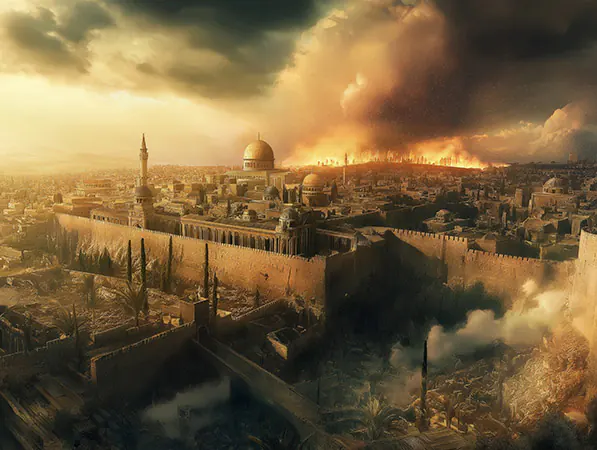
Jerusalem's Fall and Christ's Return
'Prophecy Watch' by Charles WhitakerIn Luke 21:20, Christ speaks of armies surrounding Jerusalem, using the plural to indicate multiple forces. Similarly, in Matthew 22:7, within the Parable of the Wedding Feast, He refers to armies in the context of the city's destruction. While in AD 70, only the Roman army under Titus besieged Jerusalem, prophetically, Christ points to a future time when many nations will send their armies against the city in the end-time. This distinction between the singular army of historical events and the plural armies of prophecy underscores that Christ is addressing a final, greater attack on Jerusalem, separate from past occurrences.
What Do the 1,290 and 1,335 Days Represent (Daniel 12:11-12)?
Bible Questions & AnswersThe armies of the Beast of Revelation 17 are expected to enter Jerusalem and ban the daily sacrifice, which Daniel 12:11 says begins a 1,290-day period ending at Christ's return, a little over three and a half years. The sacrifices may have been briefly restored by the Jews in the modern nation of Israel, possibly with only an altar and no rebuilt Temple. The 1,335-day period begins first, and what starts it is unclear. It could be the end of the organized proclamation of the gospel, or the restarting of the daily sacrifices. Forty-five days later, 1,290 days before Christ returns, the Beast's armies will surround Jerusalem. Those who are worthy will have been warned and will have 30 days to flee to the place of refuge God has provided (Revelation 12:14-16). Once God's church is in that place of protection, the 1,260 days of the Great Tribulation begin. These are also described as a time, times, and half a time, or 42 months. At the end of that period Jesus Christ returns. Those who patiently endure, putting on righteousness and holiness, will be among the blessed who reach the 1,335 days. Daniel 12:11 was fulfilled in type when Antiochus Epiphanes desecrated the Temple in 167-164 BC.
The Appointed Time of the Resurrection
Sermonette byThe time of Christ's return appears to be soon in the light of recent events. Watch for the gathering of armies around the future capital of the world.
The Olivet Prophecy Paradox
Sermon by David C. GrabbeIn the Olivet Prophecy, Jesus Christ speaks of a time of great tribulation, marked by intense pressure and peril. Among the signs of His coming and the end of the age, He describes a specific event involving armies surrounding Jerusalem. This is noted in Luke's account, where the presence of such armies is linked to the concept of an abomination, though it must involve more than mere military encirclement to be considered an abomination of desolation. This event signifies a profound desecration, honoring a foreign god in a place dedicated to the true God, echoing past fulfillments like the actions of Antiochus IV and the Roman army under Titus, who defiled the holy place with idolatrous symbols and sacrifices. This time of armies surrounding Jerusalem ties directly to the greatest tribulation, a period so severe that unless God had limited the days, no flesh would be saved. It is connected to the days of vengeance, a fulfillment of divine warnings, where Jerusalem will be trampled by Gentiles, and worship will be halted. The epicenter of this turmoil will be Jerusalem and its environs, with Gentiles as the troublers, leading to warfare, death, and captivity for the people. This period, described as Jacob's Trouble, culminates in God's vengeance against all flesh, both Israelite and Gentile, as He gathers nations to battle against Jerusalem before ultimately fighting against those same nations.
A Place of Safety? (Part 1)
Sermon by John W. RitenbaughIn the midst of unprecedented distress, as foretold in prophecies concerning the end times, Jerusalem will face a dire situation where armies surround it, posing a grave threat to all within. This scenario, marked by unrelenting terror, underscores a time so devastating that without divine intervention, no flesh would be saved alive. The urgency to flee from this encirclement is paramount, as God, through His servant Jesus Christ, advises not to remain in the midst of trouble but to get out, to escape the danger that engulfs the city. This flight, described as a physical escape, is not merely a suggestion but a critical response to the worldwide calamity that focuses intensely on Jerusalem, where the survival of even the elect hangs in the balance unless God intervenes. Historical echoes, such as the protection of Hezekiah and the Jews when an entire Assyrian army was struck down overnight, illustrate that God's hand is not short; He can save anywhere, anytime, according to His purpose. Yet, in this unique time of tribulation, the directive remains clear: flee from the surrounding peril, trusting that He will open a way of escape for His people, just as He has done in the past.

'Unless Those Days Were Shortened . . .'
'Prophecy Watch' by David C. GrabbeIn Jesus' Olivet Prophecy, the warning that Jerusalem will be surrounded by armies signals the nearness of its desolation and the onset of the days of vengeance that fulfill all things written by the prophets. This event centers the epicenter of end-time turmoil in Jerusalem and Judea, where Gentile forces will trample the city and its people underfoot for forty-two months until the times of the Gentiles reach their completion. The surrounding armies bring death by the sword and captivity for Jacob's descendants into all nations, directly tying the crisis to the time of Jacob's trouble described in other prophecies. This development parallels the abomination of desolation and the urgent commands to flee, showing that the overwhelming peril stems from divine vengeance for covenant unfaithfulness rather than human technology. God gathers the nations against Jerusalem as instruments of judgment, allowing the city to be taken and half its population led into captivity before He intervenes to fight those same nations. The pattern reveals that such vengeance will intensify until iniquity fills every nation, making it necessary for those days to be shortened lest no flesh survive. Ultimately, the armies surrounding Jerusalem mark the transition to Christ's return, when He executes vengeance first on His people and then on the Gentiles who have oppressed them, redeeming the land and establishing His reign.
The Book of Daniel (Part Eight)
Sermon by Martin G. CollinsIn the prophecy of Daniel 11:40-45 and Daniel 12:1-3, a time of great tribulation is foretold, marked by armies surrounding Jerusalem as a significant sign of the end times. This event heralds the beginning of intense persecution and trouble, unlike any other, immediately preceding the return of Jesus Christ. A short time before His return, these armies will encircle the city, and an abomination will be committed within it, signaling the start of the Great Tribulation. The saints in Jerusalem are urged to flee to the mountains for safety during this period. The form of this end-time abomination remains unspecified, but it may resemble past desecrations, possibly involving a blasphemous act or the erection of an idol in the temple precincts by the invading forces. Additionally, the prophecy indicates that at the 1,290 days before Christ's return, the armies of the beast will surround Jerusalem, and those saints deemed worthy will have 30 days to escape to a place of refuge for final training and protection while still human. This precise timing, predetermined by God, underscores the urgency and gravity of the events as the world moves toward the culmination of these prophetic fulfillments.
To What Do the 'Woes' of Matthew 24:19-20 Refer?
Bible Questions & AnswersThe time is coming again when Jerusalem will be surrounded by armies. Any Christians there at the time will have to flee to avoid the prophesied bloodshed.
Death, or Not A Hair of Your Head?
Sermon by Martin G. CollinsOur challenge in the wake of the terrible things we witness now is to retain confidence that God is in control, even though our faith will be sorely tested.
A Place of Safety? (Part 5)
Sermon by John W. RitenbaughObsessing about the Place of Safety is a sure way to disqualify oneself from it. God calls some faithful, zealous ones for martyrdom during the Tribulation.
Concerning Edom
Sermon by Richard T. RitenbaughThe prophet Obadiah sorrowfully dramatizes God's judgment upon Edom (Esau) for his hatred, haughtiness, and pride, and how and why Edom will be annihilated.
The Two Witnesses (Part Seven)
Sermon by Richard T. RitenbaughChrist's Two Witnesses will accomplished their work before the Beast kills them. Humanity will feel relief at their death, but stark terror at their resurrection.
The Works of the Devil Destroyed
Sermon by Martin G. CollinsSatan and his demons know that their time is short and are determined to destroy as many people as possible, especially the Israel of God.
Whoever Loves and Practices a Lie
Sermon by Charles WhitakerIn Revelation 21:8, Christ lists three spiritual conditions and four behaviors, all of which He links to deceit and which will lead to the Lake of Fire.
The Continuous Testing of Our Faith
Sermon by Martin G. CollinsThe constant tests to which God submits His people enable them to build character by responding in faith. God perfected Abraham's faith through difficult trials.