


Filter by Categories
The State of the Union
'WorldWatch' by David C. GrabbeSince the end of World War II, Europe has been shifting and growing into a more unified entity, with the European Union (EU) emerging as a potential challenge to the United States' position as sole superpower. After two devastating world wars, European leaders sought to restrain conflict by establishing the Council of Europe in 1949 and proposing an economic community in 1950, aiming to bind economies together to prevent war. Through treaties like the Treaty of Paris (1951), the Treaty of Rome (1957), and the Maastricht Treaty (1992), a framework was created to unite Europe economically. However, many European elites, dissatisfied with the current free-trade zone, are pushing to transform the EU into a full-fledged state, requiring a constitution to define its government and policies. In 2005, the first attempt at a European Constitution was rejected by the Dutch and French, and a revised version, the Lisbon Treaty, was also rejected by Ireland in a referendum, despite not requiring a public vote. The message from these rejections is clear: while Europeans may tolerate the EU bureaucracy and enjoy economic benefits, they resist a supranational government that might subjugate their national identities. For the Lisbon Treaty to be ratified, all 27 member states needed to agree, but the EU remains far from statehood, with political union appearing increasingly unlikely due to diverse economies, historical divisions, and varying national views on politics, trade, and defense. Trust among member states, many of whom were at war for much of the last century, remains low, and the union seems to have reached its limit in terms of integration. Indications suggest that some ties binding the EU are loosening as states prioritize their own interests. Smaller states lack the influence to push for a governing document, and while Germany has driven efforts like the Lisbon Treaty, France, holding the EU presidency in July, prefers looser policies and will not pursue a new treaty. Britain, the next major country to hold the presidency, will not do so until 2017, by which time the EU's demographic challenges may overshadow any push for statehood. Demographic trends show an aging EU population, with life expectancy increasing but a birth rate of only 1.5 per woman, far below the 2.1 needed for stability. To maintain the workforce and support retirees, the EU requires 1.5 to 3 million immigrants annually, potentially totaling 13.5 to 27 million by 2017. These immigrants, largely from Middle Eastern and North African nations, are increasing the Muslim population in countries like France, Germany, and Italy, raising concerns about cultural integration. As evidenced by events like the 2005 cartoon riots and car burnings in Paris suburbs, assimilation remains a challenge. If the EU persists for another nine years, addressing these cultural tensions may take precedence over forming a super-state.
A Snapshot of European Sentiment
'WorldWatch' by David C. GrabbeThe EU Observer in Brussels reported that EU foreign ministers altered the wording of a statement concerning the Danish cartoon controversy at the urging of Dutch foreign minister Bernard Bot, who sought to avoid any implication of an EU apology to the Muslim world. For weeks, the EU Council had been drafting a statement to present a unified stance on the cartoon uproar. The original text, which stated that the EU council acknowledges and regrets that these cartoons caused offence to Muslims across the world, was revised to say that the EU council acknowledges and regrets that these cartoons were considered offensive and distressing by Muslims across the world. While some view this as a preservation of freedom of speech with no formal apology issued, critics of the Brussels bureaucracy see it as a prime example of Europe's current state, with politicians debating over semantics while crises unfold around them.
Yet Another Call for a European Army
Commentary by Richard T. RitenbaughThere is a persistent call for a strong military power to arise in Europe, with recent advocacy for a European army led by French President Emmanuel Macron. He argues that the European Union (EU), comprising 27 member states, needs its own military due to the perceived unreliability of the US as an ally, citing issues like the US exit from Afghanistan and pressures over China. However, the EU faces significant internal disagreement on this matter. While some member states support the idea of an independent European army, others prefer the security of the NATO alliance and are reluctant to fund a new military initiative, often due to financial constraints and bloated social programs. Many EU countries, including Germany, the largest economy in the EU, spend far below the required defense budgets, with Germany allocating only 1.53% of its GDP to defense in 2020. Reports highlight severe deficiencies in German military readiness, with critical equipment shortages and maintenance issues rendering much of their forces ineffective. France and other European nations fare little better, lacking the resources to field a substantial army. Despite aspirations for a formidable European military, the current reality shows limited capability, with only a small Rapid Reaction Force of about 10,000 men in place. Most EU nations, except for Poland and Belgium, which are committed to NATO integration, struggle to contribute effectively to a unified defense force.
Franco-German Divergence
'WorldWatch' by David C. GrabbeFor the last fifty years, the Franco-German partnership has been the bedrock of European power, yet their interests are beginning to diverge. France has been a main proponent of the European Union (EU), using it to keep most of Europe bound together while maintaining a dominant role. However, the EU is far from united, with member states entangled in bureaucratic red tape from Brussels, stagnating economies, and lacking a unified voice in foreign affairs. The CIA has predicted the potential collapse of the EU within 15 years, partly based on France's decisions, as the EU is seen as a primarily French creation to preserve and enhance French power in Europe. In crises, France could either write a new constitution or violently dismantle the EU, suggesting Europe may face an explosive collapse. For any strength to arise in Europe—political, economic, or military—the old institutions will have to fall, and a Franco-German divergence could mark the beginning of such a reorganization.
The European Financial Crisis
'WorldWatch' by David C. GrabbeAs the world's recession deepens and America's financial struggles become apparent, some believe that a united Europe, led by Germany, will swiftly emerge as the dominant economic power. However, this perspective ignores critical issues. Europe faces its own sub-prime mortgage and unemployment crises, with major financial institutions suffering losses comparable to those in the U.S., ranging from $138-200 billion. The eurozone's unemployment rate stands slightly higher at 8.0% compared to the U.S. rate of 7.2%. Additionally, the eurozone's policy of setting low interest rates has led to unsustainable growth in smaller countries, with Spain exemplifying this through a real-estate boom fueled by cheap credit, now resulting in foreclosures and a 14.4% unemployment rate. European housing markets, overheated even more than the U.S., await price corrections, and the central role of banks in Europe's economy means banking losses impact all businesses. The direct links between European banks and businesses, while protective against minor shocks, exacerbate the crisis when billions are written down, drying up funds for businesses. The European Union's structure, with 27 diverse economies and bureaucracies, hinders a unified response to the crisis. The European Central Bank lacks the power to set broad financial policy, only adjusting interest rates, which benefits some nations while harming others. During recent eurozone meetings, nationalism prevailed over solidarity, with no Europe-wide solutions offered, leaving each nation to pursue its own path under overarching policies that can both help and hinder. Designed for prosperity, the EU and its bureaucracy, including the ECB, lack real power in crises, deferring to major capitals like Berlin and Paris. The EU remains far from a federalized state capable of cohesive action, unable to even agree on a founding document. Despite expectations for Germany to lead, it rejected a proposal for an economic government that would provide political direction to the eurozone, unwilling to sacrifice national sovereignty or bear the financial burden of supporting weaker economies. Compounded by vulnerability to a resurgent Russia using natural gas exports as leverage, forcing individual energy deals, Europe is neither united nor immune to the market forces and weaknesses of the fractional reserve economy it shares with the U.S. Currently, Europe is not positioned to rise, nor is Germany able to assume effective leadership while tied to a struggling eurozone economy.
Is France Ditching the EU?
'WorldWatch' by David C. GrabbeThe inclusion of Bulgaria and Romania into the European Union on January 1, 2007, marks a significant turning point in its history, though not necessarily in a positive light. Strategic Forecasting (Stratfor) notes that their addition will transform the fundamental character of the union more than any previous members, potentially ushering in its downfall as a political grouping. The accession is attractive to the EU as it brings the Balkans further under Western influence and provides access to the Black Sea for strategic and economic benefits. However, this expansion poses challenges for core states like France and Germany, who have historically driven the EU politically and economically. With a 27-member union, the voting balance shifts, allowing other states to override a Franco-German veto, diminishing their control over union-wide decisions. France, in particular, faces growing difficulties in manipulating the EU to serve its interests. The French, along with the Dutch, rejected the EU constitution, signaling discontent with the direction of the union. Additionally, French leadership, including Prime Minister Dominique de Villepin, has challenged the European Central Bank's authority over monetary policy, advocating for policies that favor French exporters and preserve aspects of its social welfare state. With Bulgaria and Romania's pro-America and pro-free-market stances, France's ability to influence EU policy is further constrained. Stratfor suggests that many French leaders are beginning to question France's rationale for remaining in groupings like the eurozone or even the EU itself. For France to stay in the union long-term, either the other member states must accede to French desires, or France must accept a diminished role, neither of which seems likely. The CIA warned in 2004 of the potential collapse of the EU within fifteen years, largely hinging on France's decisions. As a primarily French creation aimed at preserving and enhancing French power in Europe, the EU's fate may depend on whether France chooses to rewrite its structure or dismantle it entirely, potentially leading to an explosive collapse. If France already views the EU as having outlived its usefulness, such a timeline may be overly optimistic.
Europe Edges Toward Common Army
'Prophecy Watch' by Richard T. RitenbaughUnder cover of Denmark's recent decision to reject the Maastricht treaty, nine member nations of the European Community took a significant step toward a unified military force. On June 19, representatives of the nine-member Western European Union signed a document revitalizing the dormant organization, pledging to send peacekeeping forces to troubled areas under UN sanctions. Analysts noted that the European Community's goal in reviving the Western European Union is to transform it into united Europe's defense arm. With the United States diminishing its presence in the region, the European Community sees a growing need for its own military force to protect its interests on the continent and abroad. German Defense Minister Volker Ruehe stated that troops could initially be sent where NATO troops could not, such as into the former USSR. At the least, the Western European Union allows the European Community to act independently of NATO and U.S. restrictions. Formation of a strong European Community demands a military option. For now, the Western European Union is a defense or security pact, deployed only to protect, but the European Community is preparing an offensive weapon, ready to be used by a leader with more aggressive aims.
Islam on the March (Part One): The West
'WorldWatch' by Joseph B. BaityIslam is on the rise in America just 25 years after 9/11. Muslims advocating Sharia law are growing in numbers and political influence from New York to Texas.
A Strengthening Germany
'WorldWatch' by Richard T. RitenbaughGermany's post-election political landscape provides the backdrop for understanding its evolving relationship with the European Union. Following the CDU's continued hold on power under Chancellor Angela Merkel, in coalition with Guido Westerwelle's FDP, Germany began asserting itself more forcefully within European structures, using its dominant position to advance its own national agenda through the EU framework. Despite Westerwelle's apparent alignment with American foreign policy goals—supporting the Afghan War, pressuring Russia and China on human rights, and favoring engagement with Iran—Germany's own self-interests were shown to outweigh any commitment to remaining a junior partner to the United States. This growing independence manifested clearly in Germany's approach to the European Union. As the continent's dominant power in geography, population, and economic strength, with only France as a distant rival, Germany began leveraging its weight to push its own objectives within the EU. Working in tandem with France, Germany served as the primary force behind efforts to ratify the Lisbon Treaty and to secure the subsequent selection of an EU president and foreign minister. Once these measures were finalized, Berlin's agenda—tempered only by a generally compliant France and a weakened Britain—was positioned to effectively become Europe's agenda. This meant that the combined economic weight of all EU member states would stand behind German policy preferences, forcing capitals such as Washington, Moscow, and Beijing to take Germany's voice seriously on the world stage. This EU-focused strategy fit within a broader pattern of Germany shedding its Cold War-era restraints and post-World War II passivity. Berlin's unilateral moves in the energy sector—extending nuclear plant lifespans, building new reactors, and investing in Russian energy infrastructure to reduce dependence on Moscow while also positioning itself as a transit hub for Russian energy to other European nations—demonstrated the same assertive independence being applied through EU institutions. Similarly, Germany's military involvement in Afghanistan, including its first use of heavy weapons and armored vehicles in offensive operations, and its status as the third-largest troop contributor in that conflict, reflected a nation increasingly willing to act on its own initiative rather than deferring to allied consensus. This resurgence of German confidence extended to domestic sentiment, as evidenced by the widespread patriotic displays during the 60th anniversary of the Federal Republic and survey data showing a doubling of national pride since 2001. As the analysis summarized, Germany was developing autonomy not only in foreign policy and energy matters but was likely to extend this autonomy into security matters as well—signaling a return to assertive German self-determination. This trajectory connects to the biblical identification of Germany with the Assyrians described in Isaiah 10:5-7, historically understood as an instrument of divine judgment whose character included the intent "to destroy, and cut off not a few nations." Germany's use of the European Union as a vehicle for its national ambitions reflects this long-standing pattern of German dominance that has historically unsettled its European neighbors, who remain wary of what Berlin's growing influence within the EU may ultimately produce.
Once Again, Britain Dominates Europe
'WorldWatch' by Richard T. RitenbaughGreat Britain has a history of playing the balance-of-power game to keep any Continental state or empire from becoming strong enough to threaten Britain.
A Battle Group for Eastern Europe
'WorldWatch' by Richard T. RitenbaughA little-known town in Eastern Europe has given its name to a newly formed battle group consisting of Poland, Hungary, the Czech Republic, and Slovakia.
Germany Ascendant
'Prophecy Watch' by Richard T. RitenbaughMany who believe Germany to be modern Assyria have waited a long time for Germany to rise again. Signs in Europe point in that direction.
Is Europe Dying?
'WorldWatch' by David C. GrabbeAnalysts have been ready to file the EU's obituary, as Europe's demographics, Constitution, and economy have languished. Can the Beast arise from Europe?
NATO: In Search of a Mission
'WorldWatch' by David C. GrabbeHaving failed to keep the Russians out and the Germans down, NATO is struggling to remain relevant in a changing world.
The Beast and Babylon (Part One)
'Personal' from John W. RitenbaughEurope is not uniting as we once thought it would. How does this affect our interpretation of the prophecies?
The Lisbon Treaty and the Future of Europe
'WorldWatch' by David C. GrabbeWhat are the ramifications of an EU with the power and authority to act as a cohesive whole? Will the members choose to act in a united fashion?
Whither the EU?
CGG Weekly by David C. GrabbeFor decades, we have watched and waited for Europe to unite to form the last revival of the Holy Roman Empire. Yet systemic weakness undermines the EU.
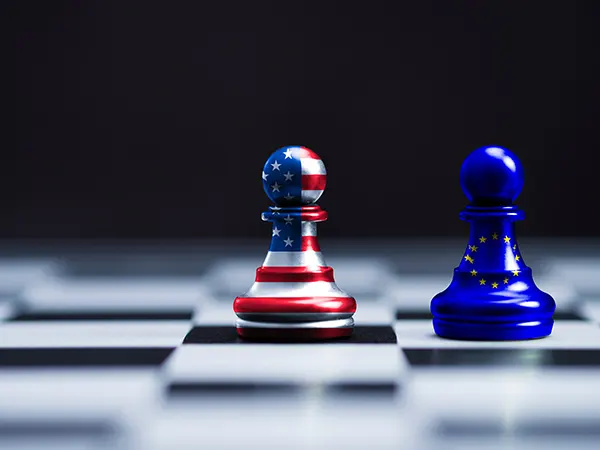
So Long, Western Alliance?
'WorldWatch' by Richard T. RitenbaughU.S. President Donald Trump angered European leaders with the release of his National Security Strategy, a document critical of Europe's recent decline. It questions whether the continent will still be "European" in a few decades, as the massive influx of migrants from the global south, many of them Islamic, changes the nations' principles and cultures. Richard Ritenbaugh urges Christians to watch for signs of fracture in the long-standing Western Alliance.
The Whole World is Writhing
Commentary by John W. Ritenbaugh (1932-2023)Wherever secularism has gained ascendancy, it has attempted to bully and harass the religious elements of society by the tyranny of political correctness.
The Dream of a United States of Europe
'WorldWatch' by David C. GrabbeBirth rates, defense expenditures, welfare spending vs. wealth creation — everything we use to gauge the health of empires suggests that Europe's fire has gone out.
Ukrainian Instability, Russian Initiative
'WorldWatch' by Richard T. RitenbaughRussia's Vladimir Putin is playing a shrewd game with Ukraine to increase his nation's power and geopolitical position.
Cold War Redux?
'WorldWatch' by Richard T. RitenbaughVladimir Putin's leadership has brought Russia back into play as a world power, and nearby nations are once again bracing against its unwelcome aggression.
Globalism (Part Ten): Israel Versus the Beast
'Prophecy Watch' by Charles WhitakerMost people think globalism is the same everywhere, but the European form is quite different from its American cousin.
A Perfect Storm of National Cycles
'WorldWatch' by David C. GrabbeThe societal and generational cycles of America, Europe, and Russia are converging, and the result will prove to be devastating.
WorldWatch March-April 2004
'WorldWatch' by David C. GrabbeNews, events, and trends from the perspective of biblical prophecy for March-April 2004: European Religious Revival?; The Vatican's Islam Dilemma
A Growing Divide
'Prophecy Watch' by Richard T. RitenbaughAmerica and Europe have been moving away from each other politically, economically, and culturally. How does this affect our understanding of prophecy?

Brexit (Part Two): Exposing the Divide
'WorldWatch' by Joseph B. BaityAs reactions to the Brexit vote run the gamut from applause to denunciation, one fact shines through: The vote exposes just how divided this world is.
Europe: Ripe for Change
'WorldWatch' by David C. GrabbeNews, events, and trends according to a prophetic perspective for November 2004: Europe: Ripe for Change, Protestantism's Decline.
His Hand Against Every Man
CGG Weekly by Richard T. RitenbaughThe world has certainly seen a great deal of '[Ishmael's] hand shall be against every man,' which has been institutionalized in his belief system, Islam.
The Rise (Again) of Nations
'WorldWatch' by Richard T. RitenbaughThe last few decades have seen the rise of globalism as a prime factor in international relations. But the pendulum is swinging back toward nationalism.
The Hidden Agenda Behind the ICC (Part One)
CGG Weekly by Charles WhitakerThe International Criminal Court is not a globally-approved institution, with only the 'unilateralist' United States standing outside.
Germany Flexes Its Muscles
'Prophecy Watch' by Earl L. HennGermany, predominantly pacifist since WWII, is beginning to show its strength, not only in economic area but also in political and military ones.
The Culture War and the Cartoon Ruckus
'WorldWatch' by David C. GrabbeThe initial reaction to the cartoons was mild and non-violent. That it took five months for rage and offense within the Muslim world to be stirred.
Ich Bin Heide
'WorldWatch' by Charles WhitakerWorld news, events, and trends from the standpoint of biblical prophecy for November 2004.

Who Is America's Greatest Enemy?
'WorldWatch' by Richard T. RitenbaughThe United States stands weakened by worldwide conditions, but its foreign enemies cannot match its power. Its real foe lies much closer.
Fiddling While Europe Burns
'WorldWatch' by David C. GrabbeThe recent riots in the Paris suburbs draw attention to a Europe-wide problem: Two very different cultures are battling for supremacy.
Will Europe Ever Unite?
'Prophecy Watch' by Richard T. RitenbaughThe church has predicted a united Europe, but it seems just as far off as ever. If Europe is ever to unite, it will take 'a strong hand from someplace.'
Blood and Soil: The Persistence of Anti-Semitism
'Prophecy Watch' by Charles WhitakerWhy has anti-Semitism remained a part of this world's way of thinking? Recent history shows that anti-Semitism has morphed into new expressions of an old evil.

New Fractures in the 'Special Relationship'
'WorldWatch' by Richard T. RitenbaughSparks are flying between President Joseph Biden and Prime Minister Boris Johnson. These cracks in the Special Relationship come at an inopportune time.
Germany's Dilemma
'WorldWatch' by David C. GrabbeGermany is an industrial powerhouse, the richest economy in Europe, but it must prop up several poor-performing economies throughout the rest of the EU.
Immigration and the Kingdom of God
'Prophecy Watch' by David C. GrabbeUnlike Europe and the United States, God ensures that all His potential citizens will conform to His culture.
The Wise Shall Understand
Commentary by Mark SchindlerThe weather miracles at Dunkirk and Normandy hearken back to God's blessing on Ephraim and Manasseh. Spanish armadas were repeatedly thwarted by wind and wave.
The Islamization of Europe
Commentary by John W. Ritenbaugh (1932-2023)Europe is rapidly being taken over by Islam. The term Islam means submission, referring to the absolute subjection to Allah and the Koran.
The Beast and Babylon (Part Two)
'Personal' from John W. RitenbaughCurrently, Europe is not looking very Beastly. Babylon is the world's anti-God system, and Roman institutions inspire Israelite culture even today.
Greece, America—Whatever
CGG Weekly by Richard T. RitenbaughThe bigger they are, the harder they fall. If America wants to avoid following Greece down the economic drain, we must take action now to stop the money leak.
Today's Christianity (Part Three): Southern Christianity's Impact on America
'Prophecy Watch' by Charles WhitakerThough secularists tried to use immigration policy to sideline Christianity, it backfired. God has used their scheme to accomplish His own purposes.
Clash of Cultures
'Prophecy Watch' by Richard T. RitenbaughEurope has seen millions of migrants, mostly Muslims, stream into their nations to the point that it has become a primary topic politically.
Searching for Israel (Part Eleven): Manasseh Found
Article by Charles WhitakerJacob's prophecy in Genesis 48 promises that Manasseh will be a great nation. One nation in today's world is the unmistakable fulfillment of this prophecy.
Nebuchadnezzar's Image (Part Four): Iron and Clay
'Prophecy Watch' by Richard T. RitenbaughThe fourth empire of Daniel 2 is explained further in Daniel 7 as a terrifying beast. This empire and its horns play a role down to the return of Christ!
Globalism (Part Eleven): The International Criminal Court and Bad Law
'Prophecy Watch' by Charles WhitakerThe creation of an International Criminal Court is another push for globalism which modern Israel would be wise to reject.
Knowing Good and Evil
Commentary by Mark SchindlerThe bombing of Hiroshima highlights the sobering consequences of eating from the Tree of the Knowledge of Good and Evil. Human solutions always fall short.
Brexit—An Unlikely Getaway
'WorldWatch' by Joseph B. BaityA sizable slice of the British people, most of them average citizens, have always distrusted the EU's encroachment on British sovereignty.
Revelation 2 and 3: Eras?
Sermonette by John W. Ritenbaugh (1932-2023)The notion of church eras in Revelation 2-3 is based on some fundamental errors. Jesus expects that all of us learn from all seven letters.
No Children, No Hope For the Future
Commentary by Martin G. CollinsMany of the leaders in Europe do not have children; they are emblematic of the curse of barrenness. Western civilization has chosen death rather than life.
The March Toward Globalism (Part One)
Feast of Tabernacles Sermon by John W. Ritenbaugh (1932-2023)The cat has been let out of the bag in terms of plans to establish a New World Order, possibly the precursor or foundation for the Beast of Revelation.
The Beast and Babylon (Part Three): Who Is the Woman?
'Personal' from John W. RitenbaughIs the Woman depicted in Revelation 12 the church, as the church has dogmatically taught? Or is she another prophetic entity that is active today?
The March Toward Globalism (Part Three)
Sermon by John W. Ritenbaugh (1932-2023)Parents have incrementally abandoned the responsibility of disciplining their children. Satan has taken over the responsibility through his matrix.
A Gift Opens Doors
Commentary by John W. Ritenbaugh (1932-2023)The bribe seems to be the magic elixir designed to turn a moral man into a pragmatic amoral man.
Out of Control
Commentary by John W. Ritenbaugh (1932-2023)Diverse cultures separate peoples, causing cantankerousness and hostility, even when these cultures share the same language or share a common language.
The Beast and Babylon (Part Four): Where Is the Woman of Revelation 17?
'Personal' from John W. RitenbaughThe Great Harlot of Revelation 17 has intrigued Bible students for centuries. Is she a church? What does it mean that she is a 'mother of harlots'?