


Filter by Categories

Parable of the Wicked Vinedressers
Bible Study by Martin G. CollinsIn the Parable of the Wicked Vinedressers, Jesus answers the religious leaders who had challenged His authority by exposing them as persecutors and murderers, beyond being spiritually empty impostors. The vineyard is Israel, planted and protected by God, who is the landowner, with the hedge representing the law and the tower His watchful oversight. The vinedressers are the corrupt civil and religious leaders entrusted with its care. The servants who are beaten, killed, and stoned represent the prophets, and the leaders' treatment of them shows their rejection of God Himself. When centuries of warning failed, God sent His only, beloved Son, whom the vinedressers kill, thinking they can seize the inheritance. This foretells Christ's death at the hands of the Jews. Jesus draws the leaders into condemning themselves by having them pronounce the fitting judgment on the vinedressers, though they do not grasp its significance. He then cites Psalm 118:22-23: the rejected stone, which the builders refused because He did not fit their idea of the Messiah, becomes the chief cornerstone of God's Temple, the church, as the resurrection and the church's founding prove. The kingdom is taken from Israel and given to a people, the church, who bear righteous fruit. Those who oppose the Stone through ignorance or weakness will be broken, but those who willfully reject Him will be crushed. The leaders understood the warning, and their enmity only grew, confirming Christ's portrayal of them as the Son, Heir, and Judge.

God's Kingdom in the Parables (Part One): Sower and Seed
'Prophecy Watch' by David C. GrabbeIn the Parable of the Wicked Vinedressers (Matthew 21:33-44), Jesus declares, "The kingdom of God will be taken from you and given to a nation bearing the fruits of it." This refers not to Christ's future Kingdom on earth but to a dominion then in existence. He spoke to the chief priests and elders, who perceived that He aimed the parable at them. The vineyard is the Kingdom of God, and the vinedressers are those tasked with tending it. They had a measure of responsibility over that national Kingdom because of their leadership positions, and they wielded religious power that Jesus acknowledged (Matthew 23:2-3) and that had its source in God (Romans 13:1). Psalm 80 and Isaiah 5 likewise picture Israel as a vineyard, confirming that the Kingdom of Israel was the Kingdom of God at that time, though not in its fullness. Because the original caretakers proved unfaithful, stewardship would be transferred to the spiritual nation, whose members would later receive the keys of the Kingdom (Matthew 16:19) and authority to rule (Matthew 19:28). As Jacob supplanted Esau, Israel's leaders would be supplanted, though not forgotten. The Parable of the Wedding Feast, which follows, carries the same message.

God's Kingdom in the Parables (Part Four): The Pearl, the Dragnet, and the Householder
'Prophecy Watch' by David C. GrabbeJesus prophesied in the Parable of the Wicked Vinedressers that the kingdom of God would be taken from the leaders of Judah and given to a nation bearing the fruits of it. This parable illustrates the failure of those leaders to uphold their responsibility in God's dominion, highlighting a transfer of stewardship to a spiritual nation, the church, which would produce the expected fruits of righteousness. Through this teaching, He emphasized the shift in God's plan from the physical nation to a people defined by faith and obedience.
Dominion and Leaven (Part One)
Sermonette by David C. GrabbeDominion theology holds that the church's responsibility is to spread God's Kingdom around the world, but it misunderstands the Parable of Leaven.
Dominion and Leaven (Part Two)
Sermonette by David C. GrabbeContrary to Dominion Theology, the Parables of the Mustard Seed and Leaven are not about the church but describe the history and condition of Israel.
Matthew (Part Twenty-Eight)
Sermon/Bible Study by John W. RitenbaughWhen God gives a responsibility, He gives all the tools to carry it out and the freedom to decide how to do it. He wants to see how we do with what He gives.
The Garden of God
Article by StaffThe Bible uses agriculture to provide many lessons for us. Are we learning them—or are we repeating history as Israel did?
A House Left Desolate
Sermon by Richard T. RitenbaughGod is a God of mercy, but He has a stiff core of justice which will not be placated unless we repent. To whom much has been given, much will be required.
Four Views of Christ (Part 4)
Sermon by John W. RitenbaughJesus sets a pattern for us by serving without thought of authority, power, position, status, fame, or gain, but as a patient, enduring, faithful servant.
Hebrews (Part Seven): Greater than Angels
Sermon by John W. Ritenbaugh (1932-2023)The book of Hebrews systematically proves Christ's superiority to patriarchs, prophets, the Levitical Priesthood, and angels, establishing His credentials.
Jerusalem's Fall and Christ's Return
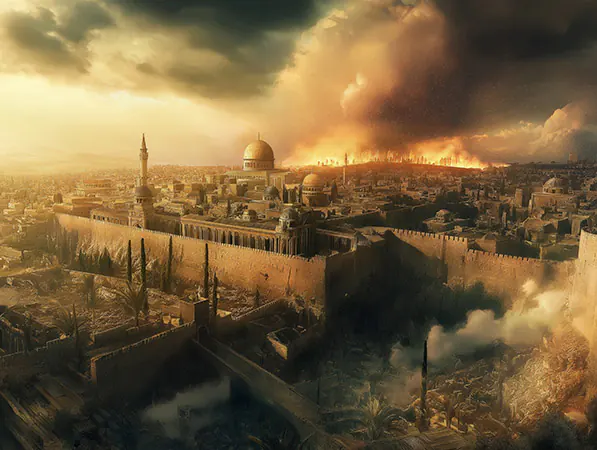
'Prophecy Watch' by Charles WhitakerIn the Parable of the Wicked Vinedressers, Jesus tells the Jews in Matthew 21:43, "the kingdom of God will be taken from you and given to a nation bearing the fruits of it." This took place with the dissolution of the Jewish state in AD 70. The Jews living in Jerusalem at that time were not God's chosen ones, as Paul explains in Romans 11:16-24, for they had been broken off for a while. Jesus alludes to the same change in Matthew 8:10-12, where He marvels at a faith not found even in Israel and says that many will come from east and west to sit down with Abraham, Isaac, and Jacob in the kingdom of heaven, while the sons of the kingdom will be cast out into outer darkness, where there will be weeping and gnashing of teeth.

Why Hebrews Was Written (Part Nine)
'Personal' from John W. RitenbaughGod has communicated tirelessly with humanity through men and angels. The first chapters of Hebrews displays Christ's superiority over even the angels.
The Doctrine of Israel (Part Six): New Testament Teaching
Sermon by Richard T. RitenbaughThose who follow Christ are the true Israel, the Elect, and the Chosen, called by God to precede unfaithful physical Israel in the salvation process.
Esther (Part Five)
Sermon by Richard T. RitenbaughGod allows each of us to experience trials and tests to humble us, leading us to repent, obey and trust, followed by an often-dramatic deliverance and joy.