


Filter by Categories
Influence of Leavening
Sermonette by James BeaubelleBoth the Old and New Testaments illustrate that sin is subtle, persuasive, and deeply rooted, prompting Almighty God to call His saints to come out of Babylon.
Dominion and Leaven (Part Two)
Sermonette byIn the parable of the leaven, as presented in Matthew 13:33, Jesus spoke to the multitudes, declaring that the kingdom of heaven is like leaven which a woman took and hid in three measures of meal until it was all leavened. This imagery of the three measures of meal first appears in Genesis 18:6, symbolizing the fellowship between God and the family of Abraham during a significant moment of divine promise. However, the introduction of leaven represents corruption, particularly of beliefs, as Israel incorporated pagan practices from surrounding nations into her relationship with God. By the time of Christ's ministry, the pure accord between God and Abraham's family had become thoroughly debased, reflecting a Judaism mixed with Babylonian and Greek influences that rendered the word of God ineffective through hardened traditions. Further insight is provided in Luke 13:18-21, where Jesus reiterates the parable of the leaven alongside the parable of the mustard seed, following a confrontation over healing on the Sabbath. The response of the synagogue ruler, filled with indignation rather than awe at divine deliverance, illustrates how corrupted beliefs had warped the understanding of God's law among the people. This leavening of the kingdom signifies a deep spiritual deterioration, highlighting a condition far removed from the original fellowship with God. Leaven, as a symbol, extends beyond the historical context of Israel to carry warnings for personal spiritual vigilance. Jesus identified leaven with hypocrisy, as seen in the Pharisees who prioritized appearance over true godliness, and with the political manipulations of Herod, who used religion for secular power. Additionally, leaven represents false doctrine, where human traditions overshadowed God's word, rendering communities unteachable and corrupt. The pervasive nature of leaven is evident as it spreads, influencing others when deception or falsehood is tolerated, emphasizing the need to actively purge such corruption to maintain spiritual purity.
The Leavening of the Pharisees, Sadducees, and Herod
Sermonette by Ted E. BowlingJesus warned of three varieties of leaven that we must guard against, staying aware of the pitfalls that will pull us down and corrupt us.
Leavening: The Types
Sermon by John W. RitenbaughLeaven symbolizes sin and false doctrine that leads to bondage. Getting rid of leaven represents the responsibility to purge out old teachings, habits, attitudes, and ways in order to remain free. Leaven is something ingested that becomes part of a person and spreads through the whole lump. Leaven puffs up and produces pride that makes one act independent of God. Leaven is pleasurable to eat and appears good though its consequences are bad. Leaven seems necessary for life yet is not required. Leaven is hard to find because it gets into hidden places. A leavened lump cannot be deleavened without a miracle from God. The effect of leaven is immediate and certain though often unseen for a time. These properties of leaven serve as an object lesson to inscribe on the mind the need to purge sin so that liberty is maintained.
How Much Leaven Can God Take?
Sermon by John W. RitenbaughLeaven functions in Scripture as a symbol of sin because any substance added to dough produces fermentation that spreads through the mixture, causing it to puff up and putrefy. This process illustrates how sin expresses pride and promotes further corruption in those who commit it. God therefore forbade leaven and honey in meal offerings made by fire, teaching that hidden sin and its accompanying pride render unacceptable any life offered in supposed service to Him and others. Jesus extended the symbol beyond literal violations of the Ten Commandments when He warned His disciples to beware the leaven of the Pharisees, the Sadducees, and Herod. He identified their traditionalism, skepticism, secularism, false doctrines, and bad examples as influences that persuade people to evil and become the basis for sinful attitudes and conduct. The same symbol appears in the two leavened wave loaves offered at Pentecost, which represent the firstfruits of both covenants and portray God's church as still containing sin. Throughout the material this imagery connects to the question of how much sin God will tolerate before intervening. Persecution does not by itself prove the presence of sin, yet sin remains present in the world and within the church, spread by both external influences and internal examples. God permits wheat and tares to grow together until the harvest so that individual judgment and loyalty may be revealed. The symbol therefore underscores personal responsibility to reject every form of leaven, maintain holiness, and endure faithfully until the end.
The Parable of the Leaven, Expanded
Sermon by Richard T. RitenbaughLeaven functions throughout Scripture as a consistent symbol of sin's corruption, an infectious agent that puffs up and spreads through whatever it contacts. Jesus employs the image to warn of false doctrine, hypocrisy, and malice that infiltrate the church, as seen when He cautions the disciples against the leaven of the Pharisees. Paul reinforces the same meaning by equating leaven with malice and wickedness that must be purged so the body remains unleavened. In the Parable of the Leaven the kingdom of heaven is compared to this corrupting element hidden by a woman within three measures of meal. The woman represents a system of beliefs and practices that seizes and conceals what does not belong to it, thereby mixing destructive teaching into the church's life. The three measures of meal evoke the meal offering, which symbolizes devoted service and love toward fellow man. By introducing leaven into this offering the false system undermines the very harmony and reconciliation the church is commanded to maintain. The parable states that the leaven succeeds until the whole lump is affected, explaining the persistent divisions, unresolved offenses, and failure to love one another that weaken the body of Christ. This internal corruption prevents the church from fulfilling its role as light and salt, since members who do not reconcile cannot offer acceptable service to God or effective witness to the world. The symbol therefore links Satan's strategy of relational sabotage directly to the church's present condition and to the urgent need for believers to purge the old leaven through genuine repentance and restored unity.
Pentecost's Two Leavened Loaves (Part Two)
CGG Weekly by David C. GrabbeThe grain offering is not substitutionary; it does not symbolize an individual but rather the product of his labors toward others from God's bounty.

God's Kingdom in the Parables (Part Two): Tares, Mustard Seed, and Leaven
'Prophecy Watch' by David C. GrabbeIn the Parables of the Wheat and the Tares, the Mustard Seed, and the Leaven, Jesus was speaking to the physical nation, which the parables clearly reflect.
The Leaven of Double-Mindedness
CGG Weekly by Joshua MontgomeryChristians must deal with double-mindedness because the flesh and spirit contend for our hearts. We overcome it by being of one mind with Christ.
Pentecost's Two Leavened Loaves (Part Four)
CGG Weekly by David C. GrabbeThe Pentecost offering of two loaves contains the idea of difference, while the New Testament Pentecost in Acts 2 shows differences being divinely overcome.
Why Do We Observe Unleavened Bread? (Part Two)
CGG Weekly by David C. GrabbeIf we overlook God's deliverance or neglect the eating of unleavened bread, we will be unable to perform the putting away of sin that God requires.
The Five Ws of Deleavening
'Ready Answer' by StaffJust what deleavening does God want His children to do? What has He commanded His people? Here are the Five Ws of Deleavening: why, where, what, who and when.
Truly Unleavened
Sermon by Richard T. RitenbaughGod has imputed righteousness to us as His Children because we are in Christ. Our state before God is unleavened provided we maintain this relationship.
The Unleavened Life Is a Happy Life!
Sermon by John W. RitenbaughThe Days of Unleavened Bread define our responsibility in God's plan to purge out habits, attitudes, and teachings that do not conform to God's way.
Deleavening the Home
Sermon by Richard T. RitenbaughIf each of us individually puts out the leaven of malice and consume the Unleavened Bread of sincerity, we would fulfill our community responsibility.
The Offerings of Leviticus (Part Three): The Meal Offering
'Personal' from John W. RitenbaughThe meal offering represents the fulfillment of the second great commandment, "You shall love your neighbor as yourself." Here is how to understand this offering.
Remaining Free
Sermon by David C. GrabbeLeaven is consistently used to represent corruption of some kind. God is adamant that nothing with leaven is allowed on His altar, symbolizing His table. Paul tells the members at Corinth that they truly are unleavened. Because the church consists of those who are in Christ, and Christ is unleavened, the church can never be all leavened, even though there certainly can be corruption within it because of carnality. Jesus says the kingdom of heaven is like leaven. Leaven is a symbol of corruption, and the church is deemed unleavened because of Christ. When plugged into the parable, the kingdom became all leavened. The covenantal relationship between God and Abraham's family completely degenerated, in large part because Israel took of corrupted belief systems from the nations around her and introduced that leaven into her relationship with God. When the principles are understood, leavening can be seen as a symbol of slavery, just as unleavened bread is a symbol of deliverance from the house of bondage. At the time of Christ, the nation had become all leavened. It was filled with corrupted teachings, traditions, and practices. The result was that when the God of their fathers walked among them, they could not recognize Him. Physically, they were in the Land of Promise, but spiritually, they were in the house of bondage. The spiritual application is far more important than the physical one. The weightier matter is what is fed to the minds, as well as what the minds are protected from, while also not leaving the physical practice undone. Even if unleavened bread is eaten each day as commanded and all leavening is avoided, if there is no dedication to ingesting truth each day but the minds are fed with things that are corrupt, this feast will leave one unchanged. God's solution is to prioritize the unleavened bread of sincerity and truth. When the hearts are filled with that, there is not much room for other things. Where there is leavening, there is bondage in some way. One is not fully free in worship because something is interfering. Truth sets free. Any deviation will enslave in some way.
Prepare to Meet Your God! (Part Five): Religion and Holiness
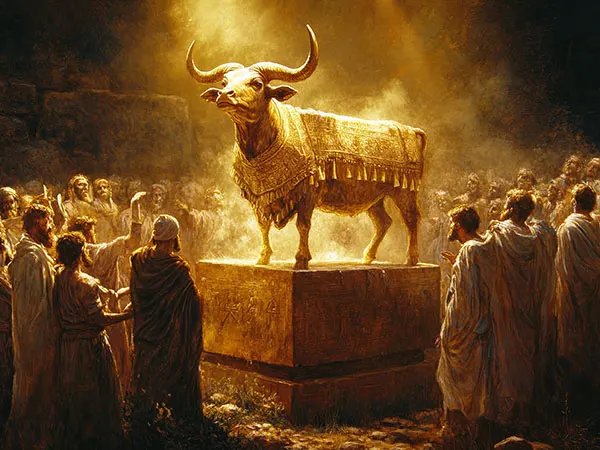
Article by John W. Ritenbaugh and Richard T. RitenbaughThe prophet Amos exposes the ancient Israelites' religion as syncretic, a blend of God's way and paganism, corresponding to this world's Christianity.
Examine and Come Out
Sermon by John W. RitenbaughThe Old Testament examples were given to show us what God had to do to pave the way for our calling, sanctification, and ultimate glorification.