


Filter by Categories
Caught Up in the Rapture
'Prophecy Watch' by Richard T. RitenbaughThe concept of the Rapture, though not a term favored in the church of God due to its evangelical associations, is rooted in biblical teachings. The primary scripture cited for this event is I Thessalonians 4:16-17, which describes believers being caught up to meet the Lord in the air. The timing of this event is crucial; it occurs at the coming of the Lord, as stated in I Thessalonians 4:15-16, when Christ descends from heaven with a shout, the voice of an archangel, and the trumpet of God. This last trumpet, also referenced in I Corinthians 15:50-52, sounds at Christ's return, simultaneously announcing the establishment of God's Kingdom, the judgment of the nations, and the rewarding of the saints. Additional scriptures like Matthew 24:29-31 confirm that this gathering of the elect happens immediately after the tribulation, as the trumpet sounds to send angels to collect them from across the earth to meet Him. Regarding the destination of those who rise to meet Christ, the church teaches that it is not to heaven but back to earth. While some assume that since Christ lives in heaven, the saints will too, based on I Thessalonians 4:17, this is not supported by other scriptures. Zechariah 14:3-5, 9 clearly shows that the saints return with our King to rule over the earth. The reward of the saved is eternal life as kings and priests ruling and teaching here on earth, as affirmed in Revelation 5:10. Thus, those who endure to the end and remain faithful will be among those caught up in the clouds to meet the Lord in the air, returning with Him to establish His Kingdom on earth.

The Rapture and Trumpets
Sermon by Richard T. RitenbaughThe concept of the Rapture, as understood by many evangelical Protestants, emerged as a significant phenomenon over 25 years ago, notably through the "Left Behind" series by Tim LeHaye and Jerry Jenkins, published starting in 1995. This series, concluding in 2007 with 16 books, portrays a world post-Rapture, where believers are suddenly taken to heaven before the Tribulation, a period of great suffering on earth. This belief, rooted in a specific interpretation of I Thessalonians 4:15-18, suggests that the Rapture occurs before the Great Tribulation, marking its beginning, and could be as much as seven years prior to the second coming of Christ. Advocates of this view, often called pre-tribulationists, assert that Christ will return in a near miss, not setting foot on earth but snatching away the saints to heaven for a period of feasting while chaos ensues below during the Tribulation and Day of the Lord. This interpretation posits that God must rapture believers to heaven to spare them from wrath, based on I Thessalonians 5:9, which states that true believers are not appointed to wrath. Consequently, they believe Christ returns twice—first to take the saints away secretly before the Tribulation, and later to return with them to earth, setting foot on the Mount of Olives. During the initial event, they envision sudden disappearances causing mayhem on earth, with unsaved relatives searching frantically for loved ones and media speculating wildly about the mysterious vanishings, setting the stage for the rise of the antiChrist and the horrors of the Tribulation. However, this view of a pre-tribulation Rapture contrasts with a perspective that aligns the event with Christ's singular return, not before but at the end of the Tribulation. This post-tribulation understanding holds that believers are caught up to meet the Lord in the air as He descends, accompanying Him back to earth to establish God's Kingdom, rather than being whisked away to heaven for years. The term "Rapture" itself derives from the Latin "rapere," meaning to be caught up or snatched, as translated from the Greek "harpagesomethe" in I Thessalonians 4:17, though it carries connotations that may confuse the event's true nature. To avoid such confusion, terms like Christ's second coming or glorious appearing are preferred, focusing on His return rather than an escape from wrath. The timing of this event, as understood differently, is critical. Rapture advocates believe in a secret return and trumpet sound before the Tribulation, whereas a contrasting view sees the trumpet of God, paralleled with the last trumpet in I Corinthians 15, announcing Christ's triumphant return and the resurrection of the elect at the same moment, not years apart. This singular event, marked by loud noises, shouts, and trumpet blasts as depicted in various scriptures, signifies the descent of God to earth, aligning with the Feast of Trumpets' themes of shouting and alarm, commemorating His powerful arrival to set up His Kingdom.
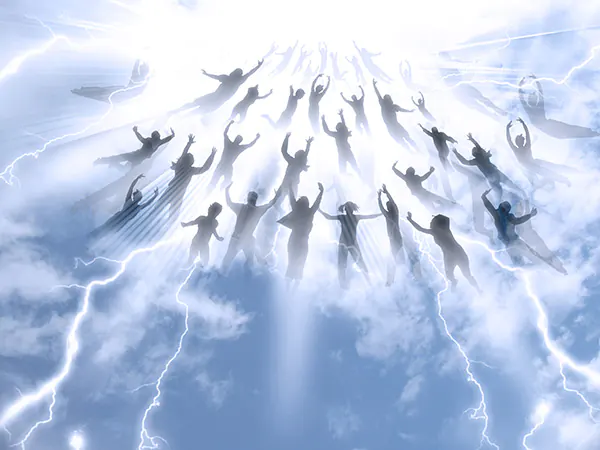
Caught Up in a Lie: The Rapture's Deceitful Origins
'Prophecy Watch' by Charles WhitakerI Thessalonians 4:16-17 stands at the center of this discussion because fundamentalist evangelicals call this passage the Rapture, yet the underlying purpose is not to disprove the Rapture itself but to expose antinomianism, the denial of God's law, as one of its roots. The Greek verb behind "caught up," harpazo, simply means to be snatched or seized, connoting violence or abruptness, as seen in Matthew 11:12 and John 10:24. Historically, before about 1800, virtually all commentators—including Increase and Cotton Mather—used the word "rapture" synonymously with the general resurrection at Christ's second coming, correctly linking it to the passage's obvious context. The distinct evangelical notion of a Rapture as a secret snatching away of believers prior to and separate from the resurrection, often placed before the Great Tribulation, did not originate from Scripture but from a specific historical development beginning around 1825 with Scottish churchman Edward Irving and popularized two years later by John Nelson Darby. A young Scottish woman, Margaret MacDonald, added to the confusion through a 1830 charismatic vision; though Darby dismissed her utterances as demonic, Irving embraced them as genuine, and an 1861 published account of her words conveniently omitted two passages that would have shown she actually understood the rapture as the general resurrection. This selective editing, along with other instances of plagiarism and misquotation documented by writer Dave MacPherson, reveals that the pre-Tribulation Rapture doctrine spread not merely through misunderstanding but through deliberate suppression of truth by dishonest churchmen. The teaching gained its greatest momentum through Cyrus Scofield's Reference Bible, which, despite containing no explicit comment on the Rapture at I Thessalonians 4:17, embedded Darby's dispensationalist framework so thoroughly that the Rapture doctrine advanced on its coattails. Dispensationalism divides history into distinct eras in which God supposedly deals differently with mankind, and Scofield followed Darby in portraying the "Dispensation of Law" as opposed to and superseded by the "Dispensation of Grace," treating law as a curse rather than a blessing. This framework is false because Scripture demonstrates that God's law spans all covenants and history, as shown by Noah's knowledge of clean and unclean animals, Abraham's obedience to God's commandments before Sinai, and the prophecy that law will go forth from Zion in the Millennium. By setting law and grace in false opposition, Darby and Scofield supplied the antinomian thinking that undermined the law-abiding convictions of earlier Puritan Protestantism, and this same dispensational, anti-law foundation is what allowed the Rapture doctrine to take root and spread so widely within evangelical Christianity.
What Does 'One Taken, the Other Left' Mean (Matthew 24:40-41)?
Bible Questions & AnswersChrist describes the Great Tribulation and the end-time events leading up to His return, likening this period to the days of Noah when disaster struck suddenly while people were engaged in their daily lives. Just as in those days, people will be working in the fields or grinding at the mill when end-time events fall upon them unexpectedly. At His return, a separation will occur between those who attain to the first resurrection and those who do not.
Are You Ready for the Rapture?
Sermonette by Richard T. RitenbaughThe rapture is a biblical teaching found in I Thessalonians 4 verses 16 and 17. It is called the first resurrection. The phrase shall be caught up in verse 17 comes from the Greek word harpaggisomitha which the Latin translates as rapio meaning to be caught up. It means to be caught up literally to meet Christ in the air. The churches of God avoid the term rapture because of its Protestant connotations and refer instead to the first resurrection or the change at Christ's second coming. On the day that Christ returns to earth to fight His enemies and establish His throne on the earth the dead in Christ will rise first. Those who are alive and converted will be caught up to meet Him in the air. The trumpets will sound. Christ will return. The dead rise first. The converted people whom God allows to be there in the first resurrection will be caught up and changed without having to go through the physical death process. They will suddenly be spirit and caught up together with Him. Theologians have made strange assumptions about the timing of this event and hold three views. Pre-tribulationists put the rapture at the beginning of a seven-year period when the beast signs a treaty with Israel. This view splits Christ's return into two parts so that He comes back at the beginning of the seven years and takes believers back to heaven then returns seven years later. It is invalid because it requires two returns and leaves no saints for satan to persecute during the Tribulation. Mid-tribulationists place the rapture at the midpoint of the seven-year period when the beast proclaims himself to be God. This view has the same problems of requiring two returns and leaving no Christians to persecute. The churches of God hold the post-tribulational view that the church will remain on the earth during the entire Tribulation. Some will be protected in a place of safety. Others will go through the Tribulation and possibly suffer martyrdom. Christ will return once gathering His elect and fighting the beast all in one event. I Corinthians 15 shows the same sequence. At the last trumpet the dead will be raised incorruptible and changed. The last trumpet is the seventh of the last-trumpet plagues in Revelation 11 verse 15 when Christ returns to set up His Kingdom. Revelation 11 verses 11 through 13 also describe the first resurrection when the saints meet Him in the air. Matthew 24 shows the sequence of the sign of Christ coming the trumpet sounding the angels being sent out and the elect being gathered. Joel 2 verses 1 through 11 describes the trumpet sounding an earthquake and heavenly signs followed by the Lord's army. Isaiah 27 verse 13 shows the trumpet sounding and the captives from Israel and the worshippers of God being gathered. At the last trump Christ returns the dead in Christ are raised and the converted people on earth are caught up together with Him in the air.
The Appointed Time of the Resurrection
Sermonette by Clyde FinkleaThe time of Christ's return appears to be soon in the light of recent events. Watch for the gathering of armies around the future capital of the world.
Do You Recognize This Man? (Part Five)
Sermon by Richard T. RitenbaughIn Exodus 19, there are 12 parallels with Christ's dramatic return illustrated in Matthew 24. All of these events will culminate in a blast of a trumpet.
Christ's Second Coming
Sermon by Richard T. RitenbaughThe Feast of Trumpets memorializes God's deliverance of Israel beginning with Joseph, and looks forward to Christ's return when God will deliver His people.
Matthew (Part Thirty)
Sermon/Bible Study by John W. RitenbaughThe events in Matthew 24 parallel the six seals of Revelation 6 and the seventh seal of Revelation 7, showing a definite chronological progression.

Where the Eagles Are Gathered
'Prophecy Watch' by David C. GrabbeJesus' statement that 'Wherever the carcass is, there the eagles will be gathered together' is a warning that He will judge those who resist Him.
Matthew (Part Twenty-Two)
Sermon/Bible Study by John W. RitenbaughThe transfiguration prefigured the Kingdom of God, with the disciples only seeing Jesus in the end, showing salvation is through Him alone.
Is Heaven the Reward of the Saved?
'Ready Answer' by StaffMost of Christianity believes humans go to heaven or hell after death. This belief does not originate in the Bible, which reveals a very different destiny.
Anarchy in God's Church? (Part Two)
CGG Weekly by David C. GrabbeNumerous biblical examples show the authority and structure of the church. However, they will hold little weight if we feel our experience invalidates them.
Lamentations (Part Seven; 1989)
Sermon/Bible Study by John W. RitenbaughLamentations 3 and 4 show the stark contrast of a once proud people (secure in their wealth, technology, and cleverness) suffering bitter humiliation.
Mr. Darby, Mr. Scofield, and God's Law
Sermonette by Charles Whitaker (1944-2021)Several destructive heresies have crept into Western religious culture, including the rapture lie, the dispensationalist theory, and the immortality of the soul.
The Handwriting Is on the Wall (2004)
Feast of Tabernacles Sermon by John W. RitenbaughWe cannot assume that we are going to be immune from tough times and persecution, but we need to ask God for the strength to endure what He gives us to endure.
Pitfalls of Scholarship
Sermon by Richard T. RitenbaughWhile we find much biblical scholarship useful and productive, without God's Spirit, most biblical scholarship is at best a mixture of good and evil.